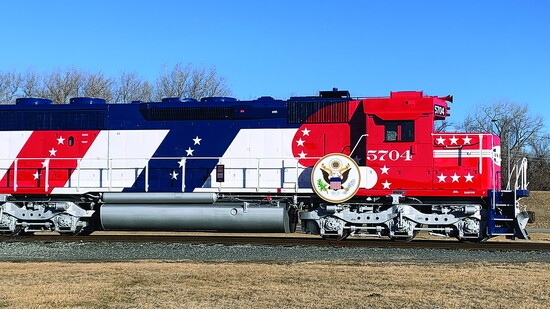
In the early 1970s, bicentennial fever descended on our country. American flags and patriotic red, white, and blue colors adorned all sorts of industrial machinery, from semi-trailers to locomotives to heavy earth-moving equipment. I clearly remember the 1976 bicentennial logo: a star with rounded points and the call-out 1776–1976. The U.S. Mint even made bicentennial quarters, and I have a few tucked away for posterity. Now, 50 years later, America celebrates its semi-quincentennial, or simply the 250th anniversary of the United States.
Back then, dozens of railroads painted new or freshly rebuilt locomotives in classy, colorful bicentennial paint schemes. The Atchison, Topeka & Santa Fe Railway was no exception. They chose to paint five newly-delivered locomotives in a stunning honorary paint scheme, complete with two 59-inch metal signboards bearing the Seal of the United States. These units (a generic term for locomotive) operated throughout the ATSF rail network, running through towns large and small served by the railroad. Municipalities could request these specially painted locomotives at local bicentennial events and celebrations. The railroad spotted the locomotives (a railroad term similar to parking) and opened them up for tours and photographs. The five bicentennial units roamed the Santa Fe rail network from Chicago to Dallas, from Denver to Los Angeles, from Phoenix to Kansas City, and hundreds of cities in between. The ATSF made every attempt to keep them clean and on the point (in the lead) when used with other locomotives to pull a train. The railroad also worked diligently to keep these units on point of “hot” (priority) mail trains that quickly traveled between Chicago and Los Angeles or San Francisco.
As a child growing up in the Kansas heartland, I only saw one of the bicentennials one time, or at least I only remember the chance meeting. Many of my friends who grew up trackside in the early 1970s remember seeing at least one of them almost every day. I am jealous!
After the bicentennial year passed and operations returned to normal, the ATSF slowly repainted the units back into its standard blue-and-yellow corporate colors, with the last of the bicentennials repainted by 1978. Their freight-hauling lives then settled down to the daily shuffling of traffic across the ATSF system.
In 2021, the ATSF began retiring this class of locomotive, and an opportunity arose that I just could not ignore. I have always been interested in railroads and railroading; in fact, I spent a good deal of my career working for the ATSF (later BNSF railroad). A friend of mine who keeps track of equipment “retirements” (when a railroad relinquishes ownership through various methods) called me to discuss the latest round of locomotives being sold off or scrapped. At the time, I did not realize the impact of that phone call. It was April 26, 2021. He mentioned that a former bicentennial was slated to be scrapped in Memphis, Tennessee. His words immediately made me wonder if anything could be done to save her. In fact, I clearly remember thinking, “This is terrible news! What a great piece of railroad and American history.” However, I also realized that there are many people whom I could at least talk with to see what could be done. I have heard it stated that one day you realize that it is your generation in charge of the world. You can make a difference with some consistent action and a focused approach.
I immediately called Eric Goodman, a close friend, model railroader, and, at that time, a member of the BNSF management team. I also approached Paul Duncan, who, at the time, was the Vice President of Service Design and Performance at BNSF. Eric and Paul became crucial to this project. Eric began working with BNSF Public Relations and Rich Wessler (who, at the time, managed passenger trains and special movements) to determine what needed to be done, if anything could be done, to pull the unit and set it aside for a period of time, thus preventing its scrapping. I set about putting together a proposal explaining why the locomotive was a historical artifact and why it was worthy of preservation. That document included a detailed history and many stunning color photographs and images of the locomotive in service.
While Eric was working his magic inside the BNSF, I set about contacting museums that might be interested in adding the 5704 to their collection. I specifically targeted operating museums that can rebuild and maintain operating locomotives and subsequently have trackage to operate large motive power. Eventually, the list was narrowed, and after some careful culling, the Southern California Railway Museum was chosen. They have a good history of rebuilding and maintaining older historic pieces of railroad lore.
While I awaited the signing of contracts and donation paperwork, I again set my sights on the restoration of the 5704 and began contacting vendors to see what I could procure in donations. Mid-America Car (a local freight car and locomotive rebuild business) was the first to step on board and volunteered to strip, rework, and paint the unit for free. I had completed several “for pay” projects with Mid-America, doing contract work for several railroads, and they are wonderful to work with and do excellent repair and paintwork. Sherwin-Williams volunteered the paint and paint shop managers to ensure the paint was applied correctly. They also worked hand in hand with me to ensure we landed on a spot-on match for the red, white, and blue paint. There was always a Sherwin-Williams representative on site while the unit was being painted. They were wonderful people to work with!
I had recently completed the design work for BNSF's 25th Anniversary fleet of locomotives, and the graphics were printed at Eagle Graphics in Wichita, Kansas, for that project. As luck would have it, one of the owners of Eagle Graphics is a railfan, and they kindly and enthusiastically donated all the graphics and printing for this project. Masking was donated and produced by InSight Print and Display in Kansas City. It is truly amazing how large real railroad graphics are — one set of painting masks filled the back seat of my SUV. At this point, we were set to cosmetically restore the locomotive to its early 1970s appearance.
Shipping
After BNSF agreed to donate the locomotive, we set about arranging for the unit to be routed to Kansas City. Eric worked with the BNSF Mechanical Department and the Operations Department to deliver the unit to Kansas City. Once in Kansas City, the locomotive was stored awaiting a shop opening and scheduled rebuild time at Mid-America Car. Once all the official donation paperwork was signed, the BNSF delivered former bicentennial 5704 to Mid-America Car on August 23, 2021.
Evaluation
A pre-grit blast inspection of the carbody was performed by Mid-America Car, and many items were added to the list of work needed to restore the unit. An initial list of parts that needed to be fabricated was created, including a new antenna ground plane, twin roof-mounted strobe bases, and an airhorn. Many items were also slated for removal from the unit, since they were not present in the 1976 rendition of the 5704. The goal was to restore all the machinery and items removed over the years as technology improved, and to remove all items added to the 5704 as part of improvements. We wanted the unit to appear as she did in the early 1970s. Parts-on and parts-off was the first study and report completed and delivered to Mid-America Car.
Grit Blast Masking
The locomotive could not simply be moved into the blast booth and be grit-blasted. Many items that could potentially be damaged by the very abrasive high-pressure blasting particulates needed to be removed from the locomotive or at least covered for protection prior to the blasting. Headlights, rear view mirrors, and other items were removed from the carbody and stored in a large bin marked “5704.” All the window glass was carefully masked as well. Air intakes, traction motors, dynamic brake grids, radiator intakes, and all other openings to the unit had to be covered with fabric to prevent incursion by the blasting media. Once all the openings were covered, the unit was rolled into the blast booth to begin the transformation.
Grit Blasting
The blast booth at Mid-America Car is modern and very efficient. The booth is enormous and designed with two levels, both open grid, to allow the blast media to fall to the ground and then pass through grids in the floor for separation and recycling. Its media recycling system does a remarkable job of removing and separating the blast media from the blasted paint and years of accumulated dirt. The employee who is blasting wears a protective suit and is supplied with clean air via a circulation hose. It all has a very NASA feeling. Blasting is basically the process of “un-painting” using high-pressure air and gritty media to physically scour the paint from the locomotive’s steel carbody. The worker simply guides the blast media across the locomotive’s surfaces in a loud, dusty process that rips paint from the locomotive. This process can take up to a day. The 5704 and most other Santa Fe locomotives originally had their paint applied over a reddish zinc-chromate primer that resists removal, making the task all the more difficult and lengthier. Once the locomotive was blasted and inspected, residual blasting media was swept and blown off the unit, and the masking and protective coverings were removed. It was thrilling to see a completely bare locomotive stripped down to raw, shiny metal. She looked brand new — from a distance.
Body Work and Restoration
The 5704 was pulled from the blast booth by the Mid-America Car shop switcher (a smaller locomotive) and placed in a well-lit area so that carbody inspections could begin. Almost immediately, we notice salt pitting all along the walkways. Some lower carbody areas also had severe corrosion. Some areas had holes completely through the 1/8-inch steel carbody. Other areas were just decayed, including a spot fore of the engineer’s side dynamic brake blister. This particular decayed area was huge, measuring almost eight inches across. The crews at Mid-America Car made a thorough assessment of the body condition and presented me with the list. It was my job to decide what needed to be done, and I spent a fair amount of time talking with Hank Winn, Vice President and Chief Operations Officer at the Southern California Railway Museum. I made a list of the appliances that had been removed or needed to be altered, including: creating the original radio ground plane and can antenna, reinstalling class lights, reworking the cab-top plumbing and conduit layout, adding large 60-inch herald plates, making the ACI label plates, relocating the headlight to its upper position and blanking the low nose hole, cutting in the oval sight glass window, designing and installing the twin-strobe mounting points, and many more items. Just as many things needed to come off the unit (dummy MU receptacles, ETD antenna, modernized ground plane, knuckle holders, AEI tags, and ditch lights). Removing the items was straightforward. Adding them required creating dimensioned engineering drawings. I worked with original plans for the Santa Fe SD45–2s, as they provided most of the information needed. A mounting system for the large shields was fabricated to prevent them from oscillating due to the moving air at track speed, up to 70 mph. Bolting them on and adding lift rings allows the shop to perform necessary maintenance. These were very heavy!
Graphic Art and Lettering
Dimensionally accurate scale drawings of the unit were made to reproduce the complex paint scheme. The body paint and lettering design were then added to that base drawing, followed by detail drawings of each piece of lettering. We were fortunate to have very good images of these units while they were in service. Even the serial number on the builder’s plates was accurately reproduced. The ACI labels (original bar codes) were printed on Scotchlite reflecting material and were faithfully reproduced so it could be scanned by the Car-Trak system (if it were not extinct). The Shields of the United States of America were hand-drawn and just fit the Eagle Graphics printer at 59 inches across. Small clusters of letters, like the trust information and gear ratios, had thin transparent paper added to the outer surface so the tacky back surface would be applied to the locomotive and burnished prior to the front material being removed. This allowed all lettering, spacing, etc., to remain in their designed locations. The actual release date was Tuesday, March 1, 2022.
Painting
Matching the colors turned out to be a challenge and a mystery. What colors were used for the units and why? Fortunately, we found original documentation and notes from a former ATSF employee who had preserved them and graciously provided them to us for this project. It turns out that the original paint colors and formulas were sourced by the Sterling Laquer Company in St. Louis, Missouri. Sterling Laquer was also providing paint for McDonald Douglas and happened to be painting American Airlines aircraft at the time. The ATSF units used AA colors — mystery solved.
Sherwin-Williams used a computerized color-matching system to recreate the original paint codes, and we ordered the paint needed to refinish the unit. The unit was primed and allowed to sit for a day before the white paint was applied. The 5704 had to be masked four times, once to cover the window glass and once for each color. The subsequent layers of masking were built up over the earlier layers as the different colors were added and more areas needed to be covered. The unit was primed, then the white, blue, and red were added — in that order — followed by the silver on the trucks, fuel tanks, underframe, and pilots. By the time the painting was completed, the unit was cocooned in masking. Removing the masking was the most enjoyable part of the project. Thrilling would be an understatement.
Stenciling
All the small lettering and warning labels were made from vinyl and applied in their appropriate locations on the unit. Photographs were used to accurately place the lettering. After all the masking was removed and the stencils were peeled off the unit, a high-gloss clear coat was applied. She was rolled out of the Mid-America Car shop and delivered to the BNSF at Argentine on March 10, 2022. She was on display at Union Station for a few days so that all who had lent a hand and volunteered could visit the locomotive in her completed form.
Mechanical Restoration
As of January 2026, the 5704 is at the Southern California Railway Museum in Perris, California. The skilled staff there is restoring the unit to operating condition. I have visited her several times, and she looks great. It will be a pleasure to go out and see her operate someday once her mechanical restoration is complete. The 5704 is now safe from scrapping and has a wonderful, preserved future where she receives the attention worthy of her bicentennial paint and heritage.