Along the Central Coast, where rocket launches from Vandenberg regularly streak across the night sky, exploration often feels pointed upward. But some of the region’s most important breakthroughs happened in the cold, dark waters just offshore.
Long before modern commercial diving became possible, the Santa Barbara Channel posed a nearly impossible challenge for divers: extreme depth, crushing pressure, limited visibility, and equipment not built for the conditions. Yet during the 1960s, local divers began pushing deeper than almost anyone in the world, transforming Santa Barbara into one of the birthplaces of modern deepwater diving.
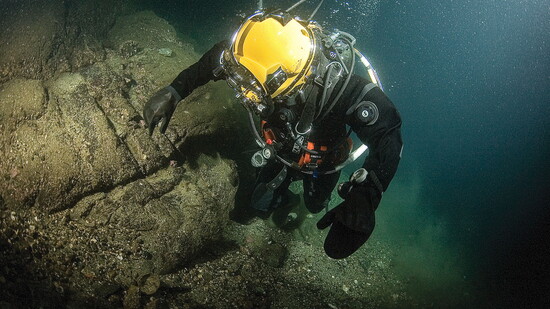
Inside Kirby Morgan Dive Systems, commercial diving helmets sit beneath fluorescent shop lights like artifacts from another world. Thick faceplates seal against crushing pressure. Stainless steel fittings gleam beneath valves and communication systems engineered for one purpose: keeping divers alive hundreds of feet underwater.
For decades, this Santa Barbara-born company has played a quiet role in the evolution of deepwater diving. While many consumers may not recognize the name Kirby Morgan, professional divers do. The company’s helmets are used in offshore energy, underwater construction, military, salvage, and subsea infrastructure operations worldwide.
That legacy now stands near the harbor, where Santa Barbara’s Deepwater Diving Monument depicts a diver wearing a Kirby Morgan helmet.
“When people think about exploration, they usually go straight to space,” says Mike Morgan, vice president of Kirby Morgan and son of co-founder Beverly “Bev” Morgan. “But you don’t have to go that far. Here on Earth, the ocean is still only about 20 percent explored. Kirby Morgan may not always be seen as the face of exploration, but as the leading manufacturer of commercial diving helmets, our equipment is what makes much of that exploration possible.”
Founded in the 1960s by Bev Morgan and commercial diver and metalsmith Bob Kirby, Kirby Morgan emerged during a pivotal era in underwater work. Before co-founding the company, Kirby had built masks for California abalone divers, part of a working coastal culture that understood the Pacific underwater environment firsthand. Alongside divers, engineers, and offshore innovators working along the Santa Barbara coast, the company helped develop lighter, more functional helmet systems that improved mobility, communication, visibility, and safety underwater.
And while Santa Barbara’s coastal identity is often associated with surfing, sailing, and beach culture, another ocean industry was quietly developing beneath the surface.
Long before the region became known for wine-country tourism and coastal escapes, Santa Barbara was becoming one of the world’s most important centers of deep-water diving. Many early innovators were abalone divers, oilfield divers, and working watermen who understood the Channel’s harsh conditions firsthand. Its dramatic underwater geography allowed divers to test limits few had attempted before, while offshore oil development pushed underwater work into increasingly demanding conditions.
“Santa Barbara was incredibly important in the early days,” Mike explains. “A lot of people don’t realize this, but it’s considered the birthplace of deepwater diving—typically defined as dives deeper than 100 meters. In the 1960s, divers here were already pushing past 400 feet in the SB Channel.”
Early deepwater diving in the Channel was physically punishing and inherently dangerous work. Communication systems were limited, equipment was cumbersome, and divers pushed beyond previously tested limits in an environment with almost no room for error. The demand for safer, more reliable systems wasn’t theoretical—it was essential.
Many of the technologies, procedures, and support systems pioneered along the coastline eventually spread throughout the commercial diving industry, helping establish new standards for deepwater operations.
Today, divers wearing Kirby Morgan helmets repair underwater pipelines, maintain offshore platforms, conduct salvage operations, and support military and industrial projects across the globe. It’s work performed in darkness and immense pressure, with the constant reality that human beings were never designed to survive underwater.
“At depths beyond about 166 feet, the human body can’t breathe normal oxygen,” Mike explains. “Divers have to use specialized gas mixtures—typically oxygen, nitrogen, and helium. But what’s interesting is that the equipment itself can go far beyond where the human body can. The helmet isn’t the limiting factor.”
Modern saturation divers can now work at depths approaching 1,000 feet for extended periods, an astonishing evolution from the pioneering Channel dives of the 1960s.
Despite the industry’s highly technical nature, Kirby Morgan remains deeply personal to the Morgan family. Today, the company remains family-led, with Mike Morgan serving as vice president, Connie Morgan as president, and John Morgan working in engineering.
“I think about that responsibility a lot,” Mike says. “My dad and Bob Kirby started this company from the ground up, and the idea of letting them down is something I take seriously.”
Beneath the surface of the Santa Barbara Channel, the conditions that once challenged a small group of local divers remain largely unchanged: dark water, immense depth, crushing pressure, and an environment humans were never designed to survive.
The equipment, however, changed everything.
"The ocean is still only about 20 percent explored. Kirby Morgan may not always be seen as the face of exploration, but as the leading manufacturer of commercial diving helmets, our equipment is what makes much of that exploration possible.”