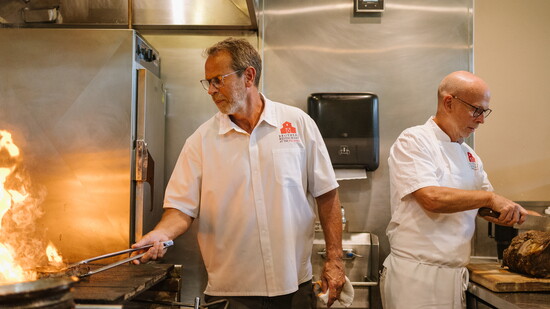
Steak makes sense in the Santa Ynez Valley. Ranching is in our history, winegrowing is all around us, and plenty of restaurants know their way around the grill. This fall, the SYVCL team set out to find the top steaks in the Valley. We didn't get far before the question changed, from which steak is best to why each chef swears by the one they serve.
We were not looking for a winner or trying to settle the ribeye-versus-filet argument. We wanted to see what each restaurant does well, what each chef cares about, and why these steaks have a place on Valley tables. The answers turned out to be very different in practice.
When most people think of steak in the Santa Ynez Valley, three names come up: Brothers Restaurant at the Red Barn, Hitching Post, and Coast Range. So we went to those three. Brothers put forward the ribeye. Hitching Post picked the filet mignon. At Coast Range, we asked chef Ryan Foley to cook us the tomahawk.
For Matt Nichols, the reasoning is simple.
"There are two trains of thought with steak," he says. "Some people love the lean, tender filet. For me, fat is flavor." That is the whole idea behind the prime ribeye at Brothers: the marbling, and what happens to it over mesquite.
Their charcoal burns hot, and that is intentional. The heat gives the outside of the steak the crust Nichols wants while the fat inside keeps it rich. "The combination of the marbling and the high temperature of our mesquite grill creates this perfect crust," he says. "It's just the way that steak cooks on our grill."
The martini is the most popular drink on the menu, so we asked a simpler question: if you're coming into Brothers, what should you order? A ribeye, and a martini or two. Brothers uses Prime, the highest quality grade of beef available. The ribeye is hot, rich, and heavily marbled. The martini is cold and clean. Neither needs explanation, but both are delicious.
Wine is still a big part of the restaurant. Nichols says about 95 percent of the list is local, something he and his brother, chef Jeff Nichols, care about. A Prime ribeye and a glass poured from a few miles down the road is about as close to a Valley signature as steak night gets.
On the other side of the Valley, Hitching Post II tells a different story.
There, the filet mignon starts as a whole tenderloin, trimmed and cut by hand in-house every day. It's a different philosophy than Brothers' Prime ribeye. Hitching Post II builds its filet on Choice grade beef and more than 30 years with the same meat supplier, a relationship as much a part of the dish as the cut itself.
The fire gets the same treatment. At night, the crew banks the coals under ash rather than letting the fire go out, then rebuilds it fresh the next morning. It's a small ritual, repeated every day, and Ostini treats it like part of the job.
Spend time with Frank Ostini and those long relationships come up again and again. Hitching Post II has been in Buellton for 40 years, and some of the people there have almost matched it.
Ostini says six employees have worked there more than 30 years. It's the kind of thing Ostini says he still hears from longtime staff: "I want to work. I don't want this place to go away. I want to be here." That kind of loyalty means something in this Valley.
Forty years in, Ostini has started letting go of the day-to-day, calling himself more advisor than boss, giving longtime employees room to decide things themselves. Some things don't need reinventing.
The youngest restaurant in this roundup, Coast Range opened in Solvang in 2021 and has evolved since. The focus these days is on serving the Valley, not just visitors passing through. Chef Ryan Foley and the team lean into that. No need for a production. The goal is simpler: cook well, take care of the details, give people a reason to come back. With community front and center, the tomahawk makes a good showstopper.
Coast Range also cooks with Prime, same as Brothers, which makes the ribeye and the tomahawk a study in two kitchens doing different things with the same grade of beef.
It's a big steak and looks like one. But after that, it comes down to the same things any steak does: the quality of the beef, the sear, the temperature, and whether the cook knows when to leave it alone.
Foley's approach is straightforward. Start with good ingredients and do not cover them up. Seasoning, heat, timing, and rest all matter, but none should become the point. The steak should still taste like beef. The tomahawk also works because it's naturally meant to be shared. Put it in the middle of the table, pour some wine, and let everyone dig in.
That part feels right for Coast Range and right for the Valley.
The steak doesn't need to make a grand statement. It just needs to be well seared, properly cooked, and worth ordering again.
For a restaurant in its next chapter, that's a solid place to start.
Three restaurants. Three cuts. Three very different reasons to order them.
Maybe you like the marbling and hard sear of the ribeye. Maybe you are a filet person. Maybe the tomahawk in the center of the table is more your speed.
Go find out.
Order the steak. Get the martini. Open a bottle or three of local wine. Bring someone you want to share a meal with.
We have a lot of good food in this Valley. The best way to appreciate it is the simplest: just show up hungry. When it comes to the steak scene of the SYV, we feel bad for the vegans of the Valley.
"There are two trains of thought with steak. Some people love the lean, tender filet. For me, fat is flavor."
"The fire gets the same treatment. At night, the crew banks the coals under ash rather than letting the fire go out, then rebuilds it fresh the next morning."
The steak doesn't need to make a grand statement. It just needs to be well seared, properly cooked, and worth ordering again.