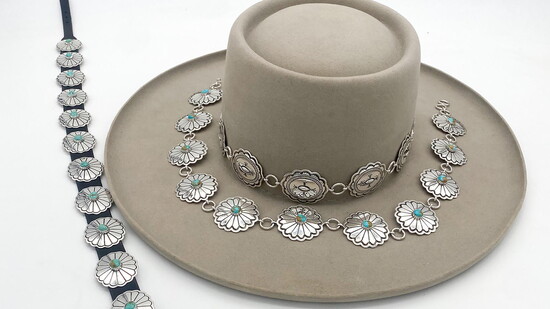
If you’re looking for a uniquely Western gift for men or women this holiday season, consider a Native-made Ranger belt. This is a style that became popularized through TV and Western films. Originally, the belt was adopted by lawmen and pistoleros in the 1840’s as a practical belt to carry heavy sidearms, so it’s a gift with a lot of Old West culture and history. It is famously associated with the Texas Rangers because it could carry one or two holsters for the Colt Walker revolvers that many of them used.
A Ranger “set” consists of three (sometimes four) pieces: an ornamental buckle, side loops or “keepers”, and a matching tip for the belt end. The leather belt is similar to the double cinching of Western horse saddles. The main part of the belt is wide and stiff to accommodate a heavy firearm, and in the front, it has a narrow billet to make it more comfortable when riding. Back in the day, some of them had cartridge loops as well.
Today’s Ranger belts are a fashionable throwback to the Old West. Native-made belts can be quite ornate and very expensive. They are works of art, many with turquoise or lapis stones on 92.5 sterling silver, or some with an inlay. We found that at the Santa Fe Indian Market, many of them were in the four-figure price range. Typically, the Ranger set is mounted on a short piece of belt for display, and the customer then needs to go to a leather worker to make a belt to their size.
We talked to Albuquerque leathersmith Dwight Lamberson at DL LeatherWorks about Ranger belts. He told us, “A Ranger belt is different than a regular belt in that it has to be custom made because of the shape of the tip and the tail. Those have to be fitted to the size of the Ranger set, and because most of them are handmade, there is a whole range of different sizes. Essentially, they have to be specific to the customer and the particular Ranger set for everything to line up correctly.” Dwight also makes purses, briefcases, and a variety of handmade leather products.
Lee Charley is an accomplished Navajo silversmith who lives in Thoreau, NM. He has been described as "The Picasso of silverwork." He learned jewelry making from his mother. His son, Mathew, is also a jewelry artist. He tells us, “When I started my silver business, what I started with was Ranger buckles. I started off making them simple...a quality piece that people could wear every day. I just wanted to let people wear my work because there were some Ranger buckles out there that were very expensive, and I wanted people to wear quality stuff, and at the same time wear something traditional and unique that is Navajo-made. After a while I had almost 700 designs.”
Lee likes to incorporate animals in his designs. He makes a butterfly motif that is particularly popular. He says, “I use stamps that were passed on from my grandma to my mom and then to me, and my son Matthew has a few of those stamps too.” Metal stamps (punches) are used by silversmiths and jewelers to imprint designs or purity marks on silver objects to verify purity and origin.
One issue that Lee encounters is counterfeit copies of his work. Leather craftsman Dwight Lamberson also told us that this is a problem. Lee says, “What I use is my stamp, but all these other stamps are bought from a store. Everybody has them now because they're manufactured and everybody has the same stamps. Since we're on the Internet, they contact me and say, ‘Is this your work?’ and some of them are fakes. My initials are LC, and that's easy for somebody to get the letter stamps and put it on their work and say it's mine. Now people are coming up to me or sending me photos saying it's your work, and sometimes I have to give them the bad news and say that's not my work, and they get disappointed. They want to buy my work, but they end up getting a fake one from somebody else.”
High-end Navajo jewelry can be a significant investment, so it’s important to buy from a reputable dealer or directly from the artist. People are selling fake Native arts in the Southwest that are made overseas. One way to ensure authenticity is to buy Native arts and crafts at events organized by the Southwestern Association for Indian Arts (SWAIA). Lee and his son Matthew are both SWAIA-juried artists. The Association’s aim is “Under the organization’s stewardship, an unsurpassed record of Native artists and their work was developed that documented hundreds of tribal styles and art forms. These records also documented the historic and ongoing participation of generations of individual artists, and their communities, in the Indian Market. The records contain photographic prints, slides, and digital images, as well as paper records of Indian Market participation, awards lists, and correspondence of historical significance. The resources SWAIA holds are irreplaceable and not duplicated elsewhere.”
A good Ranger belt will last a lifetime and can even be passed down as an heirloom piece. It’s a gift that will be appreciated every time that it’s worn.
Lee and Matthew Charley’s work can easily be found on multiple social media platforms, including several jewelry shop websites.
Dwight Lamberson’s website is: https://dlleatherworks.com/
Thanks to the Southwestern Association for Indian Arts for their assistance in researching this article.
This is a style that became popularized through TV and Western films.
When I started my silver business, what I started with was Ranger buckles.
Originally, the belt was adopted by lawmen and pistoleros in the 1840’s as a practical belt to carry heavy sidearms, so it’s a gift with a lot of Old West culture and history.