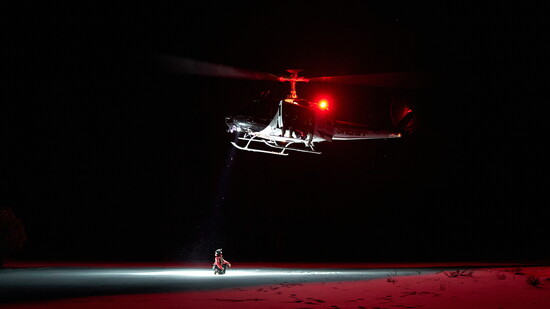
Imagine for a moment cross-country skiing in mountainous back country is new to you. Maybe you miss a marker and wander off your planned course. It’s late in the day and you’re out of water and have already finished the limited food in your pack. As the sun goes down and night sets in, you realize you’re lost and temperatures are dropping quickly.
It might not take long for some fear to start creeping in, especially if you were injured or your equipment had failed. As hours pass, you’d likely begin to pray for help. Over the years, similar scenarios have certainly played out in the Sierra Nevada wilderness.
And in more than a few of those, the Washoe County Sheriff’s Office has deployed its Regional Aviation Enforcement Unit (RAVEN) to help individuals lost or injured in hard-to-reach rural terrain. The unit features three helicopters – two OH-58 Kiowas and an HH-1H Huey – as well as highly trained WCSO personnel.
For every one of those victims saved—some even from death—you can bet that when they heard the whirling sound of a helicopter approaching and saw RAVEN unit officers coming to help, they felt a sense of relief likely unmatched.
“Without question, the capabilities provided by RAVEN have proven their value time and time again over the last three decades,” Washoe County Sheriff Darin Balaam says. “The unit has been involved in countless missions where lives were saved because help arrived faster and with a level of situational awareness that would not have been possible otherwise.”
While Search and Rescue (SAR) operations are a key piece of the RAVEN’s operations, the unit is far from a one-trick pony. Other primary RAVEN missions include responding to calls of crimes in progress, counter drug surveillance, Department of Homeland Security missions, and other emergencies such as fire and flood.
Nick Ediss is a 17-year veteran of the WCSO, a deputy assigned to the RAVEN unit. He served in rescue missions while in the Marine Corps and Air Guard prior to hiring on with the Sheriff’s office. He was interested in aviation from a young age, but he knew the college route wasn’t for him. In 2020, an opening came up in the RAVEN unit. He applied and earned the specialty unit assignment.
“I was asked about my interest in SAR. It’s my primary job now,” Ediss says. “I really like it because I enjoy the strategy piece like figuring out a search radius. How big would that be based on conditions? Or, using other information to form a strategy on how/where to look. It’s very rewarding when we get that save. It’s rewarding when you save lives as a team.”
Unlike a CareFlight operation or air ambulance, a RAVEN unit deployment does not come with a bill at the end of the day for victims or those who needed help. The helicopters and staff are law enforcement tools just like a police car and patrolman. Garrett Bird is the WCSO Sergeant that oversees RAVEN. He says that’s a common misconception – many people believe RAVEN comes with charge. Bird also emphasized how highly trained his unit is, adding that RAVEN personnel undergo hours of education and preparation to be at their best when needed.
RAVEN responds to over 1,000 calls for service annually, arriving first on scene in 70 percent of those calls. RAVEN also clears hundreds of calls a year, freeing up ground units for other higher priority calls.
“There’s so much involved in the helicopter program,” Bird says. “People think we come out, jump in a helicopter, save a life, fly back, get out of our jump suits and go home. That’s not even close.”
RAVEN features a full-time civilian pilot — Noah McCorkle — as well as a few other part-time pilots and a handful of TFO’s or Tactical Flight Officers, who are all sworn WCSO staff. McCorkle, who earned his aviation stripes by flying Blackhawk helicopters for the Army, says it’s important for locals to understand the RAVEN unit and what it does.
“This whole program is for the community, saving lives,” he stresses. “It’s not just policing the community. We support our ground assets. We want people to see the helicopter flying around and have a good feeling, not like they’re being spied on by ‘big brother.’ We want to show people what we’re capable of and that we’re here to help.”
Sheriff Balaam knows the importance of RAVEN. In fact, he’d have a hard time imagining his department without it.
“RAVEN has become an indispensable search and rescue resource, with aircraft and crews trained and equipped to locate and rescue missing or injured individuals in difficult terrain where ground teams may be limited, ultimately expanding our ability to protect lives throughout the region,” the Sheriff says.
“Without question, the capabilities provided by RAVEN have proven their value time and time again over the last three decades."
“People think we come out, jump in a helicopter, save a life, fly back, get out of our jump suits, and go home. That’s not even close.”