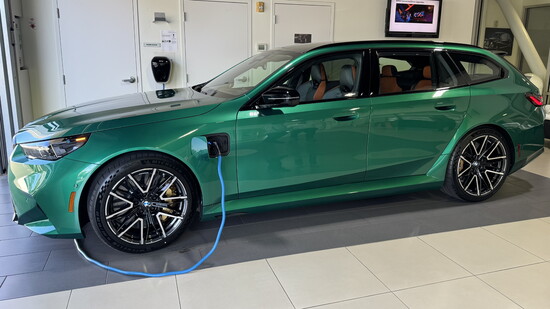
There are cars that announce themselves—and then there are cars that whisper, only to leave everything else behind.
The return of the M series wagon to the United States after a 15-year absence isn’t just a product launch. It’s a philosophical shift. And according to Mark Harrington of BMW Seattle, the response has been immediate—and telling.
“It’s actually selling faster than the sedan,” Harrington notes. “People get what this is.”
What this is—is the rarest thing in modern automotive design: contradiction, resolved.
Performance Without Announcement
On paper, the numbers feel almost excessive. A 717-horsepower twin-turbo V8 paired with a hybrid system. Zero to 60 in 3.5 seconds. All-wheel drive. An electric-only range of roughly 25 miles.
But numbers don’t tell the story. Presence does.
“This is what we call a sleeper,” Harrington says. “It’s understated. People pull up next to you and don’t realize what it is.”
That’s the magic. It doesn’t shout like a supercar. It waits.
And when it moves, it moves with purpose.
A New Kind of Utility
For decades, the American market drifted toward SUVs—height, bulk, perceived dominance. But somewhere along the way, something was lost: connection to the road.
The M5 Touring quietly restores that balance.
It carries 27.2 cubic feet of cargo space behind the rear seats—enough for golf bags, ski gear, or a weekend’s worth of life. But unlike an SUV, it does it from a lower stance, with sharper handling and a driver-first orientation.
“It’s a performance car that you can take skiing,” Harrington says. “Or take your kids to baseball practice.”
That duality isn’t a compromise. It’s the point.
Hybrid Thinking, Real Freedom
For drivers coming from fully electric platforms, like the BMW i4, the hybrid system introduces something subtle but powerful: optionality.
The M5 Touring can run purely electric for short, everyday drives—errands around Mercer Island, quiet city movement. Then seamlessly transition into full performance mode when the road opens up.
“It’s gas and electric,” Harrington explains. “You can use them together or separately.”
No range anxiety. No trade-offs. Just freedom.
Why Now—and Why Here
Perhaps most interesting is where the car is resonating.
In the Pacific Northwest—where mountain roads, weekend escapes, and lifestyle versatility define the rhythm—the wagon feels almost inevitable.
“I think people like wagons because they handle better than SUVs,” Harrington says. “They sit lower. They feel like a real car.”
There’s also something more subtle at play: taste.
The modern luxury buyer is shifting away from obvious signals of status toward something more refined—something that rewards those who know.
The M5 Touring doesn’t need to prove itself.
It assumes you understand.
The Modern Gentleman’s Machine
In a world increasingly defined by extremes—fully electric vs. combustion, utility vs. performance—the M5 Touring lives in the middle.
And in that middle, it excels.
It’s the car for someone who doesn’t need to choose between roles. Between driver and parent. Between weekend escape and weekday routine.
It’s not just a comeback.
It’s a reminder that the best things don’t always announce themselves.
Sometimes, they just arrive—and quietly change the conversation.
“A true sleeper—717 horsepower, hybrid precision, everyday utility, and freedom to go from silent city drives to full-throttle mountain roads.” Mark Harrington