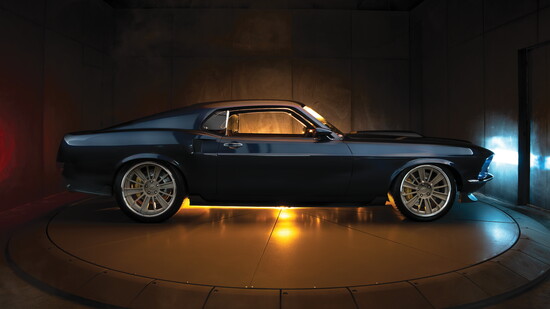
Ask Blaine Nolan what he’d take for Bleu Bayou, his nationally celebrated 1969 Ford Mustang, and his answer is pure John Wick.
“She’s not for sale.”
In three years, the one-off icon has earned near-mythic acclaim. It was featured in the History Channel’s one-hour special, SEMA: Battle of the Builders, commanded a 20-page spread in Wheel Hub, was crowned the 2025 ISCA International Class Champion in Semi Hardtop, and won enough trophies to need its own passenger seat.
But none of it prepares you to behold the car itself.
Beneath its Yachting Blue halo sleeps an apocalypse of power: a 666-horsepower supercharged Roush 5.0-liter Coyote—enough torque to tempt Jesus Himself to take the wheel.
Yet while Bleu Bayou was canonized as American muscle royalty, the man behind the machine, Mandeville’s Blaine Nolan, has remained largely outside the frame.
Until now.
Ignition
Before Bleu Bayou had a name, Blaine Nolan rode shotgun in another Ford: his father’s service car, rolling from farm to farm outside Crowley, Louisiana.
His father was a well-known water-well contractor who knew all the farmers, the sheriff, and nearly everyone between. His mother raised three boys and, for a time, worked at the local newspaper.
She typed. His father drilled. Blaine took things apart.
“I was always a hands-on kid,” he says. “Always digging things up, tearing down everything.”
Blaine played basketball until his parents dragged him indoors. When his father handed him money for fireworks, Blaine sprinted to the stand, bought what he could, lit the fuse, then ran back for more.
Buy. Light. Repeat.
Stillness never stood much of a chance.
“You’re living too fast,” his father would say. “Slow down, Blaine.”
Blaine’s reply comes just as quickly.
“I’m not slowing down. I just have one life to live.”
A Life of Service
For the Nolans, life was local before local became branding.
When another Ford joined the family, a sky-blue Thunderbird, it too was put into community service.
“It was our first car with power windows and locks,” Blaine recalls. “Every Sunday, my father drove it to the Christian Care Center. He’d collect bread and groceries pulled from store shelves but still good, then carry them to families who could use them.”
During the week, his father brought water out of the ground. On Sundays, he carried bread to people.
“My parents loved serving,” Blaine says. “Running concessions. Running fundraisers. You name it. They taught me what life was supposed to be about.”
Service ran deep in the family. Uncles fought in Korea and Vietnam. One great-uncle was connected to the company of men who raised the flag at Iwo Jima.
“What did your parents give you most?” I ask.
Blaine pauses.
“They were always there,” he says. “Mom and Dad were always there for us.”
The Chassis
If his parents taught Blaine the power of presence, his high school football coach taught him what to do once he arrived.
Lewis “Louie” Cook Jr. had a gift for finding the strength hidden inside a young man. His career later inspired Gaylon H. White’s Coach of a Lifetime, with a foreword by Nick Saban.
“He could extract every ounce from you without you even realizing it,” Blaine says. “He saw things in you that you couldn’t see in yourself. He was the best coach.”
After one difficult game, Cook gave Blaine a sentence he would carry for the rest of his life.
“You can be pleased, but never satisfied.”
The words followed him into college, where he studied engineering, and then into construction, when a contractor offered him nearly three times the salary. Then in 2003, after several years learning the industry, Blaine opened his own contracting business in Mandeville.
Success gave him plenty to be pleased about. He had a thriving company, a wonderful marriage, and two children.
Then came an unexpected family member.
The Want
“It starts with a want,” Blaine says. “Not a need, but a want. Then that want grows.”
It grows through conversation, photographs, and half-serious ideas that become increasingly expensive. Then someone finds the donor.
“That’s when it gets real,” he says. “Now you either pull the trigger or you don’t.”
The call came from Arkansas. They had found a drivable 1969 Mustang fastback.
Blaine pulled the trigger.
Not a Copy
Blaine had no interest in the more fashionable 1967.
“Everybody’s got a ’67,” he says.
The 1969 was longer. Sharper. Curved without becoming soft. To Blaine, it was the most balanced Mustang Ford ever made and he knew exactly who he wanted to build it.
Jonathan Goolsby runs Goolsby Customs in Hueytown, Alabama, outside Birmingham. The award-winning shop transforms classic hot rods and muscle cars from bare frame to finished masterpiece beneath one roof. Its previous 1969 Mustang won the 2016 Goodguys Street Machine of the Year.
Blaine wanted one just like it.
Goolsby refused. “Let’s build you your own car,” he said. “Not a copy car.”
That meant preserving the unmistakable shape of 1969 while rebuilding almost everything beneath its skin.
“How about we do the car in red?” Blaine asked.
Goolsby refused.
Red, he believed, would overpower the car they were trying to create. If Blaine insisted, he could find another builder.
“Then build whatever you want,” Blaine told him.
And just like that, a man accustomed to managing crews, budgets, and construction sites surrendered control of the most personal object he had ever commissioned.
Custom Fit
The build took four years.
Early on, the Goolsby team placed Blaine inside the unfinished Mustang to measure seat height, headroom, sightline, and reach.
He would not see the car again until the big reveal.
While Blaine waited, Goolsby Customs cut out the floors, channeled a Roadster Shop chassis into the body, and welded the Mustang back into a single, low-slung piece. They installed a supercharged Roush 5.0-liter Coyote tuned to 666 horsepower, a Bowler six-speed manual transmission, Baer brakes, and one-off Forgeline wheels.
The exterior emerged in Porsche Yachting Blue, sharpened by Storm Gray accents. Inside, chocolate leather covered the seats, dash, steering wheel, and panels. The factory lines remained, but every surface had been tightened, lowered, lengthened, or refined.
It looked aggressive without shouting and modern without vanishing. A gentleman’s hot rod with the devil under its hood.
Then the builders gave her a name.
Bleu Bayou.
The Reveal
Four years later, on Halloween morning in 2023, Bleu Bayou waited beneath a black cover inside the BASF booth at the SEMA Show in Las Vegas, the sprawling annual spectacle where the custom-car world comes to inspect, admire, and judge its own.
“I was sweating bullets,” Blaine says. “I’d only seen a rendering.”
Then the cover came off.
His knees nearly gave out.
“I was covered with emotion,” he says. “It was almost like seeing your child born.”
He climbed inside, studied the stitching, touched the emblem and gas cap. Then circled the car again. It was familiar and impossible: unmistakably a 1969 Mustang, unmistakably Blaine, yet beyond anything he imagined.
Blue was the right color after all.
Battle of the Builders
While Blaine was packing to fly home, the judges began calling.
Bleu Bayou reached the Battle of the Builders Top 40.
Then the Top 12.
Then the Top 3.
The unknown car was ranked among the three finalists in SEMA’s Hot Rod/Hot Rod Truck category, one of the most prestigious custom-car competitions in the country.
“We lost by one vote to a seven-million-dollar Buick,” he says proudly.
The car was the 1960 Buick Invicta Custom X-60, a nine-year build by Andy Leach and CAL Automotive Creations. It won Blaine’s category, then took the overall 2023 Battle of the Builders title.
Bleu Bayou had arrived at SEMA known to the world and unseen by its owner. But it left as one of America’s finest custom cars.
Victory Lap
Under Blaine’s agreement with Goolsby, the shop kept the Mustang for another year and toured it across the country on the Goodguys circuit. City after city, trailer doors opened, velvet ropes rose, and crowds gathered around the Yachting Blue debutant.
The trophies followed her home.
Builder’s Choice in Nashville. Best Custom in Birmingham. Best Metal Fabrication and Best of Show in Texas. First Place and Outstanding Custom in Houston. A Barrett-Jackson Cup invitation. The 2025 ISCA International Class Championship in Semi Hardtop. Magazines and television shows came calling.
By the tour’s end, Bleu Bayou could idle into any stadium without needing an introduction.
A Legacy of Transmission
Not all of Blaine’s best work fits inside a trophy case. For four seasons, he has coached Fontainebleau High School’s offensive line.
“I love the game,” Blaine says. “I feel like I have something to give back.”
In addition to teaching young men football tactics, he also teaches them about life, transmitting to the next generation lessons he learned along the way.
“It’s easy to tell people what they want to hear,” Blaine says. “But when a kid trusts you with a question, you owe him honesty.”
Blaine often tells his players: “Character isn’t what you do while people are watching. Anybody can walk the right line in public. Character is what you do behind the curtain when nobody is watching.”
Controlled Combustion
When Blaine isn’t working in his office or winning a car competition, there’s a good chance you’ll find him lighting up the night’s sky.
The boy who once sprinted to the fireworks stand with his father’s money now designs professional displays, engineering each shell, fuse, and explosion into a single choreography of controlled combustion.
One year, his canvas was the sky above Beau Chêne’s Fourth of July display. Other times, a friend who owns a fireworks company hires him to shoot fifteen-minute shows.
As faces tilt upward, the magic is instantaneous for the kids. And for a few incandescent minutes, even grown-ups become children again.
“It’s like cooking the perfect meal and watching somebody enjoy your food,” Blaine says. “You put together the perfect show, and everybody oohs and ahhs.”
Into the Blue
When I ask Blaine what sixth gear feels like in Bleu Bayou, he does not mention speed.
“When you drop it into sixth,” he says, “that’s when you sit back and enjoy the ride. The revolutions fall. The noise softens. All that power settles into something smooth enough to carry you home. To me, sixth gear is spending time with family, taking a trip, or having coffee with my mom.”
Bleu Bayou still wins competitions, but Blaine’s finest work happens outside the frame: beside young men learning to hold the line, beneath a sky filled with wonder, and among people he serves without anyone noticing.
“What happens next?” I ask. “Where does the road lead?”
“Ireland,” Blaine says. “Back to my roots. I can't wait to meet an Irish Nolan.”
He gives himself ten more years in business, enough time to put a few things in place, finish what remains unfinished, and perhaps retire.
The word “retire” lands uneasily.
Then Blaine settles into it.
Re-tire.
And perhaps that’s where we’ll find him next. Driving along an Irish coastal road with the wind around him, the sea beside him, and enough blue above him to make his Mustang feel at home.
“Character is what you do behind the curtain when nobody is watching.”
Under the Hood
Bleu Bayou began as a 1969 Ford Mustang fastback and emerged four years later from Goolsby Customs in Hueytown, Alabama, as a one-off study in controlled power. Beneath its BASF Glasurit Yachting Blue body sits a Roadster Shop Fast Track chassis, Baer Pro+ brakes, and a supercharged Roush 5.0-liter Coyote producing 666 horsepower. A Bowler T56 six-speed manual sends that power to a GearFX nine-inch rear end. Forgeline wheels wear Michelin Pilot Sport tires, while the cabin combines chocolate leather, Classic Instruments gauges, Vintage Air, and JBL sound. Extended rocker panels, tucked bumpers, custom vents, and machined taillights sharpen the original silhouette without erasing it. The result is unmistakably 1969, its original muscle refined into something lower, cleaner, meaner, and more exact.