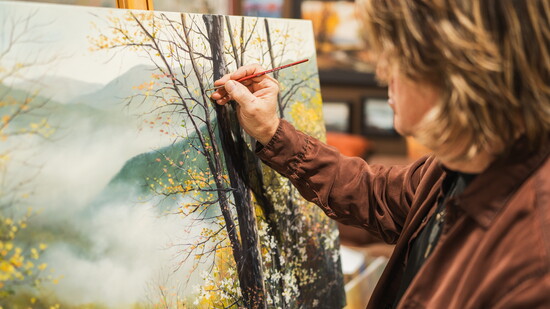
When Robert A. Tino was 12, he picked up pastel chalk and started drawing. Soon after, he picked up a paintbrush and never put it back down. When Mary John Denton Tino was 12, she rode with her mother, an enthusiastic collector, to pick up a limited edition print. Out of the blue, Elizabeth Denton asked her daughter, “Wouldn’t it be something if you married an artist someday?”
“It’s so uncanny to me that is exactly what I did,” Mary John says, four decades after marrying her high school sweetheart, who has become one of the most renowned artists of the Great Smoky Mountains and Appalachian landscapes.
“I’ve always been inspired by music and drew what I saw in music,” Robert says. When he was 13, he moved with his family from North Carolina to Sevierville. “With my love of nature, I started painting the Park and around Sevier County … and I just kept doing it. It’s a blessing to be able to do this, and I’ve put my whole life into it.”
For hundreds of thousands of Robert A. Tino Gallery visitors, collectors and fans, pouring his life into his art was a beautiful choice.
“…when we wandered into Robert A. Tino’s gallery, we met the artist himself, warm and genuine, surrounded by paintings that felt like music made visible. We brought one home, and every time we see it, we’re taken back to that Sevierville golden afternoon.” Oct. 5, 2025 Wanderlog Review.
“I’m a studio painter,” Robert says. “I take photos and make sketches, but come back to the studio to make my compositions. That’s where I feel good about creating.” Originally working with a signature mixing of watercolors and gouache, Robert ultimately moved to primarily oils and acrylics. Known for combining realism and impressionism, he later introduced his abstract style with a black bear limited-edition print, appealing to an even wider audience. Robert has dedicated years to exploring the Smokies, painting well-known and unknown vistas and valleys, and countryside landscapes in all seasons. “The light, the mood is always inspiring. Every day is different.”
However, Robert’s drive, discipline and passion for his craft are half the story. Thanks to an open door in an antebellum farmhouse transformed into a gallery, his work never was the best-kept secret in Sevier County.
“Because we’re in Sevier County, where people visit from all over the world to see the Smokies,” Robert says, “people come to our door … and I have art in places all over the world.” Over the past 35 years, hundreds of thousands have visited the Robert A. Tino Gallery, which overlooks the Winfield Dunn Parkway leading to Sevierville, Pigeon Forge, Gatlinburg and the Great Smoky Mountains National Park.
While still a University of Tennessee student, Robert was selling his originals locally at art shows and festivals when he decided to also produce prints. “My first print was in 1982. We literally started our print business in a dorm room in the oldest dorm on campus,” Robert laughs. Mary John, who was also a UT student, adds, “Robert invited me and my roommate over for pizza and an opinion. ‘I’m thinking about doing a print of this painting,’ he told us. Over pizza!”
With the help of fellow artist Vern Hippensteal, Robert learned the lithograph business. “I was young and probably created more prints than an older artist might, but our loyal core of collectors kept growing, many getting reserved numbers for each release. We did five or six lithographs a year [limited, collectors and signed editions of 500 to 950] from 1982 to 2010.”
Along with a steady stream of private and corporate commissioned pieces, Robert’s reputation grew quickly in the public sector. “My art is probably in as many public buildings, hotels, banks, restaurants, offices and medical centers as it is in homes,” Robert says. Mary John, business partner and brand ambassador-in-chief for Robert’s work, explains. “These are local companies and regional brands that want to personalize their space with art that is representative of their environment. It’s that full circle of our community supporting Robert’s art. People often find us because businesses integrate his art into their décor.”
Robert and Mary John opened their first gallery in downtown Sevierville in 1984, the same year they married. Eight years later, when they outgrew their 600 sq. ft. space, Mary John, with her father’s blessing, looked to the family home she would inherit from her grandparents. In 1940, John and Ima Denton were displaced from their community by TVA dam construction. “My grandmother cried when she saw the house my grandfather had bought, who summed up its condition with, ‘If we could have afforded nails, we would have destroyed it.’” But over the years, they lovingly restored the house built in 1844. In 1980, the gallery was listed on the Register of Historic Places in Tennessee, honoring the handcrafted woodwork of artisan and master cabinetmaker Lewis C. Buckner during an 1880 renovation of the house.
After serving in World War II and finishing college, Mary John’s father, Jack Denton, bought the adjoining acreage and house, which completed Sunset View Farm. “Our family raised cattle, hogs and chickens, grew tobacco, canned out of the garden and churned butter. I was at my grandparents’ house every day because it was a working farm.”
“Back in that day, you could open your door to absolutely anyone. When motel rooms in the area were scarce during busy seasons, sometimes they’d call my grandmother. ‘We’ve got this really nice couple, and there aren’t any rooms. Can they stay in a room upstairs?’” Ima would say yes and even cook breakfast. One summer, a special guest was their granddaughter’s boyfriend, who needed a room between high school and college. Ima cooked for him and loved him, not knowing Robert would feature her beloved family home in paintings that many people would enjoy in their homes.
Because of their restoration work, the Dentons’ historic home was in great condition when the Tinos transformed it into the Robert A. Tino Gallery in 1992. “Because of their place in this close community, my grandparents’ door was open to so many different people in their lifetime. We’re the third generation to continue that tradition, welcoming both the community and visitors from all over the world. As a gallery, we could sustain that open door legacy that otherwise could not have been preserved.”
When the gallery transitioned from lithographs to giclée prints, it offered creative and customizable advantages for both artist and collector. “Working with a giclée feels so much more like an art business,” Robert says. “It’s smaller, more intimate and hands-on for the artist. You can print on-demand on canvas, paper, metal, and other media.” Mary John adds, “Prints can have the look of a watercolor printed on watercolor paper, or an oil painting on canvas in different sizes.”
“There’s a beautiful advantage of building relationships in small businesses,” she continues. “We’ve had the same frame shop manager since 1992. Donna Garza has the experience and expertise to truly understand our customers’ tastes to totally customize their art investment.” The Tinos consider themselves fortunate to create jobs in Sevier County while cultivating a loyal core staff dedicated to the gallery’s growth. Former employees often return to help with holiday open houses and annual fall festivals that attract thousands.
Celebrating a 40-year relationship with Sevier County, Robert says, “This area has experienced phenomenal growth, and our business fortunately grew with it.” The Tinos continue to invest in their community, supporting and fundraising for groups such as Smoky Mountain Youth Leadership and Leadership Sevier, among many others. “It’s important to us to give back to this community that has always been there for us,” he adds.
Robert and Mary John have also been leading supporters of major fundraising campaigns for East Tennessee nonprofits that hold a special place in their hearts, like East Tennessee Children’s Hospital and Friends of the Smokies. Over decades, various donor events, limited edition releases, private label edition wines, custom art credit cards, among many other efforts, have raised hundreds of thousands of dollars for regional nonprofits.
Forty years after that first entrepreneurial decision in a dorm room, Robert and Mary John are forever grateful for their extended gallery family—generations of East Tennesseans, thousands of Robert’s devoted fans and avid collectors, one-time visitors from all over the world and those who come back every year. John and Ima Denton’s gracious antebellum farmhouse has become a destination stop, its open door welcoming friends and an ever-changing market of guests in all four seasons.
“So many people tell us Robert’s work evokes a memory, a feeling, like a song lyric. An emotional thread that takes you back to being 25, lakeside at sunset. But this painting is not a lake; you may never have been there before. But it’s familiar, because it evokes a feeling you’ve had before. Art has to speak to you. That’s why you invest in it.” RobertATinoGallery.com.
"As a gallery, we could sustain my grandparents’ open door legacy of welcoming both the community and visitors that otherwise could not have been preserved.” —Mary John Tino.
Robert A. Tino Gallery, Owner
Named by Southern Living in August 2024 as one of “The 16 Best Things to Do in Sevierville, Tennessee,” it is located in a two-story antebellum house listed on the Register of Historic Places in Tennessee. The gallery houses original oils, acrylics and watercolors as well as numbered and signed print releases by the renowned Southeastern artist. Open Tuesday–Saturday 10:00 a.m. to 5:00 p.m. 812 Old Douglas Dam Rd., (off Winfield Dunn Parkway) Sevierville, TN 37876 RobertATinoGallery.com.