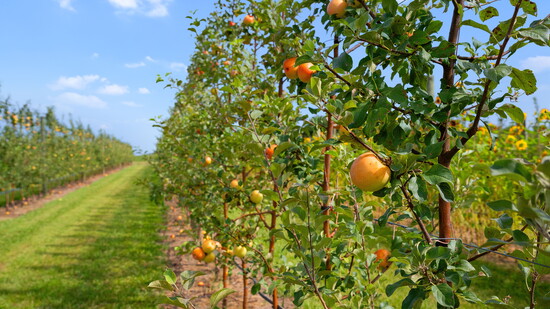
It’s a cool autumn morning in northeast Kansas. Sweater weather has officially arrived, pumpkin spice is back in season, Wildcat football is on the radio, and it’s the kind of day that could make even a scarecrow start craving a trip to the pumpkin patch.
Head west out of Riley on Highway 77, and the season seems to fit the scenery. Less than a mile out of city limits, on the north side of the highway, sits Fall Color Farms, where rows upon rows of landscape trees stretch across the property. Continue a little farther west, on the south side of the highway, and another sign appears: Creekside at Fall Color Farms. This time trees are filled with apples, and a new kind of family farming tradition is beginning to take root.
At the center of Creekside at Fall Color Farms is Miah Howe, a lifelong tree lover, the twin sister to Kori, sibling to Wyatt & Lane, Riley County High School graduate, and Kansas State University-trained horticulturist. Miah grew up growing trees and has always been drawn to them. Even as a K-State student, she viewed campus differently than most, remembering only a handful of building names while navigating instead by the trees growing around them.
To understand how Miah ended up becoming a tree aficionado, and tending to an apple orchard west of Riley, the story needs to go back to 1992.
That was the year her father, Scott Howe, founded Howe Landscape. The company grew to become one of the largest landscaping operations in the Manhattan area, building its reputation around professional and unique designs, attention to detail and quality customer service. The farm west of Riley served as the company’s home base, where the Howes also grew roughly 800 to 1,000 trees each year for use in landscaping projects.
In 2015, Howe Landscape was purchased by its managers and became PrairieStone, Inc. Scott, however, kept the farm.
After taking what Miah jokingly describes as a few years of sabbatical, Scott knew something important about the ground beneath his feet: it grew good trees. So, he planted 7,000 of them, and the operation began expanding exponentially. As Miah laughingly puts it, “Once a farmer, always a farmer.”
Today, Fall Color Farms has approximately 60,000 trees in production, and ships around 15,000 trees each year, distributing across the country, particularly throughout the Midwest. Its fields include many of the deciduous landscape varieties well suited for the region — maples, oaks, elms, London plane trees and others.
But growing up around all those trees gave Miah an idea for something different: apples. For her, an apple orchard became the perfect intersection of the two worlds she loved.
“I basically met in the middle between my two passions,” she says. “I love an apple orchard. It’s got trees, but it’s also got fruit.”
After studying horticulture at K-State, she spent three years working at other Kansas farms, learning fruit and vegetable production. Eventually, she called her dad with an idea, wondering if they could do something like that themselves. His response was simple: “Let’s do it.”
That idea became Creekside at Fall Color Farms.
The first apple trees went into the ground in spring 2023, followed by additional plantings in 2024 and 2025. Because apple trees generally take about three years to begin bearing fruit, the staggered approach was intentional, allowing production to increase gradually as the new business found its footing.
Those early years have also taught Miah patience. In the beginning, the sight of an insect could send her into a panic, while losing a tree to frost might keep her awake at night. Over time, experience has taught her to balance intervention with simply trusting a tree to do what trees have been doing for thousands of years. Seeking guidance from experts, including famed K-State entomology professor Raymond Cloyd, has also helped ease her mind and build confidence in the process.
Creekside itself opened in July 2025, but 2026 marks its first U-Pick apple season. Today, the roughly 2½-acre orchard is home to around 3,200 trees and 17 apple varieties, ranging from familiar favorites like Gala, Fuji and Pink Lady, to Crimson Crisp, Pixie Crunch, Snapdragon, Ludacrisp, EverCrisp and others.
The orchard is designed to make the experience both approachable and memorable. Guests purchase a bag, head into the rows and fill it with whichever ripe varieties they choose. Ripening dates shift with the weather, meaning the experience itself evolves from late summer through fall. Signs throughout the orchard identify which apples are ready to pick, along with details about their flavor, crunch, storage life and recommended uses.
For those unfamiliar with orchard terminology, apples are traditionally sold by the peck. Four quarter-pecks make one peck, while four pecks make a bushel. A full bushel of apples weighs about 42 pounds.
Creekside at Fall Color Farms is much more than just an apple orchard.
Inside The Market, the red, 2,800-square-foot main building, visitors can find seasonal produce such as watermelon, cantaloupe and garden tomatoes, along with jams, craft sodas, adult beverages and farm-themed gifts.
Outside, The Patio was built specifically as a place to gather. A wood-fired pizza oven has become a favorite feature, with Friday and Saturday pizza nights drawing guests throughout the summer and fall. One of the pizzas even incorporates Jobo’s, a handcrafted barbecue sauce made by the city of Riley’s mayor, giving Creekside another distinctly local touch.
South of the market lies The Pavillion, which expands the possibilities even further, functioning as an event space for live music, community gatherings and private rentals, including wedding receptions. The farm’s setting along Wildcat Creek adds another layer to the property, and Miah can already imagine future gathering spaces tucked closer to the water.
Then, The Lawn, with meticulously manicured grass, offers another place to slow down and stay awhile, with lawn games and Adirondack chairs scattered across the grass to simply enjoy the afternoon.
The attention to detail is visible throughout Creekside. Miah says quality is integral to everything the family does. From the nursery stock and fruit to the watermelon propane tank, to the landscaping and overall appearance of the property. The orchard’s straight rows, well-groomed trees, maintained grass and drip irrigation give it a manicured look that feels like a natural extension of the Howe family’s landscaping roots.
That may ultimately be what separates Creekside from a traditional roadside produce stop. Sure, the produce itself matters. The apples matter. The trees certainly matter. But Miah’s bigger ambition is for the farm to become a destination, and a place where memories have room to grow.
Miah’s goal is straightforward: “I have a goal of getting people obsessed with apples.” It is easy to understand why. Miah admits she was not always an apple person herself. Then she began eating them straight from the tree.
“A fresh-picked apple straight from the tree on a cool fall morning, it’s heavenly,” she says.
But apples are only part of Creeksides story. Scott’s goal, he says, was never to simply “copy and paste” another agritourism farm. The family wanted to create a place with its own personality, and somewhere people might come for produce and stay for an afternoon.
Miah’s dream is that someone might return 15 years from now with children in tow, and tell her they once met their spouse at Creekside.
“The biggest goal of this place is to create a space where that can be done.”
And maybe that is the most fitting next chapter for a family business built around growing things. First landscapes. Then trees. Then apples. Now, perhaps most importantly, it is growing something even better: fond memories and human connections, rooted deep.
“A fresh-picked apple straight from the tree on a cool fall morning, it’s heavenly,” - Miah Howe
“Our goal was never to 'copy and paste' what other agritourism places were doing. We wanted Creekside to feel original, welcoming and completely its own from the very first day.” - Scott Howe