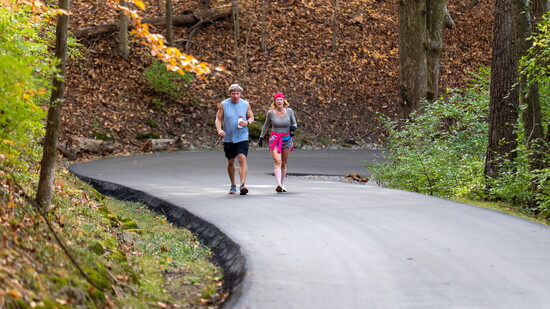
If you've ever run a marathon and thought, 'You know what this needs? More hills, more roots, and a lot more soul,' then the Flying Monkey Marathon in Bellevue was made for you. Held each November in the lush, forested terrain of Percy Warner Park, the Flying Monkey has built a reputation as one of the most challenging trail marathons in the Southeast. With a course that climbs and twists, it is the kind of race that breaks you down and builds you back up, all before lunch. And year after year, runners continue to return. Some for the challenge. Some for the community. Most for both. We sat down with race founder Trent Rosenbloom to find out what it takes to build a race that people love to suffer through.
Tell me a little bit about the marathon.
The Flying Monkey Marathon is a small, cozy marathon that takes place in Percy Warner Park, which is one of the largest metro parks in any city in the country. It is beautiful, in the woods. It is hilly and difficult, and it's run by a community of people who really love the challenge. And the marathon raises money to support the charitable organization that helps curate and maintain the park.
What's the story about how it got its name?
We started the marathon in 2006, and around that time in the running community, there were rumors of the legend of the dangerous flying monkeys living in the parks. We chose to embrace the legend.
What made Percy Warner Park the right home for the race?
When we created the race, we created it out of the running community as a sort of for-us, by-us race. And the community that created it was made up of a lot of people who regularly ran in the park.
What's your background? Are you a runner?
I am a runner. As I've gotten older, I don't run as much as I used to. But I've run over 50 marathons and ultra marathons throughout my life.
When the marathon was first organized, it came out of, as I said, love among the running community for the park. And it was at a time when I was running a lot of marathons and when marathoning was going through a bit of a cultural boom, and so I took it on simply because it seemed to me it would be both a lot of fun and a way to give back to the parks and all my running friends.
Tell me what a typical race day looks like behind the scenes. What goes into producing an event like this that most runners never even see or think about?
We do a little bit of work in the lead up to race day such as ordering the shirts and making sure we have all the volunteers in place, but after more than 20 years we've got it fairly well down to a routine.
On race day, we get there at about 5:00 AM before the official 8:00 AM start time. We spend the first couple of hours getting everything set up on the race course, including the eight stations where people will get support, will get fluids or sports drinks, setting up the start and finish area, and the timing area. We have an after party so we also will set up the area where the after party is.
We organize the volunteers to help the runners as they show up, pick up their bibs so that they can run the race and have that timed. As they get their bibs, they can either line up and start at the early start for the people who are slower or who are walking, who want to just take more time on the course. And then we have a competitive start at 8:00 AM for all the people who are really vying for a win or a place and a finisher's prize. Our finisher prizes are all individually handmade knit, crocheted, or quilted monkey dolls. Each one is different and the winners get their pick of what we have available in a given year.
Tell me a little bit about the course, because it has developed a reputation as a pretty challenging course. Is it an unsanctioned race?
It is sanctioned. It is uncertified.
And by that I mean there's a certifying body that most road races use, USA Track & Field, either directly or through a delegate, will certify that a racecourse is the distance it says it is
And races use certification for a few reasons. One of them is if you run a certified race in under a certain time, that then qualifies you to go on and run some other race. So if you run a certified marathon fast enough, that will allow you the right to register to run the Boston Marathon, for example. It also allows you to compare a race time on one course with a race time on another course. The Flying Monkey Marathons course is extremely hilly. There are no comparable road race courses to it in the United States, so having that sort of standard for comparison did not make sense.
It's a fairly small crowd of people who get to run our race every year. And in many years we don't have enough slots for everyone who wants to run it. And so we don't want people running our race because they want to qualify to run another race. We want the people coming to run the Monkey to be people who want to run the Monkey in and of itself.
How do people sign up?
We do registration in th first week of August, and what folks can do is put their name in and if after that week we have too many registrants relative to the spots that we offer, we'll run a lottery. And the lottery accounts for people who have shown commitment to supporting the park or who have run the race multiple times or who have other factors that we value. And if we don't get too many runners, we'll just let everyone in. We usually do that the week of August 8th.
We also have a half-marathon that takes place around the same time but on a different date, and registration for that is the same week and the same process.
We really feel like, because this is a by-runners, for-runners race that really celebrates the difficulty of the course, the beauty of the course, that it is unique. And it's one of the races that draws people back year after year, including people who otherwise don't ever run the same course or same marathon more than once. And we're very proud of our support for the Warner Parks. HarpethHillsMarathon.com
"There are no comparable road race courses to it in the United States,"
Trent Rosenbloom
Creator and race director, Rosenbloom, founded and established this race in 2006 after proposing the event to the Nashville Striders.