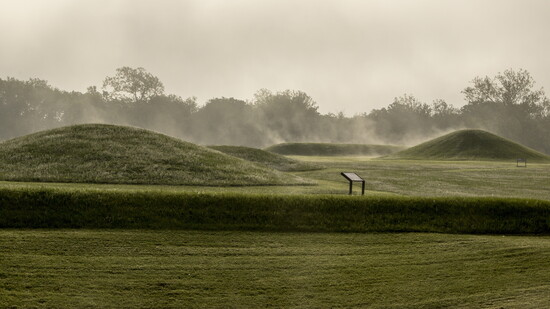
Between 1,600 and 2,000 years ago, southern Ohio became the heart of a vast religious movement that spanned much of North America and was known for the building of massive ceremonial earthworks. Indigenous tribes made pilgrimages from as far west as the Rocky Mountains and east as the Carolinas to visit these sites, many of which are recognized today as the Hopewell Ceremonial Earthworks.
“Ohio features a unique concentration of monumental landscape architecture found nowhere else in the world,” explains Neil Thompson, marketing department manager at the Ohio History Connection (OHC).
These sacred masterpieces served as communal gathering places where Native Americans conducted ceremonies, honored their ancestors and celebrated the passage of seasons. The builders of these earthworks had a sophisticated understanding of geometry, often aligning earthen structures with solar events such as solstices and equinoxes. They even tracked the complex 18.6-year lunar cycle, a feat accomplished by few contemporary cultures.
Eastern Shawnee Tribe of Oklahoma Chief Glenna Wallace, a citizen of one of the nearly 50 American Indian tribes with a historical presence in Ohio, explained the importance of honoring these spaces at the September 2023 committee meeting in Riyadh, Saudi Arabia, inscribing the Hopewell Ceremonial Earthworks as a UNESCO World Heritage Site.
“I am so humbled, so honored and so thankful that the world at long last recognizes the commitment, the spirituality, the knowledge of astronomy, mathematics, art, geology and aesthetic vision resulting in the imaginative thinking used by our ancestors to create these magnificent earthworks. They were not just geniuses. They were uncommon geniuses.”
If you grew up in Southwest Ohio, you may have childhood memories of visiting some of the earthworks that still exist in our own backyard. Maybe you took a bus ride with your fourth-grade classmates to explore Fort Ancient in Warren County, a 126-acre hilltop enclosure. Perhaps one summer afternoon, you piled into a van with your family to visit Serpent Mound in Adams County, the largest surviving effigy mound in the world.
Fort Ancient Earthworks & Nature Preserve in Oregonia and Serpent Mound in Peebles are directly managed by the Ohio History Connection, a private 501(c)(3) nonprofit organization chartered by the Ohio General Assembly in 1885 with a mission to spark the discovery of Ohio stories. Fort Ancient was the first site within the OHC network of 58 sites throughout the state and is one of the eight sites included in the Hopewell Ceremonial Earthworks.
“I recommend Fort Ancient as a great starting point for those interested in earthworks sites. It has the most extensive museum and visitor center along with an interpretive garden and 3.5 miles of hiking trails, including a path leading to an overlook of the Little Miami River,” shares Neil.
Historical experts, like Fort Ancient and Serpent Mound Site Superintendent Bill Kennedy, staff each of the sites. Bill is an archaeologist with 30 years of experience who previously worked for SunWatch Village and teaches at Wright State University. Visitors can join these experts for guided tours most Friday afternoons year-round at alternating locations.
“I identify first and foremost as an educator. Our primary focus is managing museum operations and community outreach, because visitor awareness is critical for the long-term protection and preservation of the sites,” notes Bill.
They also actively collaborate with at least 46 federally recognized American Indian tribes that have ancestral ties to Ohio, but were removed in the 19th century. A dedicated OHC department facilitates tribal consultation on presentation, programming and authentic representation of indigenous history.
“This approach ensures we are ‘talking with' rather than just ‘talking about’ our tribal partners and helps fill history gaps by incorporating oral traditions and indigenous perspectives into the presentation of the sites,” Neil says.
The main goal for visitors is to understand earthworks as active American Indian sites, rather than artifacts of an extinct culture. “American Indian communities are still thriving today, and the ultimate objective is to inspire visitors to continue learning about and exploring other significant historical sites,” Bill emphasizes.
For visitors interested in continuing their exploration, Bill and Neil recommend taking a road trip to the Newark Earthworks in Licking County, Ohio. The Newark Earthworks include both the Great Circle Earthworks and the Octagon Earthworks, which until last year had not been fully accessible to the public in over 100 years.
The Newark Earthworks are also part of the Hopewell Ceremonial Earthworks and are directly managed by OHC. The Octagon, which is in a transitional phase away from its former use as a private golf course, is a sophisticated lunar observatory, meticulously oriented to capture the northernmost point of the moonrise.
Five additional Hopewell Ceremonial Earthworks sites are managed by the National Park Service and are located in the Chillicothe area: Mound City, Hopewell Mound Group, Hopeton Earthworks, High Bank Works and Seip Earthworks.
While summer may be an easier time to visit for families, fall and winter are optimal times for a more peaceful, contemplative experience with clearer views of the earthworks. Solstice sunset/sunrise events are also popular, with opportunities to hear from archaeologists and tribal leaders.
As a steward for two local examples of Ohio history and ancient brilliance, Bill expresses, “Fort Ancient and Serpent Mound are sacred, open-air cathedrals that require careful management to prevent damage. Preservation requires a deep understanding of these sites, which are finite and diminishing resources. It involves working with American Indian partners to ensure the sites are treated with respect and can continue to exist for years to come.”
“Ohio features a unique concentration of monumental landscape architecture found nowhere else in the world." -Neil Thompson, the Ohio History Connection