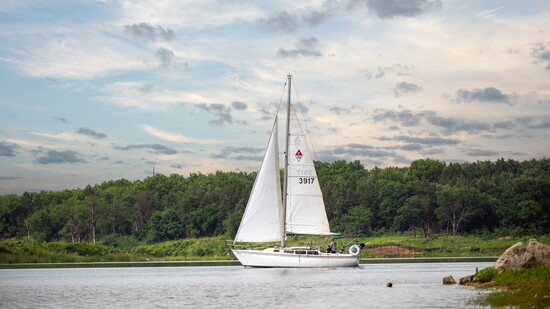
On a beautiful day across open water, the Commodore calls firmly to his trimmer, “prepare to come about.” A few steady moments pass as the white sailboat with forest green accents holds its line. Then, swiftly, comes the next command: “Come about!”
With a quick pull of a rope, the sails shift sides, the boat turns through the wind, and the bow finds a new course across the open seas of Milford Lake. For Dan Dempsey, it is just another day sailing the Flint Hills of Kansas.
Dempsey, known around the docks as “Danno,” sails with his longtime girlfriend, Lisa Bietau, aboard Island Time, their 1985 Catalina 30. The boat is 30 feet of fiberglass, teak, canvas, rope, stainless steel and memories.
While motorboats roar across the water, a sailboat listens first. It waits for the wind, catches it, leans into it and moves with an old kind of grace. Dempsey calls the boat his “chill zone.” For that, Island Time is certainly well-named.
The Catalina 30 is one of the most beloved production sailboats ever built. Designed by Frank Butler and built by Catalina Yachts, the boat became popular because it offered a balance sailors still appreciate: big enough to feel sturdy and comfortable, small enough to remain approachable, and practical enough for both weekend cruising, and serious lake or ocean sailing.
His own Catalina carries a story. Dan is the boat’s third owner. It was originally purchased new by a soldier stationed at Fort Riley. Later, it was sold and taken to Lake Perry, where it sat neglected for several years. Then Roger Matthews, a longtime Southwind Yacht Club member known for finding, fixing and placing sailboats with new owners, discovered it and brought it back to Milford Lake.
Dempsey had just retired from his Manhattan dental practice, Gentle Dental, in 2017 when he went to see it. He bought it almost immediately.
For Dan, the Catalina became more than a boat. It became a second act.
Below deck, the Catalina feels like a compact floating condo. Forward is the V-berth, the triangular sleeping area tucked into the bow. The main cabin, or salon, includes seating, a table and storage, while the galley serves as the boat’s small kitchen. There is also a head, the nautical term for a bathroom, along with fresh water, a water heater and enough interior comfort for weekends aboard. In the cockpit, six people can sail comfortably.
Like many keelboats, the Catalina 30 carries its strength below the surface. Beneath the hull, roughly 5,000 pounds of lead ballast sits low in the fin keel, giving the boat its stability. To a first-time passenger, the lean of a sailboat can feel alarming as the mast tips and the rail edges closer to the water. Dan is quick to reassure guests: the boat is built for this. Instead, the keel acts like a counterweight and underwater wing. As the sails catch the Kansas wind, the keel helps the boat resist sliding sideways, keeps it balanced and allows it to move forward with control. Still, no sailboat travels in a perfectly straight line.
A sailor must know where the wind is coming from, understand the points of sail and accept that some directions are impossible. A sailboat cannot travel directly into the wind. To go upwind, it must tack, zigzagging back and forth at roughly 45-degree angles. The boat turns through the wind with the sails “coming about” by crossing sides, and the crew resets for the next line. That blend of science, instinct and feel is what makes sailing endlessly interesting.
On Island Time, the mast rises high above the deck, carrying the mainsail and the genoa, the larger headsail at the front. Lines run back to the cockpit, allowing the crew to raise, trim, furl and control the sails without climbing the mast. The boat also has a small 21-horsepower, three-cylinder diesel engine, which Dan compares to a little Kubota tractor. It is mostly used to move in and out of the slip. Once clear of the dock, the real engine is the wind.
And Kansas has plenty of it.
That is what makes Milford Lake and Tuttle Creek Lake such natural sailing grounds. The same prairie wind that bends the grasses of the Flint Hills gives sailboats their power. On open water, with room to run, that wind turns a Kansas lake into something that feels much larger.
Southwind Yacht Club has helped foster that feeling at Milford Lake for more than half a century. Established in 1969, the club was created to promote sailing, friendly competition and social activities for sailors on Milford Lake. The lake itself, a 16,000-acre reservoir with 163 miles of shoreline, was created in 1965 near Junction City. Over the years, Southwind has grown from a small group of sailors into a dockside community with approximately 37 sailboat slips, water and electricity on the docks, a shelter house, picnic area and gathering spaces for members and guests.
The club hosts events throughout the season, including Memorial Day, Fourth of July and Labor Day gatherings. Members often spend full weekends aboard their boats. Some are longtime sailors. Others are newer to the sport. Some, like Roger Matthews, have helped bring multiple boats back to life and into the hands of members. His granddaughter, Mikayla, owns a yacht herself and serves on the board, proof that the club’s future is not only tied to old stories, but new energy.
Closer to Manhattan, Blue Valley Yacht Club has served sailors on Tuttle Creek Lake for more than 50 years. The club maintains a private dock, keelboat moorings, a dinghy park, boat ramp, boat lift, mast hoist and picnic shelter. Its calendar includes social events, racing series, long-distance races and youth sailing through partnerships with the Blue Valley Youth Sailing Foundation, the Boy Scouts of America and the Kansas State University Sailing Team.
Together, Southwind and Blue Valley reveal a hidden world many people in the Manhattan area may not know exists. Out here, in the middle of Kansas, there is no ocean in sight. But, there is wind. There is water. And there is more than enough room to sail the Flint Hills.
And aboard Island Time - it’s always 5 o’clock at Milford Lake!
"If you want to lower your blood pressure, go sailing. It’s very peaceful.” - Dan Dempsey
“You’ve got to know the direction of the wind. You can never sail directly into it, so you tack back and forth, working your way upwind. That’s how you get there.”