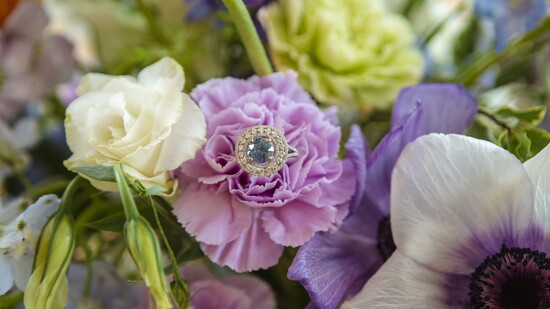
There is something lovely about walking into a jewelry shop and realizing you are not just looking at pretty things in glass cases. You are looking at time, patience, and tiny hand-made decisions. It is craftsmanship that has lived in one family long enough to become a business… and a way of life.
Whitefish Goldsmiths has been that place of craftsmanship since 1987, when Aric King and his wife, Kate, opened the shop. Aric is a master goldsmith. Kate handles bookkeeping and has her own bead line of necklaces. She also strings pearls—something she says she may be the last person in the valley still doing.
Their son, Jesse King, now works alongside them, as do their nephews Kai Schuhriemen and Jeremy King. It is a true family operation where skills are passed down through observation, and hands-on learning.
Aric first became interested in jewelry while traveling with his father to Native American reservations for audit work. “I really got motivated by the beautiful Hopi jewelry I saw,” he says. Soon after, he got a job at a jewelry store in Whitefish, coming in as the afternoon sales kid. The jewelers would work for a few hours while he watched, then after they left, he would play around with the tools on his own.
Eventually, master jeweler Murphy McMahon, took him on as an apprentice. When Murphy’s shop closed, Aric and Kate opened their first storefront on Central Avenue and nine years later, moved to its current location on Third Street.
In those early years, custom jewelry looked different from what it does today. “Aric hand-carved waxes by hand,” Kate says. “This was before 3D printing and custom milling.” In 2006, they bought a laser and a mill, expanding what they could offer while keeping the work personal and in-house. The team specialize in custom fine jewelry, expert repair, and a curated selection of gemstones—Montana sapphires, diamonds, opals, and especially Yogo sapphires.
Yogo sapphires are renowned across the world, and for good reason. Unlike the vast majority of the world's sapphires, which are discovered in alluvial deposits—meaning they were eroded out of their original rock over millennia and washed into riverbeds—Yogos are found in situ. They remain locked inside the host rock that brought them to the surface known as the Yogo dike. This dike is a narrow streak of lamprophyre rock stretching roughly five miles long and only a few feet wide.
Long ago, molten magma pushed its way up through these deep layers of limestone. As this magma forced its way upward, it intercepted sapphire crystals that had already formed under immense heat and pressure deep within the Earth's crust. The intense heat of the ascending magma dissolved the sharp edges of many crystals, which is why raw Yogo sapphires look like smooth, flat, or rounded wafers rather than sharp hexagonal prisms.
When the magma finally cooled, it solidified into a relatively soft, gray-brown rock, sealing the cornflower-blue treasures within a hard subterranean vault.
What makes a Yogo sapphire a true marvel of the gemological world comes down to two unique traits: unprecedented clarity and uniform, untreated color.
Aric confirms: “What makes a Yogo special is its rarity and quality. It comes only from one mining area in Montana, and nature finishes the job. The color is a true blue, and it’s not ever treated in any way.”
Yogos do not need artificial enrichment or human intervention. Because of the unique chemistry of the lamprophyre magma, they emerge from the earth completely free of rutile silk and with perfectly balanced trace elements.
Whitefish Goldsmiths has worked with Yogos since the beginning. Aric credits Jeff Kunisaki, owner of the Yogo mine, as the person who first got them buying the stones. Today, the shop maintains one of the largest Yogo inventories around, something that has required patience and intention. When the mine pauses or production slows, stones can become incredibly difficult to source—especially larger ones.
Because Yogo rough is so flat, finished stones over one carat are exceptionally rare. Most recovered Yogos yield finished gems under 0.50 carats.
Because Yogos tend to be smaller and flatter stones, they require thoughtful design. Many become rings, though the shop also carries Yogo earrings, pendants, and necklaces. Once, a customer fell in love with both a Yogo and diamond bracelet, along with a Yogo pendant. Realizing the bracelet was slightly too small for her wrist, the team modified it by adding the pendant into the center. “It made it spectacular,” Aric says.
“It’s exactly what the customer wants,” Jesse says of their custom process. “You get to really know the customer. They become friends.”
Aric agrees. “When we are working with you, you’re not going to be surprised by a piece you don’t like. You’ve seen what we are doing along the way.”
In a world where so much feels fast, outsourced, or impersonal, a rare Montana stone made by a local family at a bench feels grounding. And this summer, Whitefish Goldsmiths expects to have even more Yogos in the shop. Honestly, they are worth coming in just to look at.
"What makes a Yogo special is its rarity and quality."
"When we are working with you, you’re not going to be surprised by a piece you don’t like. You’ve seen what we are doing along the way."