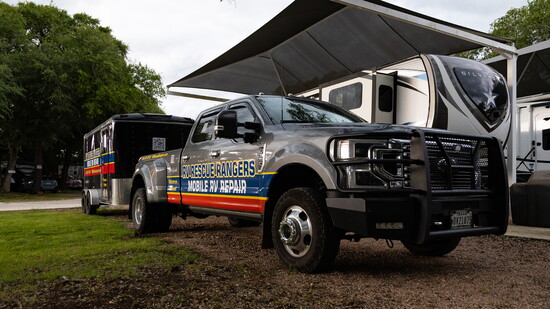
When an RV breaks down, the trip rarely just pauses. It can unravel the whole plan: the lake weekend, the family getaway, the cross-country trip, the long-awaited stop in a favorite campground. For RV Rescue Rangers, that is exactly where the work begins.
Based in the Hill Country, the mobile RV repair company was built by Alisha and Michael Hunter, who know what it means to adapt, troubleshoot, and keep moving. Before they were working on rigs, they were both working in healthcare. Both eventually hit the wall familiar to so many people in demanding careers: burnout. They wanted something more flexible, more hands-on, and more directly rewarding.
Their next chapter started long before the business was official. In 2020, they began traveling full time. Along the way, they found themselves doing what many RV owners eventually do...fixing whatever broke.
“We ended up fixing a lot of RVs without realizing it was even a career field,” Alisha said. “We were already doing it, so we figured we might as well do it professionally.”
In 2024, they saw an ad for RV technician school and took the leap. What had started as full-time travel and problem solving on the road became a business rooted in lived experience. It wasn't simply reading a manual and looking at it from a technical standpoint. They understand them from the owner’s side, too. They know the stress, uncertainty, urgency, and disappointment that come when a trip is suddenly on hold.
That perspective shapes everything about how they work. Instead of making customers haul their rigs into a shop and wait their turn, they bring the service to them, no matter if it's to a driveway, storage lot, campground, or RV park.
“Why wait six months at a shop when we can often get you fixed in a day or two?” Michael said. “We go right to the driveway, the storage lot, the RV park. Wherever you are.”
Their approach is also shaped by their time in the military. Both are veterans, and they both describe that background as one of the biggest influences on how they run the business.
“That military background gave us discipline and honesty,” Alisha explained. “If we don’t know, we find out. We don’t just say ‘I think I can fix it.’ We either fix it or we don’t.”
That honesty matters in RV repair because many owners do not know what they are looking at when something goes wrong. They may know the AC stopped working or the slide is acting up, but not whether the issue is electrical, mechanical, or something deeper in the system. A lot of the time, the first problem is simply that maintenance was skipped for too long.
“Preventive maintenance is the number one thing that gets missed,” they both said. “If people just stayed on top of it, a lot of these emergencies wouldn’t happen.”
Preventive upkeep is the quiet hero of RV ownership. Roof seals, AC cleanings, slide seals, batteries, and tires all need regular attention, especially in the Hill Country, where dust, pollen, heat, and humidity can wear systems down faster than owners realize. For full-timers, they recommend AC cleanings every three to six months and roof seal checks about every 90 days. For seasonal RVers, twice a year is a smart baseline. The key is not perfection. The key is keeping eyes on the rig before a small issue becomes a major repair.
They have seen the cost of waiting. A neglected roof can lead to water damage. A damaged slide can turn into a repair bill that runs into the thousands. A battery issue can affect systems that owners assume should still work. An AC unit that sits unused all winter can fail right when temperatures climb. Most of the time, the money spent on regular checks is far less than the cost of addressing larger repairs later.
“Just do a simple walk-around,” Alisha said. “Look for water where it shouldn’t be. Check your ceiling for discoloration. Watch your tires. It really does start that simple.”
Some of the best maintenance only takes five minutes. If the RV sits for long periods, they suggest moving the slides every few months so the seals do not lock up. Keeping systems active helps prevent expensive failures later. “They’re made to move,” Michael said. “They’re not made to sit still for years.”
For first-time RV owners, RV Rescue Rangers offers something just as important as repair: education. They provide walkthroughs and guidance because they know how confusing a new rig can be. Their own early RV experience included more than a few lessons learned the hard way, including realizing that the bedroom thermostat was not the one controlling the furnace.
The stories they shared make that clear. They helped a newly divorced father who needed hot water for his son. They stopped on the side of the road to help stranded travelers get back on their way. They have helped a pop-up camper owner with a young child get rolling in minutes. Last year alone, they donated eight AC units to veterans trying to beat the Texas heat. The pattern is always the same: someone is stuck, stressed, or overwhelmed, and the Rangers try to turn the moment around.
That commitment to help also extends to trust. If you are traveling somewhere unfamiliar, they say, check reviews before hiring a technician. They encourage RV owners to verify technicians, ask questions, and take their time making decisions that feel right for them.
“We’ve seen people pay $7,000 for a $1,000 air conditioner,” Michael said. “If something feels off, pause and get a second opinion.” Even if that means calling up Alisha or Michael from several states away just for their opinion.
For RV Rescue Rangers, that kind of trust is everything. It is not just about fixing a rig. It is about protecting the trip, the memory, and the investment behind it. It is about making sure a family vacation does not end on the side of the highway. It is about helping someone feel confident enough to keep going.
That may be the best way to understand the name. RV Rescue Rangers are not just repairing broken parts. They are rescuing the next adventure, one seal, one battery, one AC unit, and one call at a time.
We’re just trying to get people back to their adventure.