It goes away, and then it comes back. That is the part of sciatica that wears people down more than the pain itself. Maybe it took six weeks to settle the first time, then eight quiet months, and now the same hot line is running from your backside down the back of your leg and you are sleeping badly again.
Sciatica has a reputation for returning, and the reason usually has nothing to do with bad luck. Sciatica is not one condition. It is a description of where pain travels, and at least two very different problems produce that same traveling pain. Sorting out which one you have is usually where the recurring part starts to make sense.
Is Sciatica Actually a Diagnosis?
Not really. It is a symptom, in the same way a fever is a symptom.
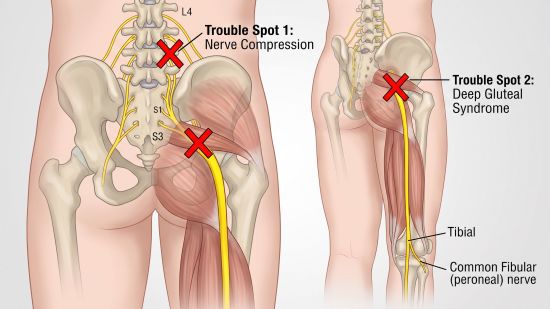
The sciatic nerve is the largest nerve in the body, roughly as thick as a thumb where it forms. It is built from nerve roots that exit the lower spine, about L4 through S3, which braid together in the pelvis, pass through the deep buttock, and run down the back of the thigh before splitting behind the knee to serve the calf, the shin, and the foot.
Anything that irritates or compresses that nerve, anywhere along that route, can produce pain that travels its whole length. That is why the pain pattern tells you surprisingly little about where the problem actually sits. The nerve reports trouble the same way no matter where it started.
Why Does the Same Stretch Work for One Person and Do Nothing for the Next?
Because there are two common places the nerve gets into trouble, and they sit about ten inches apart.
The disc pathway. At the spine, a bulging or herniated disc at L4-L5 or L5-S1 can press against a nerve root right where it exits. So can a narrowed opening from arthritic change. The irritation happens before those roots ever braid into the sciatic nerve, which is why this version is properly called radiculopathy rather than sciatica.
The deep gluteal pathway. Farther down, the nerve passes through the buttock alongside the piriformis, a small muscle running from the sacrum to the top of the thigh bone. When that muscle and the tissue around it tighten or thicken, they can compress the nerve there instead. In some people the nerve runs directly through the muscle, which makes it more vulnerable.
Now the stretch question answers itself. The classic figure-four piriformis stretch can genuinely relieve the deep gluteal version, because it lengthens the tissue doing the compressing. Applied to a disc problem it does nothing useful, and folding forward into it can raise pressure inside the disc and make the day worse. Same stretch, same symptom, opposite result.
How Do You Tell Disc Sciatica From Piriformis Sciatica?
There are patterns, and they are useful, though none of them is proof on its own.
Disc-origin sciatica tends to be worse with sitting, and noticeably worse with coughing, sneezing, or straining, because all of those raise pressure inside the disc. It often comes with real low back pain, follows a narrow stripe down the leg rather than a vague spread, and is the version more likely to produce measurable changes, a dulled reflex, a numb patch, a weak foot.
Deep gluteal sciatica tends to be centered in the buttock, deep and specific, often sore to press directly. It is worse with long sitting, particularly on something hard, and worse with driving. Back pain may be absent entirely, and reflexes and strength are usually normal.
An exam is what separates them. Straight leg raise, slump testing, hip rotation under load, reflex and strength testing, and sensation mapping will usually point clearly to one or the other. Imaging helps when the exam raises a question it cannot answer. It is worth knowing that disc findings turn up on scans of people with no symptoms at all, so a report by itself is not a verdict.
When Does Sciatica Need an Emergency Room?
A few presentations are not a chiropractic problem, a physical therapy problem, or a wait-and-see problem.
Go to an emergency room, the same day, for any of these. Loss of bowel or bladder control, or new difficulty starting urination. Numbness through the groin, the inner thighs, or the area that would contact a saddle. Weakness in both legs, or weakness anywhere that is clearly worsening day over day. Sciatica alongside fever, or after a significant fall or car crash, or with unexplained weight loss or a history of cancer.
That first group can signal cauda equina syndrome, where the bundle of nerves at the base of the spinal cord is compressed. It is a surgical emergency and the window matters. Do not wait for an appointment with anyone, including us.
Why Does It Keep Coming Back?
Usually because what got treated was the flare and not the driver.
An acute episode calms down on its own more often than not. Time, movement, and anti-inflammatory medication get most people through the worst of it, and once pain drops below the level that demands attention, most people stop there. The disc that was under load is still under load, and the muscles that were not controlling the segment well are now weaker than before, because a painful month is a sedentary month.
Then a long drive, a weekend in the yard, or a bad stretch of desk work reproduces the same conditions, and it returns. That is not a mysterious relapse. It is the same problem meeting the same load.
Recurrence is also a signal in the other direction. Sciatica that keeps coming back, or never fully resolves, deserves a real diagnosis rather than another round of symptom management. Sometimes the honest answer is that it was never the disc or the piriformis at all. Hip arthritis, sacroiliac joint irritation, and hamstring tendon trouble at the sitting bone all refer pain into the same territory and get called sciatica routinely.
What Does Care Look Like for Each of the Two Causes?
Different causes, different plans. That is the whole reason for sorting them first.
For the disc pathway, HealthSource of Harper's Preserve uses a DOC computerized decompression table. Rather than pulling on the whole spine the way older traction equipment did, the table is positioned so the distraction load concentrates at one segment, the level the exam and imaging point to. It works in cycles of pull and release, with sensors watching for muscle guarding so the body does not brace against it. The intent is to lower pressure inside the disc and encourage fluid exchange in a structure that has no blood supply of its own.
For the deep gluteal pathway the tool is different. A Zimmer Class IV laser delivers light energy to a depth of roughly five to six centimeters, which is what it takes to reach tissue sitting well below the surface. The intent there is to influence inflammation and tissue recovery at that depth rather than at the skin.
Both are paired with Progressive Rehab, because taking pressure off a nerve without rebuilding the hip and trunk control around it tends to buy relief that does not hold. If you want [how a care plan gets built once the cause is identified], that is a fair thing to ask about before committing to anything.
What none of this does is repair a torn disc wall, pull a loose fragment back into place, or resolve cauda equina, a fracture, an infection, or a tumor. Progressive weakness and a sequestered fragment are surgical conversations. A clinic that never sends anyone to a spine surgeon or back to their physician is a clinic worth being skeptical of.
What Happens at a First Visit?
Mostly listening and testing.
Expect a conversation about where the pain travels, which positions make it worse, how often it has come back, and what has already been tried. Then a movement screening, orthopedic and neurological testing to work out whether the nerve is being irritated at the spine or in the buttock, and imaging where it is warranted. If you already have an MRI report, bring it.
A first visit at HealthSource of Harper's Preserve is $39 and includes all of that. It is an evaluation, not a treatment package.
On timelines, be realistic. Nerve irritation settles in weeks, not days. Plans built around decompression usually run several sessions a week at the start and taper as symptoms ease. If a fair trial is not changing anything, that is information, and it should change the plan rather than extend it.
Sciatica gets handled badly so often because the word describes a route, not a cause. Once you know which end of the nerve is in trouble, most of the confusion falls away, including why one person's miracle stretch was your wasted month.
You do not have to organize your year around the next flare. Driving into Houston without shifting every four minutes, getting through a Saturday in the yard, sitting all the way through a school program. Those are reasonable things to want back, and more often than not this is a mechanical problem with a mechanical answer.
HealthSource of Harper's Preserve is at 10354 Highway 242 Suite 900, Conroe, TX 77385. HealthSource of Creekside is at 24345 Gosling Road Suite 110A, Spring, Texas 77389.