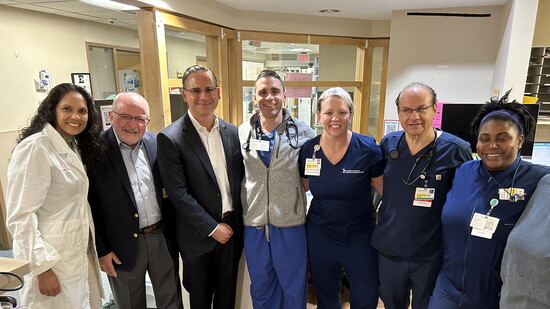
You’ve called Harford County home for decades. What has this community meant to you personally, and how has living here shaped the way you approach your role at UM Upper Chesapeake Health?
Harford County has been home to my family for many years. We have raised our children here, built friendships here, and become part of the community. That makes leading University of Maryland Upper Chesapeake Health (UM UCH) deeply personal for me. I’m not leading a hospital in a community where I happen to work. I’m leading the health system that serves the community where my family lives. The patients we care for are our friends, our neighbors, our children’s teachers. That creates a tremendous sense of responsibility.
Your career has taken you through health policy, law, economics, and leadership. What ultimately drew you toward work centered on improving health and strengthening the communities you serve?
My path into healthcare leadership began with a very personal experience. When I was a freshman in college, my younger brother became critically ill and spent three months in the ICU awaiting a heart transplant. I saw healthcare from the perspective of a frightened family member. It motivated me to pursue a career where I could help families just like mine. That led me through health policy, economics, law, and ultimately healthcare leadership. My question has remained essentially the same: How can I help? At UM UCH, I am trying to help create the systems, cultures, and environments that allow the people at the bedside to do their best work.
When you stepped into the role of president, you emphasized listening to patients, team members, and community partners. What have you learned from those conversations about what Harford County needs most from its local health system?
I’ve heard a consistent message: people want excellent, safe healthcare close to home. They want to know that when they or someone they love needs care, UM UCH will be there and will provide the best possible care. And they want us to listen – to patients, families, physicians, nurses, and our broader community – and then act on what we hear. For me, that’s what continuous improvement is about. We should never assume that because we’re doing something well today, we can’t do it better tomorrow. Our patients and families have a unique perspective on their experience, and we have an obligation to listen to that perspective, learn from it, and turn it into action.
A community hospital often becomes part of people’s lives during their most vulnerable moments. How does that responsibility influence the decisions you make as a leader?
I’ve experienced healthcare from the family side many times. My brother’s critical illness, losing my mother and my father-in-law to cancer, and other experiences with illness and mental health in my own family have given me a very personal understanding of how vulnerable families can feel. It reminds me that behind every patient is a person and a family who may be experiencing one of the most difficult moments of their lives. That influences how I lead. We must create a culture of psychological safety where teams communicate and speak up. We must create systems, structures, and processes that are safe and reliable, that empower our bedside caregivers to do their best work under difficult circumstances. It’s a sacred responsibility. We must provide the kind of care we would want for the people we love.
What does it mean for Upper Chesapeake to truly be a community health system rather than simply a place people go when they need medical care?
It means taking responsibility for the health of the community, not simply treating people when they become sick. We need to provide outstanding care when people need us, but we also need to work with physicians, schools, employers, community organizations, and others to help people stay healthy and navigate the health system. And being part of the University of Maryland Medical System gives us something very special. We are a local health system with access to clinical expertise, research, technology, and investment of a world-class academic medical system. Our goal is to bring those resources closer to home for the people of Harford County.
Harford County has supported Upper Chesapeake for generations. In what ways do you see the relationship between the health system and the community as reciprocal, with each strengthening the other?
Harford County and University of Maryland Upper Chesapeake Health have grown together for generations. The community has supported us through philanthropy, volunteerism, advocacy, partnerships, and, most importantly, trust. That support allows us to invest back into the community – in our people, facilities, technology, physicians, and services. We have inherited something very valuable, and our responsibility is to steward it well and leave it stronger for the next generation.
Who within the Upper Chesapeake team or the broader Harford County community inspires you, and what have those individuals taught you about service and leadership?
I’m inspired and humbled by the many people who show up when it matters. That includes the nurses, physicians, technicians, environmental services workers, volunteers, and so many others who understand that what they do matters enormously to someone else. I’m also inspired by people throughout Harford County who have invested decades of their lives in strengthening this community. You see that spirit in our volunteers, community partners, and philanthropists who give their time, talent, and resources because they believe in their neighbors and in this community. They remind me that leadership is ultimately about service. The question isn’t simply, “What can we accomplish?” It’s, “How can I help?”
This issue of the magazine is centered on gratitude. What are you most thankful for as you look at the people, partnerships, and community surrounding Upper Chesapeake, and what do you hope to give back in return?
I am deeply grateful for the extraordinary generosity that defines this community. For more than 20 years, the Chesapeake Cancer Alliance has united volunteers, donors, and advocates around a shared mission: supporting local cancer patients and the people who care for them. Because of their dedication, Cancer LifeNet at the Kaufman Cancer Center is able to offer supportive care programs and services to patients and families at no cost. Their impact extends far beyond financial support. It provides comfort, encouragement, and hope during some of life’s most difficult moments.
I am equally grateful to the families and donors whose transformational investments in UM Upper Chesapeake Health are helping shape the future of care in our region. Their generosity is expanding access to services, bringing advanced technologies to our community, and strengthening our ability to meet the needs of future generations. Their confidence in our mission is both humbling and inspiring, and it reminds us of our responsibility to be thoughtful stewards of a resource that means so much to so many.
It is a privilege to lead an organization that is deeply connected to the community I proudly call home. I am thankful for our team members, whose compassion, talent, and commitment make a difference every day; for the generations of community members who have supported UM UCH; and for the patients and families who place their trust in us during some of the most vulnerable moments of their lives. That trust is a gift, and it inspires us to care for every patient with excellence, empathy, and respect.
It is a privilege to lead an organization that is deeply connected to the community I proudly call home.