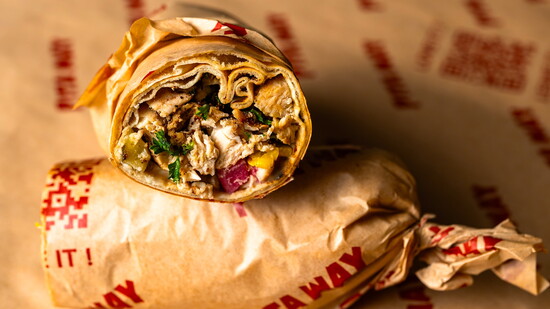
Ask Brandon Bahoura how his day is going, and his answer offers a quick glimpse into the personality behind Pita Way.
“Every day’s a great day.”
That optimism has carried Bahoura from a single Clarkston restaurant where he once wondered whether he could keep the doors open to a fast-growing Middle Eastern restaurant brand with more than 50 locations and 800 employees.
But for Bahoura, the numbers only tell part of the story. Pita Way’s growth has always come back to people: the customers, employees and the communities the restaurants serve.
“If we can’t help one another, what are we here for?” he says.
Bahoura graduated from Oakland University in 2007 with a degree in marketing, tried the corporate world and returned to his family business before deciding he wanted something of his own. Remembering how much he had enjoyed restaurant jobs as a teenager, he found his direction. His parents immigrated from Iraq in the 1970s, and Bahoura grew up eating Middle Eastern food. He envisioned turning those familiar flavors into a modern, fast-casual concept.
With his savings and a loan from his father, he opened Pita Way in Clarkston in 2010. His best friend helped him, his sister worked the register and opening-day sales totaled $300.
“I was like, wow, people actually showed up,” he says.
The reality soon became tougher. Bahoura worked as many as 120 to 130 hours a week and went six months without a paycheck. First-year sales totaled about $250,000, and he considered giving up.
“What kept me going were my regulars,” he says. “And failure’s not an option.”
He began closely watching what customers ordered, refining the menu and building relationships. He also pursued catering, sometimes driving an hour or two to deliver an order.
Sales climbed. In its fourth year, the original restaurant surpassed $1 million.
Those early relationships endured. Some customers became friends, including Kipp Quarton, now Pita Way’s chief marketing officer.
As the company expanded, Bahoura realized growth depended on developing leaders. After reaching 10 locations by 2020, he created a profit-sharing model that gives successful managers a financial stake in their restaurants.
“I’m not in the restaurant business any longer,” Bahoura says. “I’m in the people-development business.”
Today, about 30 employees are in profit-sharing roles. What makes him proudest, Bahoura says, is watching someone start as a crew member, advance to managing a restaurant and ultimately become a profit-sharing leader.
That focus on people extends into the community. Pita Way supports employees facing financial difficulties and regularly donates food to schools, hospitals and nonprofit organizations. The company has also supported groups serving people affected by Parkinson’s disease, Alzheimer’s disease and multiple sclerosis.
“We get to people’s hearts through their stomachs,” Bahoura says. “No one should go hungry.”
Quarton says Bahoura’s hands-on example helps explain the company’s success. Despite its size, Bahoura still steps behind the line, develops recipes and demonstrates food preparation in employee-training videos.
And he has no intention of slowing down. Bahoura envisions Pita Way reaching at least 20 states and 300 locations within the next decade.
“If I’m not growing, what am I doing?” he says.
Yet for a company expanding at a remarkable pace, Bahoura’s measure of success remains surprisingly personal: creating opportunities, building relationships and helping people.
“It is the American dream, right?” he says.
For Bahoura, the dream began with a single Clarkston restaurant, $300 in first-day sales and a determination to keep going.