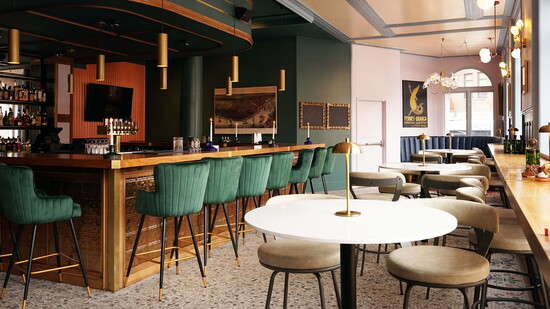
The Marquis feels like it has always belonged on Park Street. Warm light spills through its windows, inviting passersby inside, while the historic bones of the Lafayette Hotel give the space a sense of place that can’t be manufactured. But creating that atmosphere took more than choosing the right paint color or furniture. For Kevin Medrek of Medrek Design, the interior of the Marquis was an exercise in balancing history, hospitality, and a very specific sense of style.
The bar and lounge is Medrek Design’s first hospitality project, as well as one of the first major projects for Medrek’s own firm, which he opened last summer. The opportunity also brought a personal connection: Medrek is a longtime friend and residential designer for Marquis owners Meg Bartos and Jacob Coombs. Together, the team set out to create a space that captured the owners’ Parisian and New Orleans influences while still feeling distinctly at home in Portland.
“The real inspiration for the space was Meg and Jacob’s brand, which tied the New Orleans and Parisian aspects into the roots of the building itself, the Lafayette Hotel,” Medrek says. Opened in June 1903, the structure was built on the site where the Marquis de Lafayette stayed during his 1825 visit to Portland. The building operated as a grand luxury hotel before converting into apartments in the late 1960s.
That history became one of the project’s greatest assets. Rather than trying to overhaul the building, Medrek worked with what was already there, including original pre-war mosaic floors and large historic windows. The existing architecture became a jumping-off point for the new design, particularly when it came to color.
The Marquis nods to the purple, green, and gold of New Orleans’ Mardi Gras, but in a considerably quieter way. Medrek and his clients conducted a color study of the existing mosaic floors, pulling out their purples and off-whites and incorporating them throughout the space. The result is a palette that feels layered and atmospheric rather than overtly themed.
“We incorporated those Mardi Gras colors into the entire space, but without being so blaringly obvious,” he says, explaining that the team essentially “sucked out about 75% of the saturation of the themed colors.” In doing so, Medrek created a quieter, timeless backdrop while punching up the colors and materials that felt at home in Portland: green velvet, blue leather, orange silk wallpaper. The palette works with the natural stone tones already present in the historic floors, allowing the inspiration to register without overpowering the room.
That restraint was important for another reason. As someone who lives in the neighborhood, Medrek wanted the Marquis to feel like a place Portlanders could actually use—not simply a novelty to visit once. “It’s a pretty niche theme to begin with,” he says. “How can we make it not weird to hang out at a New Orleans-themed bar multiple times a week?”
The answer, in part, was comfort. Medrek’s background is primarily residential design, and he found that experience surprisingly useful in a hospitality setting. His goal was to make the commercial space feel livable and inviting, with an ease that allows it to transition from daytime events to happy hour and late-night gatherings. “When I do a commercial space, I want to make it feel as homey as possible,” he says.
That approach also meant thinking beyond the interiors. Because the Marquis occupies a landmark building with its entrance tucked around the corner on Park Street, visibility was a challenge. Physical signage on the exterior was limited, so Medrek turned his attention to the building’s windows, illumination, and overall presence from the street.
The result, he says, is a space that is hard to miss at night. “When I’m walking around in the neighborhood, there’s no missing the Marquis,” he says. “From the outside, it looks like such a great, warm vibe of a place.”
For Medrek, that transformation is one of the most rewarding parts of the project. Hospitality design offers something residential work simply can’t: the chance to watch strangers experience the finished space in real time. With the Marquis, he gets to walk past a project of his own every day, meet friends there, and hear what people think. “It’s been cool to see it get such a positive response, and to really get to see one of my projects become a part of the town that I live in,” he says.
That sense of belonging is the Marquis’ greatest design success. The space is meant to encourage people to settle in, whether they’re stopping for a drink after work, listening to live music, or staying for one more round. The food and drinks may be the reason to arrive, but the design clearly gives guests a reason to stay.
“When [you're] walking around in the neighborhood, there’s no missing the Marquis."