Snowfoot began, as many good inventions do, with a simple annoyance. In the Italian Alps, surrounded by steep climbs, icy ridgelines, and deep winter snow, Robert Behrens wanted to move the way he moved in every other season — freely, curiously, without feeling like he had strapped dinner plates to his feet. Traditional snowshoes allowed him to float on snow, sure, but they forced a wide, awkward gait, slowed him down, and limited what he could explore. So he started tinkering. What emerged from his garage was strange and promising: a compact deck, a binding that hugged the boot like it belonged there, and a set of crampons sharp enough to bite into the steep terrain right outside his door. Over time, that prototype evolved into Snowfoot, a winter mobility tool unlike anything else.
When Robert’s sister and CFO of Snowfoot, Janet McCoy, talks about those early days, she laughs. “He’s a crazy genius,” she says. “Like a mad scientist.” She’s not exaggerating. Robert holds a global patent for Snowfoot’s deck — a complex, multi-layered structure that compresses a surprising amount of surface area into a small footprint. What looks simple from the outside is, according to Janet, “packed with intentional design you’d never notice but immediately feel.”
Snowfoot’s heart may be in the Alps, but its soul is rooted in Minneapolis, where Janet, her husband Keith, and their teammate John Frahm help carry the brand forward with a focus on the product's ability to make any winter activity fun. Together they form an unlikely but deeply enthusiastic crew determined to make winter less of a burden and more of a playground.
John, the company’s marketing lead, likes to describe Snowfoot as the “anti snowshoe.” You step into them, he says, and something clicks — literally and figuratively. Your foot locks into a natural position, the deck supports your stride, and suddenly you’re moving the way you expect to move, not the way winter usually allows. “You start walking,” he says, “and you forget you’re wearing them. Your gait’s natural. You’re not wobbling or shuffling. It just feels right.”
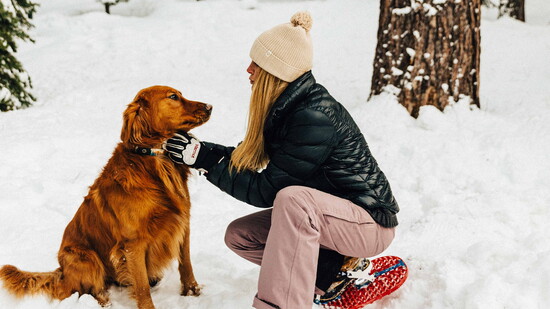
That sensation — that ease — is what makes people smile the first time they try them. It’s also why the Snowfoot team insists that this is less a piece of outdoor equipment and more an invitation. It’s permission to follow curiosity down a snowy trail, climb a hill you wouldn’t normally attempt, or stroll to the neighborhood brewery without worrying about ice patches. Users take them ice fishing. They wear them to shovel driveways. They track animals with them, scale trees, wander city parks, or simply walk the dog without fear of slipping.
Keith, the company’s USA director of operations, sits somewhere between the daredevil energy of Robert and the cautious practicality of his wife, Janet. He likes taking Snowfoot into places he probably shouldn’t: the off-limits corners of Minnehaha Falls, the shaded steep trails that turn to ice by January. “You just feel secure,” he says. “You’ve got grip, you’ve got traction, you’ve got control.” It’s the kind of confidence that changes how you interact with winter — suddenly the season is not an obstacle but a landscape. “The whole world opens up to you, making colder months more fun.”
Janet, ever honest about being the least naturally bold member of the group, sees Snowfoot a bit differently. For her, it’s an approachable, no-prep way to fight off cabin fever. “Anyone can do it,” she says. “You’re just moving your body.” She likes that you don’t need special boots or extra gear; your sneakers or winter boots work just fine. And she loves to share with parents that kids grow with their Minis. “It’s the one winter product you don’t have to size up every year,” she says.
The product’s quality is a point of family pride. Everything is sourced within 90 miles of Robert’s home in the Alps, and he still hand-assembles each pair. The team has yet to find someone capable of breaking one, despite the many enthusiastic attempts at outdoor shows. And in an era of disposable gear, Snowfoot feels solid, durable, almost heirloom-like.
But the true magic appears in quieter moments. John talks about taking his three kids into the snowy backyard with their Minis, watching them pull their own sleds up a hill for the first time. Janet describes discovering winter in Minnesota — and liking it. Keith remembers seeing a group of older adults using Snowfoot simply to feel safe while shoveling their walkways.
In these stories, a pattern emerges: Snowfoot doesn’t transform winter. It transforms our relationship to it. It makes people lighter on their feet, more playful, more willing to step outside and see what the cold months might offer. And maybe that’s the real invention — not the deck or the crampons or the binding, but the feeling that winter can move you, if you let it.
To purchase a pair, visit snowfoot.com.