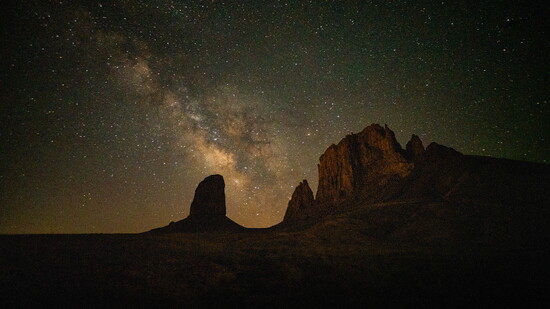
Daylight fades slowly in the Bisti/De-Na-Zin Wilderness. Hoodoos and cracked badlands soften into shadow as silence settles across the high desert. Then the stars begin to appear — first a handful, then thousands. “What often stays with people is the silence,” shares Kialo Winters, a Diné (Navajo) and Zia (Pueblo) tour guide, photographer, and founder of Navajo Tours USA. “Bisti is one of those rare places where you can truly hear the absence of modern noise.” Winters leads Sunset and Night Sky Tours through the remote wilderness of northwestern New Mexico, where exceptionally dark skies reveal the Milky Way in remarkable clarity. Visitors may arrive expecting astrophotography or dramatic scenery, he says, but many leave remembering something quieter. “The stillness slows people down,” Winters explains. “We’ve seen guests become unexpectedly reflective, emotional, even spiritual out there.”
Experiences like this are part of why New Mexico has become one of the country’s best places for stargazing. High elevation, vast public lands, and legislation like the 1999 Night Sky Protection Act help preserve some of the darkest skies in the Southwest. From Navajo-led night tours of the Bisti Badlands to Sky Railway’s Stargazer excursion to the Galisteo Basin with a professional astronomer, here’s where to explore after dark this summer.
Bisti/De-Na-Zin Wilderness
Strange stone wings, hoodoos, and deeply eroded badlands make the Bisti/De-Na-Zin Wilderness one of the Southwest’s most surreal landscapes after dark. “With almost no light pollution, the stars here feel overwhelming in the best possible way — not just something you observe, but something you are physically surrounded by,” says Kialo Winters, whose Indigenous-led night tours help travelers experience the wilderness beyond its striking geology. Winters says many guests initially expect the darkness to feel intimidating, but are surprised by how calm and connected they feel once their eyes adjust. “There’s something deeply human about navigating by moonlight and stars that seems to resonate instinctively,” he says, noting that for many Indigenous cultures across the Southwest, the stars remain closely tied to ceremony, identity, storytelling, and seasonal understanding.
Where to stay: For a more immersive experience, consider desert camping nearby. Otherwise, Casa Blanca Inn & Suites makes a comfortable overnight base for exploring Bisti/De-Na-Zin.
White Sands National Park
White Sands National Park feels entirely different after dark. Beneath the moonlight, the white gypsum dunes seem to glow against the night sky, creating one of the Southwest’s most surreal landscapes. Summer evenings are especially rewarding once daytime desert temperatures begin to ease. While the park typically closes at sunset, seasonal programming often includes full-moon hikes, ranger talks, and annual events like April’s “Starry Night.”
Where to stay: When available, backcountry camping permits offer one of the most memorable ways to experience the dunes beneath the stars. Otherwise, base yourself in Las Cruces or escape to the cooler mountain town of Cloudcroft, both within an hour of the park.
Chaco Culture National Historical Park
At Chaco Culture National Historical Park, the night sky feels inseparable from the ancient landscape itself. Centuries ago, ancestral Puebloan communities built great houses and ceremonial structures aligned with the movements of the sun and moon. Today, visitors wander the sprawling ruins by day before gathering beneath some of the darkest skies in North America for ranger-led night programs and telescope viewings. The journey requires planning — roads are rough and services are limited —although that remoteness is part of what makes the experience feel so extraordinary.
Where to stay: Farmington works well as a gateway base before heading into the high desert, but camping inside the park offers the fullest immersion.
Cosmic Campground
Deep in the Gila National Forest, Cosmic Campground offers simple, stripped-back stargazing under some of the nation’s darkest skies. As the first International Dark Sky Sanctuary in the Northern Hemisphere, it provides full, 360-degree vistas of the Milky Way during summer new moons.
Where to stay: Camp onsite or stay at Casitas de Gila, a secluded collection of guesthouses near Silver City known for its exceptionally dark skies and astronomy-friendly setup.
The Rare Luxury of True Darkness
Travelers repeatedly return to the same observation Kialo Winters hears on his night tours in Bisti: how quiet it all feels. Whether it’s moonlit dunes or a stargazing train ride outside Santa Fe, New Mexico’s landscapes feel extraordinary after dark when temperatures cool, and the Milky Way stretches overhead.
New Mexico’s Best Stargazing Escapes
After dark beneath the Milky Way
Daylight fades slowly in the Bisti/De-Na-Zin Wilderness. Hoodoos and cracked badlands soften into shadow as silence settles across the high desert. Then the stars begin to appear — first a handful, then thousands. “What often stays with people is the silence,” shares Kialo Winters, a Diné (Navajo) and Zia (Pueblo) tour guide, photographer, and founder of Navajo Tours USA. “Bisti is one of those rare places where you can truly hear the absence of modern noise.” Winters leads Sunset and Night Sky Tours through the remote wilderness of northwestern New Mexico, where exceptionally dark skies reveal the Milky Way in remarkable clarity. Visitors may arrive expecting astrophotography or dramatic scenery, he says, but many leave remembering something quieter. “The stillness slows people down,” Winters explains. “We’ve seen guests become unexpectedly reflective, emotional, even spiritual out there.”
Experiences like this are part of why New Mexico has become one of the country’s best places for stargazing. High elevation, vast public lands, and legislation like the 1999 Night Sky Protection Act help preserve some of the darkest skies in the Southwest. From Navajo-led night tours of the Bisti Badlands to Sky Railway’s Stargazer excursion to the Galisteo Basin with a professional astronomer, here’s where to explore after dark this summer.
Bisti/De-Na-Zin Wilderness
Strange stone wings, hoodoos, and deeply eroded badlands make the Bisti/De-Na-Zin Wilderness one of the Southwest’s most surreal landscapes after dark. “With almost no light pollution, the stars here feel overwhelming in the best possible way — not just something you observe, but something you are physically surrounded by,” says Kialo Winters, whose Indigenous-led night tours help travelers experience the wilderness beyond its striking geology. Winters says many guests initially expect the darkness to feel intimidating, but are surprised by how calm and connected they feel once their eyes adjust. “There’s something deeply human about navigating by moonlight and stars that seems to resonate instinctively,” he says, noting that for many Indigenous cultures across the Southwest, the stars remain closely tied to ceremony, identity, storytelling, and seasonal understanding.
Where to stay: For a more immersive experience, consider desert camping nearby. Otherwise, Casa Blanca Inn & Suites makes a comfortable overnight base for exploring Bisti/De-Na-Zin.
White Sands National Park
White Sands National Park feels entirely different after dark. Beneath the moonlight, the white gypsum dunes seem to glow against the night sky, creating one of the Southwest’s most surreal landscapes. Summer evenings are especially rewarding once daytime desert temperatures begin to ease. While the park typically closes at sunset, seasonal programming often includes full-moon hikes, ranger talks, and annual events like April’s “Starry Night.”
Where to stay: When available, backcountry camping permits offer one of the most memorable ways to experience the dunes beneath the stars. Otherwise, base yourself in Las Cruces or escape to the cooler mountain town of Cloudcroft, both within an hour of the park.
Chaco Culture National Historical Park
At Chaco Culture National Historical Park, the night sky feels inseparable from the ancient landscape itself. Centuries ago, ancestral Puebloan communities built great houses and ceremonial structures aligned with the movements of the sun and moon. Today, visitors wander the sprawling ruins by day before gathering beneath some of the darkest skies in North America for ranger-led night programs and telescope viewings. The journey requires planning — roads are rough and services are limited —although that remoteness is part of what makes the experience feel so extraordinary.
Where to stay: Farmington works well as a gateway base before heading into the high desert, but camping inside the park offers the fullest immersion.
Cosmic Campground
Deep in the Gila National Forest, Cosmic Campground offers simple, stripped-back stargazing under some of the nation’s darkest skies. As the first International Dark Sky Sanctuary in the Northern Hemisphere, it provides full, 360-degree vistas of the Milky Way during summer new moons.
Where to stay: Camp onsite or stay at Casitas de Gila, a secluded collection of guesthouses near Silver City known for its exceptionally dark skies and astronomy-friendly setup.
The Rare Luxury of True Darkness
Travelers repeatedly return to the same observation Kialo Winters hears on his night tours in Bisti: how quiet it all feels. Whether it’s moonlit dunes or a stargazing train ride outside Santa Fe, New Mexico’s landscapes feel extraordinary after dark when temperatures cool, and the Milky Way stretches overhead.
What often stays with people is the silence.