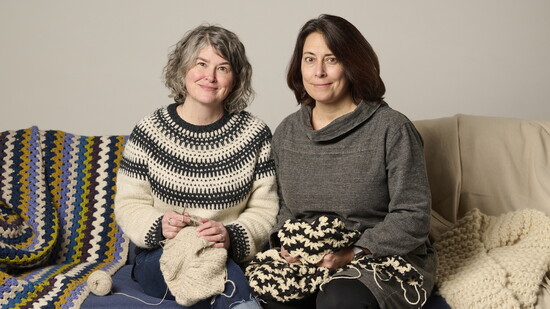
There is something wonderfully Maine about helping without making a big production of it. You bring a casserole to a neighbor who’s having a hard week. You shovel the walkway before anyone asks. You know someone who knows someone who can fix the thing that needs fixing. And if you happen to know how to knit, sew, quilt, crochet, embroider, or otherwise make something with your hands? Well, you might just finish a stranger’s sweater.
That last one is the idea behind Loose Ends, the organization co-founded by Falmouth-based Masey Kaplan that connects unfinished textile projects with skilled volunteers who can complete them. What began as a simple act between friends has grown into an international network of some 40,000 finishers, with crafters participating from 83 countries.
Loose Ends was born during the pandemic, when a friend’s mother died and Kaplan finished the woman’s sweater. The experience stayed with her—not simply because she was able to complete something meaningful, but because of how good it felt to give in such a tangible way. “I remember just thinking, ‘This has to happen more,’” she says. “How do we get this to happen more for people, on both sides?”
The idea eventually became Loose Ends. Today, a person with an unfinished handmade project can submit it to the organization, which works to find someone with the skills to finish it. The work might take an hour, or it might take hundreds. Some projects have required more than 1,000 hours of handwork.
And while the obvious beneficiary is the person who gets to finally use or wear something their loved one began, Kaplan believes the finisher receives something, too. Handwork, after all, is as much about the process as the finished product. There is something meditative about moving yarn through your fingers, pulling a needle through fabric or watching a pattern slowly emerge. “It feels good,” Kaplan says. “And it kind of makes you meditate, even if you don't want to.”
There’s also the added satisfaction of knowing those hours are helping someone else. “To be generous to someone else is also a gift to yourself,” she says. That spirit of mutual generosity has created a community Kaplan admits she didn’t fully anticipate. Loose Ends’ original mission was centered on making matches, but as the network grew, something else happened: strangers started becoming friends.
Where projects once had to be mailed across state lines, Loose Ends can now frequently connect people close enough to meet in person. A finisher might meet a project owner at a coffee shop or library, hand over the completed work, and then keep in touch. Some finishers have even gone on to teach the people they helped how to knit, sew, or otherwise work with their hands.
A 15,000-person private Facebook group is the online gathering place where finishers troubleshoot together, swapping advice about unfamiliar stitches, patterns and yarns. Kaplan calls it a “beautiful little oasis” on social media. Loose Ends is also, in Kaplan’s words, “very introvert friendly.” Volunteering doesn’t require a crowded event, a committee meeting, or even much small talk. You can help someone simply by sitting in your living room and doing something you already love.
This quieter form of connection feels especially reflective of the place Kaplan calls home. She has lived in Maine for 30 years and is quick to point out that, technically, she isn’t a Mainer—she wasn’t born here. But she has spent enough time here to recognize something she considers essential to the state’s character: a tendency to look after one another. “I do think Mainers are generous and take care of each other,” she says. “You hear about someone in need and the community will address that.”
Maine’s unusually vibrant textile and craft community doesn’t hurt, either. Kaplan remembers using Peace Fleece yarn as a teenager and points to the many designers, makers, and fiber artists who have roots in the state. Though Loose Ends is an international organization, its staff and board have been Maine-based, and Kaplan says the organization carries a distinctly “Mainey” vibe.
At its heart, that vibe is less about crafting than it is about caring. “It is rare that we see anything other than kindness here,” Kaplan says of Loose Ends. “People really do want to care for each other. We're just a mechanism through which people can be kind.”
Sometimes, that kindness crosses lines that seem otherwise impossible to cross. Kaplan’s favorite part of the organization is watching people connect who might never have met otherwise—people who could have very different politics, beliefs, or backgrounds, but who can still sit across from each other and share a very human experience. One person has lost someone, another has the time and skill to help.
Kaplan describes Loose Ends’ contribution to the world as “bonus love.” It isn’t solving every problem or addressing the most urgent crises facing society. It’s something smaller and more attainable: one person giving a little of themselves to another. “I've loved being part of this system that creates more love in the world,” Kaplan says. “That's just been a gift.”
Loose Ends reminds us that not everything has to be completed perfectly, or even by the person who started it. Sometimes we get to leave something behind. Sometimes someone else picks it up. And sometimes, in the simple act of continuing where another person left off, we discover that generosity has a way of stitching people together.
Learn more about Loose Ends, become a finisher, or submit a project at looseends.org.
"To be generous to someone else is also a gift to yourself."
"People really do want to care for each other. We're just a mechanism through which people can be kind."