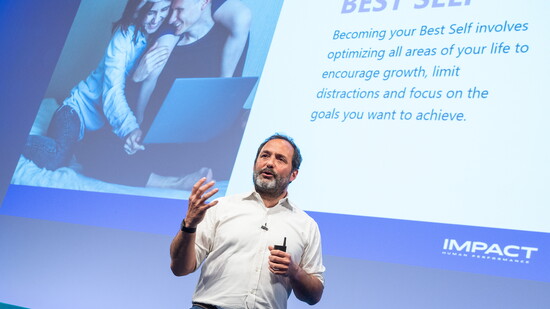
Westporter Nick Propper began his career in consulting, where he saw firsthand just how quickly that kind of work can burn out the people who do it. That observation eventually led him out of consulting and into the human performance world and, now, to writing his first book, Stressed Self to Best Self (Wiley, October 13), which he co-wrote with his business partner Kevin Kachin. Nick sat down with Westport Lifestyle to talk about the book and what inspired them to write it.
Westport Lifestyle: Tell us about your background.
Nick Propper: My first career was in consulting at a global professional-services firm, first in the UK, then running businesses across Europe, and eventually leading a global division, which is what brought my family to Westport. Those businesses run on high individual billing targets to meet the revenue goals, and I saw firsthand how quickly this utilization pressure could wear our people down. You'd look at the business and think: we've got the right people, the right skills, the right headcount to hit our targets. But if everyone's operating at 70 percent because they're so squashed by stress, you've got an invisible problem that you can't quite put your finger on.
That question sent me looking for ways to actually support the humans inside these organizations. I found a company doing really interesting work in energy-management training, brought them in to train our people, and got so drawn to what they did that I eventually left consulting to join them. When that company was later acquired, and its training work folded into an internal-only program, my now-business partner and I felt the work still needed to be in the market. We launched Impact Human Performance in January 2021 — right as COVID hit, which turned out to be more of an accelerant than the bad timing it looked like. Almost overnight, this kind of training went from a "nice to have" to something organizations felt they urgently needed.
WL: How did writing a book come about?
NP: After nearly every training session we did, whether in the corporate, military, or government environment, someone would ask if we had a book, because they wanted to hand it to a spouse, a friend, a kid away at college—people who'd never otherwise get access to the material. About eighteen months ago, my business partner and I decided it was time. Everyone who now goes through our training gets a copy, so it's become a way for people to keep working the material long after the session ends. And now people outside of organizations we work with will be able to access our content.
WL: Without giving too much away, what can readers expect from the book?
NP: There are really four parts to our system. The first is reconnecting people to what their best self actually looks like: the emotions, behaviors, and characteristics they need more consistent access to in order to maximize their personal and professional performance. It sounds obvious, but most people haven't slowed down enough to actually answer that question. Once you know what you're aiming for, you can see the gap between that and where you are today, creating a nice linear approach.
From there, we work on three things that tend to separate people from their best selves: a limited skillset around emotional regulation, ‘coping’ with stress rather than ‘managing it’, and a lack of intentional recovery. Intentional recovery is the piece most people get wrong. It doesn't have to mean a weekend or a vacation. It can happen in bite-sized chunks, even 30 to 60 seconds at a time, in the middle of a busy day. That oscillation between stress and recovery is really the research-backed foundation of how people build resilience.
We have also filled the book with real stories we've collected from the thousands of people we've trained over the years, which helps visualize the practical application of the content.
WL: This is our Thankful issue. Does gratitude play a role in what you teach?
NP: It does, and we teach it a little differently. The usual advice is to list two or three things you're grateful for in the moment, and there's good science behind that. But gratitude is really an emotion, not a list. Instead, we have people recall a specific memory of a time someone showed real gratitude toward them for something they did, and replay that memory until they can actually feel that emotion again. When you're stressed, your brain is sending what we call a danger signal. Replaying a memory like that sends a safety signal instead, and it's one of the most effective ways to downregulate the nervous system.
WL: On a personal note, after five years building this company, and now writing this book, what are you grateful for?
NP: Getting to be in these rooms with people, and now, with the book, getting to reach even more of them. If we can give people something practical that helps them be at their best for the people and things that matter to them, that’s what it's all about.
This interview has been edited and condensed.
To learn more about Stressed Self to Best Self or buy the book, visit amazon.com