Since photography was invented, images have existed as physical objects. Daguerreotypes, tintypes, film, paper. They lived on walls, in dusty frames, attics, and antique stores—fragments of history, sometimes the only physical reminder of a life lived.
Digital photography revolutionized how people hold onto their memories. While our days are now extensively documented, most of those images never leave a screen—a shared album, an Instagram story, a Facebook post. We rarely see our memories in the physical world.
“Photos today live in our phones,” Maria Mayer Feng, founder of Studio Maria Mayer Feng, tells us. “They’re everywhere—and nowhere. We carry thousands of images in our pockets, but they’re not accessible. They’re locked in devices behind passwords and on clouds.”
Maria has built her career around solving this problem: transforming digital ephemera and long-forgotten physical artifacts into exquisite, tangible heirloom books designed as works of art that families can hold, share, and pass down for generations.
Born in Romania to German parents, Maria moved back to Germany with her family during Nicolae Ceaușescu’s regime. There, she later trained as a social worker—but even then, she found herself drawn less to clinical practice and more interested in her patients’ stories.
We’re chatting with Maria in her newly renovated studio. It’s bright, cozy, and inviting. A large worktable anchors the room. There’s a fire warming the space. Maria’s studio samples—books of varying sizes, textures, and subjects—are displayed throughout, beckoning visitors to open them and discover the stories within.
In 2001, Maria moved to New York City on a scholarship to study documentary photography at the International Center of Photography. But even then, it was the storytelling—not the image alone—that pulled her in.
“There’s a certain nostalgia in storytelling,” she says. “A desire to hold on to the past and tell the story back. I always say, ‘Your life is how you remember it.’ I thought that was just poetic, but later I realized it’s actually rooted in neuroscience.”
She explains how learning about the experiencing self and the remembering self shaped her thinking. One lives through moments as they happen; the other one stores these moments as memories.
“That made me think: why don’t we make sure we keep those memories beautifully?”
This idea became the foundation of Maria’s work. After finishing school, she stayed in New York and crafted her first book, which was hand-cut and hand-bound. Two decades later, she no longer makes the books herself, but her standards remain exacting.
“Years ago, I was fired by my original bindery for being too picky,” she says, smiling. “They told me I demanded too much perfection. But that pushed me into a higher tier of craftsmanship. Now I work exclusively with a small, dedicated unit at a West Coast bindery. They source paper, print, bind, test unusual fabrics, and execute very complex ideas.”
As the studio has grown, so has her team—a deliberately small circle of four women supporting everything from production to client experience and communications. Katherine Ryan, who joined Maria straight out of college, now designs books. Monica Trica, based in Romania, handles all retouching. Local Ridgefield mom Isabell Kossman helps manage the studio while assisting with production tasks.
Maria also partners with Nour Seikaly, founder of Grey House, who leads the studio’s public relations.
Each heirloom-quality book that the studio produces tells a different story: milestone birthdays, weddings, family vacations, family histories. Maria’s clientele ranges from local families to celebrities, politicians, athletes, and Fortune 500 companies.
“There’s something very personal about handling people’s lives this way,” Maria says. “I truly marvel at the trust these families put into me and what’s most important is that I honor that trust. Often, one person in a family has a box of photos and documents no one else has ever seen. The book becomes a way of sharing that history and of making sure it doesn’t disappear.”
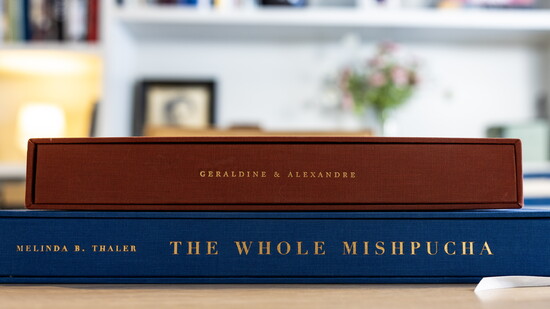
One such project, The Whole Mishpucha, chronicles a Jewish family’s history across three volumes and took more than a decade to complete. The books contain photographs, identity papers, letters, and other materials tracing the family’s immigration to the United States in the years leading up to and throughout the Holocaust.
For another project, Maria created a book of love letters exchanged between a husband and wife throughout their 25 years of marriage. Rather than scanning them flat, she photographed each letter so the folds, torn edges, and patina of time remained intact.
“I love photographing three-dimensional objects instead of scanning them—handwritten notes, fabric, kids’ artwork,” she says. “I want the book to feel tactile, like you could lift something right off the page.”
While these extraordinary projects are deeply meaningful, Maria tells us her favorite books to work on are annual family books.
“The years go by so fast,” she says. “When you have kids, you’re just surviving day to day. Having a book for each year, or every five years, lets you look back and realize how much actually happened. How much you did.”
Maria gets to know the families she works with intimately through annual books, watching children grow and marking life’s milestones. Sometimes she works retrospectively, creating volumes that span from infancy to college graduation in a single project. Distilling a whole life into books that can sit on a shelf is, she says, endlessly rewarding.
“When I finish a large family book project, I often feel a kind of mourning,” she says. “I’ve lived inside someone else’s world for months or years, poured my heart into it, and then suddenly I have to ship it away.”
But like a parent refusing to choose a favorite child, Maria is quick to add that she also loves creating travel books.
“Travel books sometimes bring me into worlds I’ll never see myself,” she says. “I’ve worked on books about places like Papua New Guinea, where someone walked for days to reach a remote village and lived among people most of us will never meet. Those projects feel almost unreal, like stepping into another century. And then there are luxury trips I could only dream of. In a strange way, when I make those books, it almost feels like I’ve been there myself.”
A defining element of Maria’s work is how she integrates tactile objects into the books. Wedding invitations, vintage postcards, handwritten notes, children’s artwork, and other memorabilia are all carefully considered, each piece treated as a meaningful artifact, part of the larger story.
She creates precise homes for these keepsakes: tiny holders for a child’s art project, pressed flowers delicately taped onto a page, custom spaces designed to cradle a wedding invitation or a vintage postcard. But she’s careful not to let the book become overwrought. Every inclusion is intentional.
For the covers, Maria often works with custom fabrics, primarily linen, collaborating with clients to select the perfect swatch. When possible, she designs the cover to mirror the story inside: snow-white textures for an Antarctica expedition, supple leather for a company rooted in craft. Unexpected materials that communicate the essence of the story before the book is even opened.
Maria’s devotion to her craft and her clients, the way she distills each story to its essence, is what elevates her work from photo books into family heirlooms.
For many clients, the most difficult part is editing: sifting through tens of thousands of digital photos, boxes of artwork, and physical memorabilia. Maria and her team shepherd them through the process, sometimes reproducing materials as they are, other times transforming them, rewriting a letter by hand, re-photographing an object so it feels dimensional.
“What people sometimes forget is that this work is deeply emotional,” she says. “I’m not just arranging photos, I’m reading between the lines. I notice when one child fades into the background. I notice imbalance. And quietly, subtly, through design, I correct it.”
From start to finish, a typical book takes about six to eight weeks. More complex projects, especially family histories or books involving memorabilia, take much longer. Projects are billed hourly with books starting at $4,000. Pricing is dependent on the material of the book, the volume of content, and the scope of the project.
“Many of the books we make are gifts,” Maria says. “When clients give them, I often hear back immediately. The responses are overwhelming. That’s when I’m reminded this isn’t really about books at all. It’s about memory—helping people remember their lives with clarity, beauty, and care.”
In an era where our most meaningful moments are endlessly captured yet rarely revisited, Maria’s work offers something quietly radical: a way back. Back to the vacation. Back to the era. Back to remembering. Not alone, but together.
“Memory is shaped by context,” Maria says. “We remember the same event differently depending on who we’re remembering it with. Books give people a way to return to those memories together, sitting at a table, pouring over the pages, having conversations that would never happen the same way scrolling on a phone.”
This philosophy, paired with Maria’s uncanny ability to find a story’s thread and weave it into its most resonant form, is her gift. She brings photographs back into people’s lives not as pixels in the cloud, but as something tangible, something to be cherished. Something that, long after we’re gone, may rest in someone else’s attic as a fragment of history. Proof that we were here. That we loved. That our lives mattered. That is Maria’s legacy.
“Memory is shaped by context. We remember the same event differently depending on who we’re remembering it with. Books give people a way to return to those memories together.”—Maria Mayer Feng