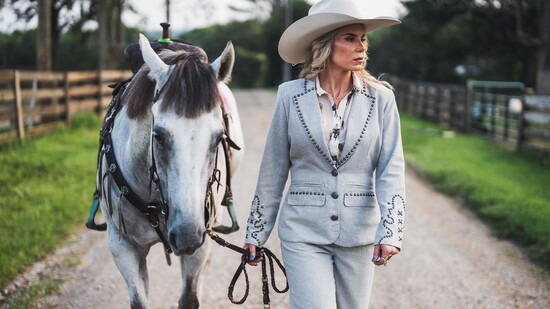
When most people think of "style," they picture clothing, trends or personal taste. But sometimes style has less to do with what's hanging in a closet and more to do with how someone chooses to live.
For Dr. Martha George, orthopedic surgeon with Tennessee Orthopaedic Alliance (TOA), style is found in early mornings spent in prayer, weekends at the rodeo, long rides through the mountains of Montana, and the quiet determination to help every patient return to the life they love. It's woven into the compassion she brings to the operating room, the grit she learned as a collegiate athlete, and the resilience she's cultivated as a wife, mother and barrel racer.
Sure, she'd be the first to admit that her wardrobe has taken on "a western or equestrian flair" over the last several years. But anyone who spends a few minutes talking with George quickly realizes her greatest trademark isn't cowboy boots - it's perseverance.
That resilience has shaped nearly every chapter of her life. George credits motherhood with making her a more compassionate physician, reminding her that every patient who walks into her office is someone's spouse, parent, child or friend.
"Being a mom has definitely inspired me to be a more compassionate person," she says. "I want my patients to know I truly care and want the best outcome for them."
Outside the hospital, horses have become another unexpected teacher.
"Barrel racing and owning horses has taught me resiliency and dedication," George says. "I am incredibly dedicated to my patients and feel the same about the animals and sport I love so much."
Those experiences have shaped not only who she is, but how she practices medicine.
Long before she became an orthopedic surgeon, George understood what it meant to compete, to work toward a goal and to push through setbacks. As a collegiate softball player at Auburn University, she experienced firsthand the discipline, sacrifice and teamwork that athletics demand. Today, those lessons continue to influence the conversations she has with patients recovering from injury.
She doesn't simply see an MRI or a surgical repair. She sees someone eager to get back on the field, back on the horse, back to work or simply back to being themselves.
"I truly believe that time as a collegiate athlete taught me to never give up," she says. "Now as an orthopedic surgeon, I know I can work through whatever comes my way, and I encourage my patients to do the same."
That philosophy was reinforced during one of the most formative experiences of her career: training under renowned sports medicine pioneer Dr. James Andrews. During her fellowship, George wasn't simply observing one of the most respected orthopedic surgeons in the country. She traveled with him to Auburn football games, covered the sidelines and worked alongside him in clinic, witnessing firsthand the level of preparation and commitment required to care for elite athletes.
"I was one of the last fellows who truly got to operate with him and travel to college football games," she recalls. "It was a lot of work, but it taught me that's what it takes to be good at what you love."
The lesson extended far beyond the operating room. Excellence, she learned, isn't accidental. It's built through consistency, humility and countless hours of preparation - principles she still carries into every surgery and every aspect of her life.
Those same qualities have helped her build meaningful relationships within another athletic community: rodeo.
While many orthopedic surgeons spend their weekends on golf courses or at the lake, George can often be found at barrel races alongside her husband and daughters. Living that lifestyle has given her an appreciation for athletes whose toughness is often underestimated.
"Man, they are tough," she says with a laugh. "They will battle through major injuries just to get back on the horse or the bull. I love their heart for their sport and the mental toughness they have."
Because she's part of that world herself, George understands something many people don't: getting back in the saddle isn't simply about returning to competition. For many riders, it's returning to a way of life, a community and a passion that's become part of their identity.
That perspective influences the way she approaches every patient - not just professional athletes.
Sports medicine is often associated with championship games and highlight reels, but George says the victories she remembers most rarely happen under stadium lights. They're found in everyday moments that become extraordinary after months of recovery: A father throwing a baseball with his daughter for the first time after surgery. A mother picking up her toddler without pain. A patient returning to the golf course, the garden or simply taking a walk without thinking about every step.
"I often hear, 'I just want to throw a baseball or football with my son or daughter,'" George says. "Then they come back after surgery and tell me, 'I threw today with no pain.' That is so incredibly rewarding because those little things bring them so much joy."
Ask George what success looks like, and it isn't measured in trophies or statistics. It's measured in restored moments - small victories that allow people to return to the lives they've been missing.
Her own journey hasn't been without challenges.
Orthopedic surgery remains one of medicine's most male-dominated specialties, and George is refreshingly honest about what it took to earn her place.
"It was tough," she says. "You had to work ten times harder and try not to make any mistakes."
Rather than allowing those obstacles to discourage her, she used them as motivation.
Today, her advice to young women considering medicine is simple: "Don't give up. Don't let someone tell you that you can't do it. If it's something you want to do, do it."
Then she shares the personal motto that's guided her through some of life's biggest challenges: "Doubt me… then watch me."
That determination extends well beyond her career. Ask George what resilience means, and she doesn't hesitate.
"Never giving up," she says. "Push through no matter what. If it is important to you then it is always worth doing even if it is tough or scary."
It's why one quote has stayed with her over the years: John Wayne's reminder that "Courage is being scared to death and saddling up anyway."
Despite the demanding schedule that comes with surgery, family and rodeo, George has learned the importance of slowing down.
For her, that place is Montana. The mountains. The horses. Endless trails winding through national forests beneath what she affectionately calls the "big sky." She and her husband often dream about loading up their horses and trailer, disappearing into the landscape and riding wherever the trail leads.
"God's paintbrush is so amazing," she says. "It feels like He made it just for me."
That same sense of peace begins each morning long before the sun rises. Before surgeries. Before emails. Before patients. Before family life begins moving at full speed.
"My time alone with God is what fills my cup," George says. "It is what I have to have to power through my day." Then she laughs before adding, "I want the devil to say, 'Oh no, she's up,' when my feet hit the ground in the morning."
If patients knew only one thing before walking into her office, George hopes it's this:
"I love big, but I am also a straight shooter. I am not going to put up with crap, but if they want to get better, I am here to help make that happen and I will give it all I've got."
For someone whose life spans operating rooms, rodeo arenas, softball fields and mountain trails, that philosophy feels fitting.
Style isn't always found in what someone wears. Sometimes it's found in the way they care for others. In the grit to keep showing up when the work is hard. In the courage to embrace challenges that others might shy away from. And in the compassion to remember that every repaired shoulder, every reconstructed knee and every successful surgery is ultimately about something much bigger than medicine.
For Dr. Martha George, style is resilience in action - and it's a look that never goes out of fashion.