When Wanda Sobieski was in high school, the entire section on women’s history in her textbook consisted of one sentence: In 1920, Congress gave women the right to vote.
“Which was not true! It came as a result of a 72-year battle,” Sobieski explains. “Years later, I was horrified to realize we had no idea what had made such an important change in the whole voting system in our country. The 19th Amendment is an enormously important story because it was the single biggest social-political change in the history of the country—and it was non-violent. We more than doubled the electorate. A century later, most of the story is already forgotten.”
There’s so much to this story that the cause of faithfully archiving, celebrating and honoring this monumental era in women’s history has become a lifetime crusading passion for Sobieski. The first female partner in the hundred-year history of the law firm Baker, Worthington, Crossley, Stansberry & Woolf (now Baker Donelson), she later founded Sobieski, Messer & Associates. She and her husband, UT College of Law Professor Emeritus John Sobieski (former Associate Dean and Acting Dean of the Law School) have three children and five grandchildren.
While building her legal career and raising a family, Sobieski founded the nonprofit Suffrage Coalition in 1995 to locate and preserve the history of the local suffrage movement. Their work keeps the stories of sacrifice and triumph alive through projects like The Tennessee Woman Suffrage Memorial, honoring three Tennessee suffrage leaders, and the Burn Memorial, honoring legislator Harry T. Burn and his mother, Febb Burn.
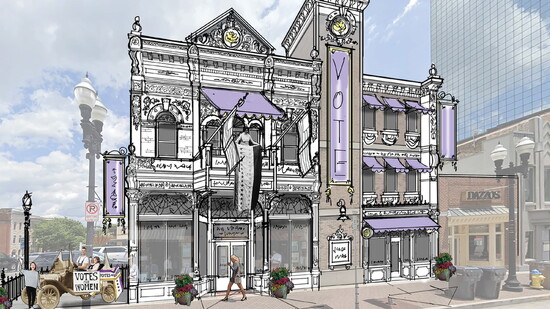
The crown jewel of the Suffrage Coalition, Inc., the Women’s Suffrage Museum Event and Cultural Center, scheduled for opening in 2028, is a place where history, education and inspiration come together. The more than 20,000-square-foot cultural landmark in downtown Knoxville will be the largest institution in the country devoted exclusively to the women’s suffrage movement. Exhibits will include immersive galleries, educational programming and more than 1,000 historic artifacts from Sobieski’s renowned collection, many of which will be displayed publicly for the first time.
How difficult has it been engaging public support and interest?
“Over the years, people have been very interested, but the most common reaction has been ‘surprise’ over the fact Tennessee was the state that finally put suffrage over the top and unfamiliarity with the backstory. I was appointed to serve on the Governor’s Tennessee State Commission to celebrate the 75th anniversary of suffrage in 1995. I realized very quickly that, in spite of the fact Tennessee had this rich, important place in the history of suffrage, nobody knew it. There were no statues, memorials or plaques that I or any of our representatives could find anywhere in the state honoring the leadership of Tennessee women. I was flabbergasted. Memorials can keep events from completely dying out, even if those events fall out of the public eye. I was determined that we needed statues, preferably all across the state.
Being on the Commission frustrated me as I discovered another pervasive problem. Suffrage had never been a significant part of the school curriculum anywhere. That means in one generation you lose the history. People my mother’s age didn’t know much about it because the campaign happened a generation before. I thought going to law school and understanding our government better, and how laws are made, would help me with other issues women were still facing. Suffrage didn’t solve everything.”
What was happening leading up to Tennessee’s historic vote?
“When the 19th Amendment came out of Congress in 1919 and went to the states for ratification, northern and western suffragists were the engine of the movement. At first, they rushed to ratify, but then it started to fail in states they had counted on. Movement leaders realized the South would make or break the amendment. The suffragists needed 36 states to ratify the amendment. When they got to 35, it looked like they might not be able to ratify it without winning at least one more former Confederate state. During Reconstruction, black men were given the right to vote, but black women, just like white women, could not, and racist backlash emerged against the suffrage case, especially in the South.
I am not native born, but I have a special place in my heart for the Southern women, both black and white, who, in a climate that was much more difficult, stood up for what they believed to be right. The Suffrage Coalition’s memorial statue in Market Square has three women who lived in and did their work in Tennessee and prevailed against what was clearly very controversial. I thought it was critical that people understood what an amazing accomplishment it was, and get to know some of the women who worked at their own peril to ensure the right to vote for women.”
Febb Burn’s letter to her son feels like a “hand that rocks the cradle” moment.
“One Suffrage Coalition project was digitizing the papers of Harry Burn, the 24-year-old East Tennessee representative whose vote changed history, for the McClung Collection. The Tennessee House of Representatives was split as the ratification vote was set for August 18, 1920. Febb Burn was against her son being a politician. When he went to the state house in Nashville, she said she didn’t want to influence him or get in the middle of issues with neighbors. But when she read in the newspaper what Senator Candler had said about the suffrage movement in the special session’s debate, it so upset her that the night before the vote, she broke her own rule and wrote Harry a letter. It was mailed from the train station in Niota that night and delivered to him the next morning—the day of the historic vote.
The letter was seven pages long and kind of breezy. They were farmers, so she talked about the weather, the family, the neighbors, and then she dropped in lines to push him toward suffrage. Ultimately, it’s very Southern. She makes it clear she wants her son to be ‘a good boy’ and vote for suffrage … closing, ‘With lots of love, Mama.’
After he got her letter, her son, wearing the symbol of the anti-suffragists, switched his vote, broke the tie and gave the 19th Amendment the 36th state it needed. Everybody was shocked that he changed his vote. The opposition tried to charge him with bribery. When asked to answer charges, he pulled out his mother’s letter and told them that he found it best to follow his mother’s advice.
It was important to me that the whole Harry Burn’s story never get lost again and that’s why we put the Burn memorial up to pique people’s interest to discover what an amazing final chapter was written to the suffrage story in Tennessee.”
What artifacts will the Women’s Suffrage Museum house to commemorate events?
“Over 1,000 artifacts in our collection are stored securely until the museum is built, with special thanks to East Tennessee History Center’s staff who have advised me over the years on storage protocol. A lot of the artifacts are fabric and paper and particularly fragile.
I am especially excited about exhibiting two guest chairs from Harry Burn’s office and one chair from his reception area. We have original handwritten letters of Susan B. Anthony and letters signed by Elizabeth Cady Stanton, Carrie Chapman Catt and others. We have a set of books that are personally moving to me from a six-volume set chronicling the history of suffrage from the Seneca Falls convention in 1848 up until passage of the 19th Amendment. The first four volumes were written by Anthony and Stanton and after they had passed away, the last two completed by a close associate. I have the first four in a leather-bound set donated to the City College of Rochester, New York, where Anthony lived and also won a campaign for women to attend the college. Our set contains a full-page inscription for each of the four volumes, handwritten and signed by Anthony. That’s a treasure!”
Do you see the museum as part of educational tourism?
“Absolutely. By joining the two buildings at South Gay–706 (9,000 square feet) and 708 (14,000 square feet), and adding 2,000 square feet onto 706 to square the floors up, we’ll have the largest suffrage museum in the country. It gives us the opportunity to tell the story much deeper than any place else. The concept model is fabulous. We brought in a world-renowned architect as designer [Bob Fleming, creative conceptual designer and master planner]who will associate with a local team to deal with local issues. We hope construction starts early in 2027, opening spring of 2028.”
What is the Perfect 36 Circle?
“We started Perfect 36 Circle to help identify serious supporters who wanted to know more about the suffrage story and lend their talents and resources to our projects. The cost of membership is $36 a year, $1 for each of the “Perfect 36” states. Upon renewal, supporters get advance information and newsletters to keep abreast of progress. Even if they can’t afford to be in donor circles, supporters still have a way to be part of what we are doing.”
What is an overarching message from the Suffrage Coalition?
“Not understanding the history makes it easier for people to ignore the rights of women. The bias had been to tell history from the viewpoint of kings, generals and presidents. And there’s so much more to history than that. The common people’s history helps shape history because it shapes how we think about things.
Because of our Coalition, Tennessee law now requires that all fifth graders are taught the Harry Burn story. Now more people will know there was controversy and a time when it looked like suffrage would be defeated in Tennessee—until a young man from East Tennessee did the right thing and brought our country much closer to a full democracy.
We can inspire future generations, connecting to modern conversations about civic engagement. It’s our story about what a difference one vote can make and how crucial being informed, exercising your right to vote and participating in the system is for everyone.”
To learn more, visit WomensSuffrageMuseum.org.
“This story, born in East Tennessee, about a mother’s courage, a son’s conscience, and the power of one individual to change the course of history, belongs to the world.” –Wanda Sobieski.