In 2000, Master Chin Sonu first brought taekwondo into mission work. The trip was a short-term church mission to a small town called Chinle, about four hours from Tijuana. He had been a software engineer for a decade and teaching taekwondo on his nights and weekends nearly as long. On the trip he assisted an older taekwondo master through a week of classes for the village children. The rest of the time was service work. He came home and stayed at the day job nine more years. But what he experienced in Mexico stayed with him. It marked him deeply, and he hoped one day he'd be able to make a greater impact.
Then 2009 came, and the mortgage crisis took the engineering job with it. "I was praying and I was fasting and I was asking God what should be my next chapter," Master Chin says. "There's nothing wrong with being a software engineer at a semiconductor company. But I wanted to do something more meaningful." He had been teaching college students at his church and helping at a local studio. He decided to put his full weight behind it. The next year he signed a lease on a two-thousand-square-foot bay in a strip mall on West El Camino Real. He called it Taekwon Kids.
Opening day, the line wrapped out the door. Staff took names and credit cards by hand, twenty or thirty minutes a signup, and Master Chin still could not get to everyone, it was so packed. He partly credits a line he kept from business school: if you have to explain what you do, you are already losing.
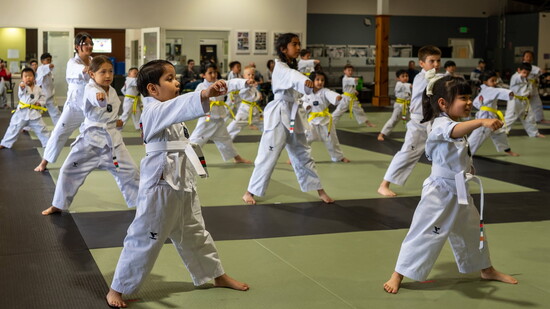
By about 2014 the studio had moved into six thousand square feet. Today it occupies roughly seventeen thousand at 2124 West El Camino Real, the storefront still visible from a busy stretch of road. Three mat-covered training rooms hold classes for children starting at age four, judo and archery alongside taekwondo, and a coaching bench that has included Olympic judokas and a world-champion archer.
Around the school, Master Chin built a nonprofit. He named it TAM, short for Taekwondo Alliance for Mission. TAM runs an Adaptive Martial Arts program for students with intellectual and physical disabilities. It funds taekwondo programs in ten countries: Madagascar, Tajikistan, Thailand, Kyrgyzstan, Jordan, South Korea, Indonesia, Tanzania, the United Kingdom, and Côte d'Ivoire. Its teams have served in Africa, South America, Southeast Asia, and the Middle East.
Master Chin compares Taekwon Kids and TAM to McDonald's and the Ronald McDonald House Foundation: the business pays for the foundation, and the two share the same building.
On Sundays the dojang transforms. Three congregations meet in the rooms where children kick and bow during the week. By Monday morning the rooms smell of new uniforms.
Children at Taekwon Kids start at four years old, in white doboks with the sleeves rolled at the wrists. They learn what taekwondo students have always learned. The bow comes at the start of class and at the end. They count to ten in Korean, beginning hana, dul, set. They learn how to fall. They are not told that part of their belt fees crosses an ocean. Master Chin says they tend to find out anyway. They ask why the school sends teams to Tanzania. They get the answer from their teachers and from each other.
Tonight a child in Tanzania will bow at the start of her class. Tomorrow a child in Mountain View will do the same. Both bows trace back to a strip mall on West El Camino Real.