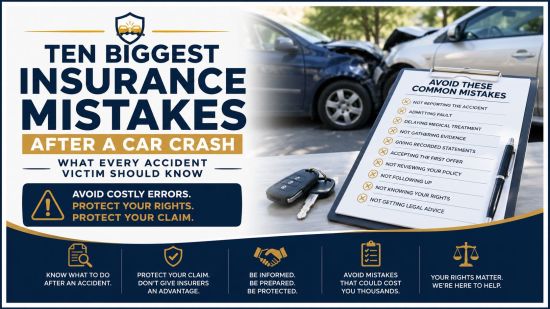
A car accident can turn your life upside down in a matter of seconds. Between vehicle damage, medical treatment, missed work, and insurance paperwork, it is easy to make mistakes that can affect both your health and your financial recovery.
Most people involved in an accident have little experience dealing with insurance claims. Insurance companies handle thousands of claims every year.
This guide discusses ten of the most common mistakes accident victims make and how you can avoid them.
Mistake #1: Failing to Report the Accident Promptly
Many people assume that if the accident appears minor, there is no need to notify their insurance company.
However, delays in reporting an accident can create problems, including:
Difficulty investigating the collision
Questions regarding injuries
Potential coverage disputes
What to Do Instead: Notify your insurance company as soon as reasonably possible and cooperate with reasonable requests for information.
Mistake #2: Saying "I'm Fine" Too Soon
Immediately after an accident, adrenaline can mask pain and symptoms.
Many accident victims tell police officers, insurance adjusters, or others that they are "fine," only to discover hours or days later that they have significant injuries.
What to Do Instead: If you are unsure about your condition, simply state that you have not yet been fully evaluated and do not know the full extent of your injuries.
Mistake #3: Delaying Medical Treatment
One of the biggest mistakes accident victims make is waiting too long to seek medical attention.
Delays can:
Worsen injuries
Slow recovery
Create questions about whether the injuries were caused by the accident
What to Do Instead: Seek medical evaluation whenever symptoms develop or if you have concerns regarding your condition.
Mistake #4: Failing to Follow Medical Advice
Insurance companies often review treatment records closely.
Missed appointments, treatment gaps, and failure to follow medical recommendations may be used to argue that injuries were not serious.
What to Do Instead: Attend appointments, follow treatment recommendations, and keep records of your care.
Mistake #5: Giving a Recorded Statement Without Careful Consideration
Soon after an accident, an insurance adjuster may ask for a recorded statement.
Because injuries and symptoms may evolve over time, statements given too early can later be used to challenge portions of your claim.
What to Do Instead: Be thoughtful, accurate, and complete when providing information regarding the accident and your injuries.
Mistake #6: Accepting the First Settlement Offer
Many people are surprised by how quickly settlement offers may be made.
The problem is that early in the process you may not yet know:
Whether additional treatment will be needed
Whether surgery may be required
Whether permanent injuries exist
The full extent of lost income
What to Do Instead: Understand your injuries, treatment needs, and financial losses before resolving your claim.
Mistake #7: Posting About the Accident on Social Media
Insurance companies often investigate claims thoroughly.
Photographs, videos, comments, and posts can be taken out of context and used to challenge injury claims.
What to Do Instead: Use caution when posting on social media while an accident claim remains pending.
Mistake #8: Failing to Document Damages
Many accident victims underestimate the importance of documentation.
Important evidence may include:
Photographs of vehicle damage
Photographs of injuries
Medical bills
Prescription receipts
Lost wage information
Repair estimates
What to Do Instead: Create a file and save everything related to the accident.
Mistake #9: Assuming the Insurance Company Is Looking Out for You
Many adjusters are courteous and professional.
However, it is important to remember that an insurance company's primary responsibility is to its policyholders and shareholders.
Your interests may not always align with the insurer's interests.
What to Do Instead: Educate yourself about the claims process and make informed decisions regarding your claim.
Mistake #10: Not Understanding Available Insurance Coverage
Many accident victims focus only on the at-fault driver's insurance and overlook other potential coverages.
Depending upon the policy and circumstances, available coverages may include:
Medical payments coverage
Personal injury protection
Collision coverage
Rental reimbursement coverage
Uninsured motorist coverage
Underinsured motorist coverage
GAP coverage
What to Do Instead: Request a complete explanation of all available coverages that may apply to your situation.
Bonus Tip:
Keep a Recovery Journal
One of the most valuable things you can do after an accident is maintain a journal documenting:
Pain levels
Medical appointments
Sleep difficulties
Emotional struggles
Activities you can no longer perform
This information may help demonstrate how the accident has affected your daily life.
Quick Post-Accident Checklist
Report the accident.
Seek appropriate medical care.
Follow medical advice.
Photograph injuries and vehicle damage.
Save all receipts and records.
Keep a recovery journal.
Be careful on social media.
Understand available insurance coverages.
Review settlement offers carefully.
Make informed decisions before signing releases.
Final Thoughts
The days and weeks following a car accident can be confusing and stressful. Unfortunately, many accident victims unknowingly make mistakes that can negatively affect their health, finances, and insurance claims.
The good news is that most of these mistakes are avoidable.
By seeking prompt medical care, documenting your damages, understanding your insurance coverages, and making informed decisions throughout the claims process, you can better protect yourself and your future.
Remember: The actions you take during the first few days after a collision can have consequences that last for months—or even years.
The Law Offices of Paul A. Samakow has been helping injured individuals since 1980 in Virginia, Maryland, and Washington, D.C. Call 301-500-0000 for a free strategy session to see if you have a case and if his office can obtain full compensation for you.