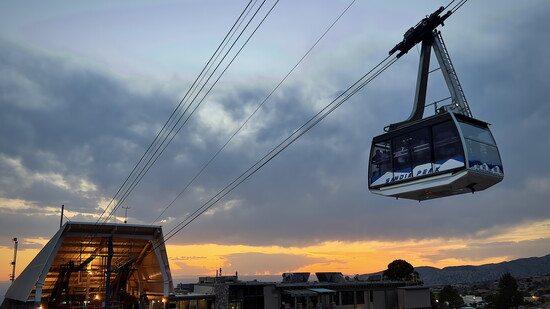
If you live in Albuquerque and have visitors from out of state, there are two things that you’re likely to show them... New Mexico ballooning and the Sandia Peak Aerial Tramway. The 2.7-mile ascent on the tramway to the 10,378-foot peak of the Sandia Mountains is a thrilling, scenic experience. This year, the tramway is celebrating its 60th anniversary. The tram has transported about 16 million visitors to the top since 1966.
Jessica Fox, the director of marketing and sales, told us about the history of the tramway. “The idea came up back in the late 1950s, and then the tram itself began construction in the early 1960s. Bob Nordhaus and Ben Abruzzo were the two masterminds of the project back then. They were adventurers and businessmen. Ben was involved in the ballooning community before the Balloon Fiesta.”
“They had a vision of something big for Albuquerque. Bob Nordhaus had the concept of connecting the ski area to the city of Albuquerque on the front side of the mountains, and he brought on Ben Abruzzo. Together they began the project of determining how they could create something that could span this distance and also be able to have limited towers because the terrain on this front side of the mountains is quite rocky, unlike the other side, which is the ski area and a little bit flatter and more passable.”
Bob Nordhaus had visited European ski lifts and tramways and was inspired to proceed with the Albuquerque project. The tram mechanism was manufactured in Switzerland.
Jessica told us, “Bob and Ben faced a lot of significant hurdles getting funding and getting approval for this process to happen, but they were adamant and dedicated to making sure that it could occur, and luckily things got signed and approved and some of the work actually began in the early 60s, and that was when they began surveying the mountain to see what would need to be done to make this happen. The engineering at that time was more limited than it is now, and what they recognized was the clear span from tower two to the top of the mountain, where there is no tower in between, which is about a 1.5-mile distance, and finding out how to connect that tower to the top of the mountain was one of the largest pieces of the engineering aspect for the tram. It was the third-largest clear span in the world at the time and remains one of the largest clear spans to this day. You go up about 4,000 feet in elevation during that 15-minute tram ride, so it's a significant climb to come up the front side of the mountains. The construction required over 5,000 helicopter trips to bring materials up the route of the tram.”
Jessica says, “We did an update in 2024, and we were closed for a few months while this occurred. The original drive and control system of the tramway was replaced, and during this closure, we also added some weather technology to our towers and the lower terminal. We also updated the cameras on our towers and both of the terminals. We brought in a new hydraulic braking system. We replaced our DC motor with a 600-horsepower AC motor, which would also be more energy efficient.”
Weather technology is very important when there is a 4,000-foot change in elevation from the bottom. Weather conditions can close the ascent. The summit can be 15-30 degrees colder than Albuquerque, so bring a jacket. The trams don’t run on a set schedule, but both the ascent and descent are a 15-minute ride and run regularly about every half-hour. Once at the summit, you can hike, ski, or dine at the TEN 3 restaurant, which offers both casual and fine dining. There is also an information center at the summit, as well as a coffee shop and souvenirs at the bottom terminal.
Another element at the tramway is the New Mexico Ski Museum, which most locals don’t know about. Jessica tells us, “At the lower terminal, we have the Ski Museum that boasts some really great historical information about the skiing history in New Mexico. I think that museum is underrated. A lot of people don't realize that's where it's located, but for any ski enthusiasts who are either from New Mexico or visiting New Mexico, I would highly encourage them to check out the Ski Museum just to learn the great history that New Mexico has for skiing.”
The website for the Sandia Peak Aerial Tramway is sandiapeak.com. You can purchase tickets there and get all the information you need for a visit.
They had a vision of something big for Albuquerque.
The construction required over 5,000 helicopter trips to bring materials up the route of the tram.