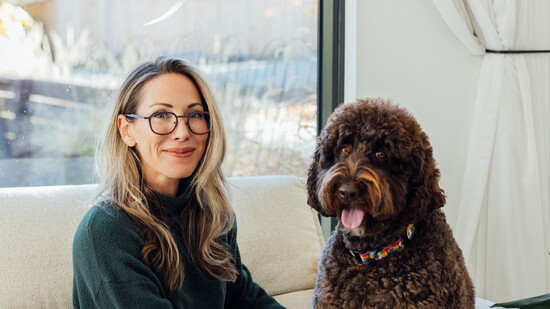
For psychotherapist Michele Goldberg, meaningful therapy begins with something deceptively simple: genuine care.
“Love is the foundation of the entire enterprise,” says Michele. “There’s a lot of work that happens when you love your client through everything.”
Michele’s path to psychotherapy began as a family law attorney, where she worked with people navigating painful transitions and futures they could no longer predict or control. Clients turned to her for a safe place to process their experiences, and she wanted to offer exactly that. But much of her work required speaking for people rather than being with them.
That realization led her to pursue a master's degree in clinical psychology and eventually establish Find Your Center, A Therapy Collective.
Early in her training, Michele believed professionalism required distance, neutrality, and restraint. Over time, she discovered that showing up as an actual person, with warmth, humor, openness, and occasional uncertainty, made the work richer and more effective.
The therapeutic relationship, she believes, isn't merely a vehicle for treatment. The relationship is part of the treatment.
That care allows clients to reveal the parts they'd rather hide and to be fully known and accepted as they actually are. They can disappoint someone, disagree, be misunderstood, or experience conflict without the relationship collapsing. Her practice's tagline captures that acceptance: Your weird is welcome.
“I don't think compassion and critique are opposites,” says Michele. “When feedback comes from genuine respect, curiosity, and faith in someone's capacity to grow, it can be one of the more powerful expressions of real care.”
Michele believes that honesty and thoughtful challenge create the trust necessary for genuine insight and change, and that includes acknowledging when she's wrong. Missteps can be repaired, and that helps clients build the capacity to maintain more resilient relationships outside therapy.
It's also why Michele expands the conversation when someone tells her therapy hasn't worked. Did they feel met with real conversation when they needed more than an echo chamber? Were they hoping for deeper exploration but got practical strategies instead?
Sometimes the fit simply isn't right. Other times, therapy offers an opportunity to practice agency: expressing one's needs directly to the therapist, living with unanswered questions, and remaining engaged when progress is slow.
This has also shaped Michele's perspective on AI. While recognizing its benefits, she has concerns about its use as a substitute for, or supplement to, therapy—particularly when people rely on it to interpret their experiences, regulate their emotions, and resolve uncomfortable questions.
An endlessly available chatbot can offer reassurance, but repeated checking may briefly relieve anxiety while strengthening the urge to seek it again. This can increase dependence on outside confirmation, limiting opportunities to learn that distress can be endured without immediate resolution.
And unlike human relationships, AI makes few demands of us. It never tires of our stories and supplies another answer if we dislike the first.
Michele sees a risk in AI's responsiveness: it may change what we expect of one another.
“AI can simulate attentiveness without asking us to practice mutuality,” says Michele. “With enough AI, a loved one's humanity can start to feel like bad customer service. I'd encourage people to consider whether they're using AI to expand their capacity to think, feel, and relate or to avoid the discomfort through which those capacities develop.”
Her approach to the holidays reflects these same ideas, especially when expectations of joy, gratitude, and family connection collide with reality.
Michele asks what people hope the holidays will provide: Connection? Belonging? Something they remember, or perhaps never had?
She recommends practicing radical acceptance: recognizing circumstances as they are rather than as we wish they would be.
Acceptance doesn't mean approving of harmful behavior. It means recognizing what we cannot control while choosing how to participate.
Michele suggests anticipating familiar dynamics and considering how you might respond, while remaining open to the possibility that things may unfold differently.
“Preparation needn't become prediction," says Michele. “You may not be able to change your mother's politics, your brother's personality, or the way your family has communicated for 40 years, but you can decide how long to stay, what conversations to participate in, and what you'll need afterward.”
Boundaries, she emphasizes, aren't necessarily about ending relationships. Sometimes they're what make continued relationships possible.
She also suggests approaching family gatherings like an anthropologist, studying familiar roles and unspoken rules with some emotional distance. Taking a brief break can help us respond thoughtfully, rather than fall into familiar patterns.
For those grieving, lonely, or disappointed, Michele cautions against forced positivity. Painful holidays don't need to be redeemed, but people can choose to make the season their own, whether that's through new traditions, chosen family, or simply a quieter holiday.
“We can make room for meaningful moments without requiring the entire season to be meaningful," says Michele.
Michele's move from Los Angeles to Colorado reflected her desire for a slower life, with more room for the things she loves. Less time in traffic, more time on mountains, and a neighborhood where children might stop by unannounced to jump on her trampoline—which they do.
In a community devoted to self-improvement, Michele counters that growth doesn't always mean becoming a more optimized version of ourselves.
Sometimes it means learning to inhabit our lives more fully, allowing the messy and uncomfortable alongside possibility and joy.
“We can remain works in progress without treating every limitation or difficult feeling as something to fix," says Michele. "And we deserve love and acceptance right now, without changing a thing.”
To learn more about Michele's practice, visit FindYourCenterTherapy.com.