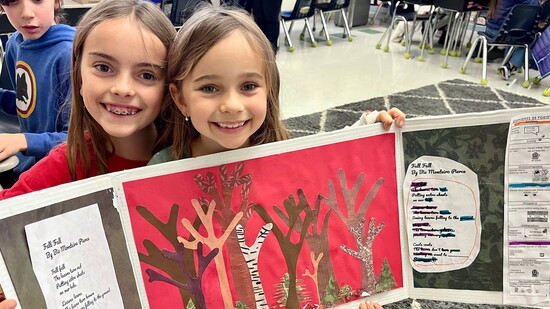
Walk into a Side x Side classroom and you're bound to find something unexpected. Maybe it's a flock of first graders elbow-deep in paper mâché, carefully sculpting birds they've spent weeks researching. It could be a group of fifth graders carving fossil stamps with the focus of professional artists. Or perhaps it's third grade students working collaboratively to create, rehearse, and perform physical theater pieces exploring and sharing their scientific understanding of frogs.
At first glance, it looks like art class. In reality, it’s so much more.
Those bird sculptures represent weeks of scientific research. The fossil carvings require students to master new vocabulary and complex concepts. The posters are lessons in history, communication, and civic engagement. Along the way, students are learning how to collaborate, solve problems, present their ideas, and trust their own voices.
In Side x Side programs like these, art is simply the vehicle. The destination is confidence, connection, and a deeper love of learning. Founded more than a decade ago in partnership with Kelly Hrenko, PhD, a professor of art education and the Associate Dean of the College of Arts, Humanities, and Social Sciences at the University of Southern Maine (USM), the Maine-based nonprofit pairs professional teaching artists with classroom educators to bring arts-integrated learning into schools across the state. Since its founding, Side x Side has reached more than 19,000 students, trained dozens of teaching artists, and partnered with hundreds of classroom teachers. Its roots began with one simple observation: not every child learns the same way.
"I was shocked and sort of heartbroken," recalls Executive Director Beth Wilbur Van Mierlo. "I saw kids that weren't engaging no matter what the teachers did. When we started bringing artists into classrooms, what we noticed right away was that all the kids started engaging."
That observation eventually led to a groundbreaking federal grant that allowed Side x Side to expand arts-integrated programming throughout Portland's elementary schools. Rather than treating art as a separate subject, Side x Side weaves creativity directly into classroom learning, turning science, literacy, history, and math lessons into hands-on experiences.
In one recent project at Talbot Elementary, first-grade students studied birds as part of their literacy and science curriculum. They researched species, completed scientific drawings, wrote reports and riddles, and ultimately created detailed paper mâché bird sculptures. For first-grade teacher Ms. Melanie, who struggled in school herself, the experience was transformative. "I know firsthand that kids don't just learn from teachers talking at them," she says. "They need to do something hands-on."
The project was Melanie's first experience working with Side x Side. When she applied for a grant to support the bird unit, she admits she wondered whether first graders could really pull off such an ambitious project. In retrospect, "they nailed it," she says. "The kids were so engaged."
Of course, it wasn't the finished birds that stuck with her most. It was watching students who had spent much of the year on the sidelines suddenly find a way in. "We've got some kids who rarely participate during the school year," she says. "And they've made a bird. They've written a riddle. It makes me emotional because I finally got to see them come alive. They built something from start to finish, and they’re so proud."
That reaction is one Side x Side staff members hear often. Arts Integration Specialist and Program Manager Meghan Scribner emphasizes that artistic expression provides students with multiple ways to demonstrate what they know. "Using art makes lessons more accessible to students who learn differently," she says. "Instead of completing a written test or a single report, students can show the breadth of knowledge they're actually capturing."
The approach is deeply personal for Wilbur Van Mierlo, who struggled in school herself due to dyslexia. She remembers what it felt like to know the answers but struggle to demonstrate her knowledge through traditional methods. It’s one reason why she’s passionate about arts integration and its ability to change lives. "These programs shift the whole dynamic in a classroom," she says. "Children who have come to believe they aren't smart because they don't excel on traditional tests often discover something transformative: they are deeply intelligent. When given opportunities to express their learning through storytelling, art, scientific inquiry, and creative problem-solving, they can showcase their knowledge in ways that reflect their true abilities. That realization changes not only how others see them, but how they see themselves. And that changes everything."
Former Talbot Elementary teacher and Side x Side board member Jes Ellis has seen that transformation firsthand. "There is a positive impact on every kid," she says, “but the kids that struggle most in school derive the greatest benefit because they experience success and pride and they feel seen." For students who struggle with reading, language acquisition, emotional regulation, or self-confidence, arts-based learning often unlocks something traditional instruction cannot.
The paper mâché birds may be long gone by next school year, but the lessons tend to stick around. Ms. Melanie watched her students develop patience as they worked through a multi-step creative process—and that’s just one of the new skills they’ll take with them to second grade. They also learned how to accept feedback, collaborate with classmates, and revise their work when things didn't go according to plan. "Art isn't always one and done," she says. "They had to learn that there are multiple steps, and it might not look right the first time. They had to think, 'How can I make it better?'"
Ellis points to many of the soft skills that students gain through Side x Side programs. "Communication, collaboration, revision," she lists. Those lessons matter because they mirror the realities of adulthood. Creativity requires experimentation; growth requires persistence; success often follows failure.
That growth doesn't happen by accident. Side x Side's teaching artists receive extensive training in classroom management, trauma-informed practices, social-emotional learning, and current curriculum standards. The goal isn't simply to teach art—it's to create spaces where children feel safe enough to take risks, make mistakes, and try again. In this environment, learning becomes something students experience together rather than something delivered to them.
As Development Manager Linda Shary points out, one of the most remarkable outcomes is the sense of community that develops. "They're watching their peers do the same thing," she says. "The feeling of community in the classroom and having each other's back is really something you can feel when you walk in."
A sense of belonging may be the organization's most important contribution at a time when many young people are struggling with isolation and mental health challenges. “As we confront the many issues affecting youth mental health, we've witnessed the arts create opportunities for connection, self-expression, and joy,” says Wilbur Van Mierlo. “Time and again, we've seen creative experiences help people feel more engaged, more confident, and more connected to one another. That kind of healing and community-building is invaluable."
As federal and arts funding becomes increasingly uncertain, sustaining programs like Side x Side depends heavily on community support. Shary says the need is greater than ever. "It's really important for folks to understand how vital it is to support the arts," she says. "That's how we're going to sustain this."
Wilbur Van Mierlo agrees. While grants helped launch the organization, today's programs rely on local donors, community partners, and supporters who believe in the power of arts education. "It's not just about donating, it's also about showing up: coming to celebrations of learning, seeing what's happening in your schools, creating those relationships."
When asked what she hopes every child in Maine experiences through arts integration, Wilbur Van Mierlo doesn't hesitate. "I hope that every kid can experience that deep sense of self and accomplishment and pride, and know that they have beautiful gifts to bring to the world."
Ultimately, Side x Side isn't just teaching children how to paint, sculpt, perform, or draw. It's helping them create, connect, and discover that there are many ways to shine.
I hope that every kid can experience a deep sense of self and accomplishment and pride.
When given opportunities to express their learning through storytelling, art, scientific inquiry, and creative problem-solving, students can showcase their knowledge in ways that reflect their true abilities.