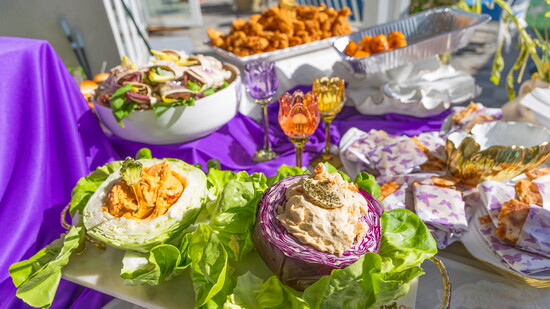
There’s a moment before guests take their first bite when a table has already begun telling its story. For Weeda Aman, founder and creative director of Weeda’s Afghan Catering, that moment matters. A sweep of richly colored food. The glint of serving pieces against layered textiles. Florals, candlelight, texture, and detail. Then, at the center of it all, the unmistakable aromas of Afghan cooking—saffron, cardamom, grilled meats, slow-cooked vegetables, and fragrant rice.
For Weeda, entertaining is about how people are made to feel. Her approach brings together two worlds that have shaped her: a background in interior design and a deeply personal connection to the traditions of Afghan hospitality. The result is an experience in which cuisine, fashion, culture, and design become part of the same composition.
“My appreciation for beauty, elegance and hospitality is deeply personal,” Weeda says. “Much of it was inspired by the women in my family, especially my mother and grandmother.”
Her mother has always been known not only for her cooking, but also for her innate sense of elegance. “She is an exceptionally elegant woman, admired by family, friends and beyond for her beauty, her sense of fashion and style, and her incredible cooking.”
These influences are visible in Weeda’s work today. Her tables are abundant without feeling excessive and polished without becoming overly formal. Traditional Afghan dishes such as Qabuli Palaw, saffron rice, kabobs and Badenjan Burani are presented with a distinctly contemporary sensibility.
Her training in interior design informs nearly every decision. Color, scale, texture, and composition matter on a dining table as much as they do in a beautifully designed room. But Weeda has also resisted the idea that the person creating the experience should remain invisible.
“I’ve never been interested in doing something simply because everyone else is doing it,” she says. “I’ve always wanted to create in my own way.”
To her, personal style is part of that creative expression. “The table can be an expression of the food, the culture, the fashion—and the woman behind it,” she says.
That philosophy is now taking shape in her latest concept, Luqma, a word evoking a bite or morsel. An Afghan-inspired grazing experience, Luqma transforms beloved flavors into elegant small bites and finger foods, presented in abundant, highly stylized displays designed to stimulate conversation and discovery.
But Weeda’s vision for Luqma extends beyond a new catering offering. She hopes to introduce Afghan grazing as a recognizable style of eating and entertaining—much as Turkish mezze and Spanish tapas have become. Her goal is to bring beautifully presented Afghan small bites to homes, parties, events, and businesses, while making the concept accessible and appealing well beyond the Afghan community.
The concept reflects a larger ambition: introducing Afghan cuisine to people who may never have experienced it before, while allowing its traditions to evolve in unexpected ways. Afghanistan is often presented to the world through a narrow lens. Through her work, Weeda hopes to reveal a broader one.
“There is another Afghanistan,” she explains. “The Afghanistan of extraordinary hospitality, beautiful traditions, family gatherings, art, food, color, elegance, generosity, and incredibly strong women. That is also part of our story.”
In Southern California, where entertaining, design and culinary experiences increasingly intersect, Weeda is building something distinctly her own: a modern expression of Afghan hospitality and a new way of experiencing Afghan food.
At its heart, she hopes the experience leaves an impression that goes beyond what can be photographed. “Ultimately, I want people to remember not only what they ate or what the table looked like, but how the experience made them feel,” she says. “That, to me, is hospitality.”
The table can be an expression of the food, the culture, the fashion...