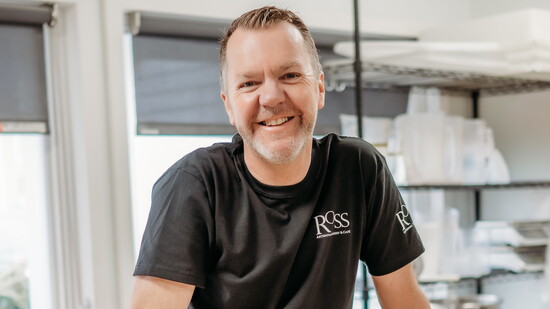
As a kid growing up outside of Liverpool, England, Ian Lewis’s first job was on a milk float.
“It was a quiet, battery-powered vehicle filled with bottles of milk,” Ian says. “A needle on a crate outside each house told us how many pints to deliver the next morning—one, two, three, or four.”
It was simple. Personal. And, in its own way, an early lesson in service.
From there, Ian worked at a local pub. In England, beer bottles were stored below grade, rendering them cool—not cold. It was Ian’s job to bring the bottles up to the bar, put them on ice, and get them ready for serving to customers. Eventually, he moved into the kitchen.
When Ian was 15, his mother asked what he wanted to do with his life.
“I don’t know,” he told her. “Maybe I’ll be an accountant.”
Her response?
“Oh love… there’s an opening at the catering college, why don’t you try that?”
Ian recounts this with a grin—and it’s easy to see why the story still delights him. We’re chatting on a weekday morning at Ross Artisanal Bakery & Café, and the place is humming—customers coming and going, staff baking in the kitchen, espresso beans being ground for a latte. The scents of freshly baked bread, of sugar, of caffeine fill the air, and there is Ian greeting each customer that walks in—many by name.
He did attend that catering college, and upon graduating at just 17, moved to London to take a position at the legendary Savoy Hotel on the Strand. There, Ian worked as the tourier—a role in the brigade kitchen system responsible for producing all raw dough. In the years that followed, he worked under British culinary luminaries Nico Ladenis and Gary Rhodes before crossing the Atlantic in 1995.
Ian’s first role stateside was at Lake Placid Lodge, a five-star resort in upstate New York, where he served as pastry chef. Then came a shift into the corporate world as Executive Pastry Chef for Travelers Group (which later merged with Citibank), Regional Director at Aramark, and eventually a role at Danny Meyer’s Union Square Hospitality Group (of Shake Shack and Gramercy Tavern fame).
Ian and his wife Carissa had been settled in White Plains for nearly two decades along with their two children. But with Carissa running a small independent school in Stamford, a move closer had long been on their minds.
Then, one Friday morning during the pandemic, their realtor called.
“She said, ‘I found your house.’ We said, ‘Where?’ She said, ‘Ridgefield.’” He smiles. “We always dreamed about coming here—we’d say, ‘Let’s go visit Ridgefield!’ But we never thought we’d actually live here. We came that weekend, made an offer Sunday—and that was it.”
Around the same time, Ian found himself drawn back to his roots. Ross Bread—which had opened in 2009 and become a beloved fixture in The Marketplace, known for its buttery croissants, Stumptown coffee, and fresh organic salads—had been taken over by co-investors Truitt Bell and Phil Murray.
“Pastry has always been my vocation—it’s what I love,” Ian tells us. “I was tired of corporate life, working remotely, being on my own. I’m a team person, and I was considering opening my own bakery.”
Ian mentioned this to a neighbor who connected him to the co-owners—and what began as a short-term consulting role soon became something more.
“I came in around October 2022 and planned to get them through Thanksgiving. Thanksgiving was a huge success—better than ever. So then they asked me to stay through Christmas.”
Ian returned to England after his father’s passing, but when he came back to Ridgefield, his path forward was clear.
“I had a small amount of inheritance from my father, and I decided to invest it in the business—almost in his name. I felt like he would be proud.”
In January 2024, Ian became Chief Operating Partner. Under his leadership, the business expanded into the neighboring storefront—previously home to Underground Co.—and was rebranded as Ross Artisanal Bakery & Café.
But the driving force behind the growth, Ian is quick to clarify, wasn’t ambition for ambition’s sake. It was about creating a better working life for his staff, who had long operated in two shifts because of limited kitchen space.
“The intention was to accommodate the team,” Ian explains. “There was a daytime shift handling everything savory and an overnight shift baking all the bread and pastries. It was important for me to have the crew enjoy their life at work, and to go home on Saturday evening and still enjoy their night.”
Regardless of intentions, growth followed. Over the last 36 months, Ross Artisanal Bakery & Café has grown by more than 40%—no small feat in the current economic climate.
In addition to the physical expansion, this growth can be attributed to the three pillars that shape Ian’s belief in how to run a good business: incredible hospitality, quality and consistency, and cleanliness.
“Everyone who works here understands that we work on hospitality and being one team. Helping the team be successful—whether monetarily or in building a sense of community—that’s the goal. Come here, be happy, go home happier. We wouldn’t open the door every day if it wasn’t for these guys.”
That intentionality extends to every corner of the store. Bulky freezers with low turnover have been replaced by elegant shelving stocked with olive oils, fruit preserves, and other carefully curated pantry items. A longtime Stumptown retailer, the shop once sold five or six bags of coffee a week—easy to miss, tucked away as it was. Today, with intentional placement at the front of the store, Ross has become the largest Stumptown retailer in New England, moving hundreds of bags weekly.
The bakery has also embraced upcycling in earnest. Yesterday’s bagels become today’s bagel chips. Croissants become bread pudding. Bread becomes croutons and breadcrumbs. Even the sourdough starter—descended from the original culture, fed daily for nearly two decades—has been reimagined. Dried on sheet pans, crumbled, and packaged as sourdough starter kits now sold at the front of the store—right alongside Ian’s own handthrown pottery.
“I’ve got this quiet bucket list of things that I want to do, you know,” he tells us. “I want to tap dance. I want to play guitar. And I don’t think I’m ever going to tap dance or play guitar. But I’d always wanted to do some pottery and my wife said, ‘Thank God.’”
After a single session at the Hammond Museum in North Salem, Ian was hooked. He bought a wheel. Then another. Then a third. His basement has become a working studio, and he recently installed a kiln. Each season, he throws a new collection. Spring brought a series of planters; summer will bring two collections—the Foodie Collection and the Summer Solstice Collection—guided, he says, by warmth, mood, and color.
The connection to his day job isn’t as unlikely as it sounds. Both pastry and pottery demand deft hands and a clear vision of the finished product. Both reward patience and punish shortcuts.
And, of course, both require a turn in the oven.
For someone as busy as Ian Lewis—running a business, helming a consulting agency, throwing pottery, raising a family—he still finds ways to invest in the community that took him in. Not long after moving to Ridgefield, he was invited by Dan O’Brien to join the Chamber of Commerce. Today, he serves as Vice Chair.
This past April, he participated in the Ann’s Place Fashion Show for the second time, raising funds and awareness for the organization.
Ian—and the bakery—donate regularly to local fundraisers and causes around Ridgefield, be it food, funds, or time. He’s quick to point out, though, that many aren’t handouts—they’re collaborations. Recently, he’s been working with an entrepreneurial student group from Ridgefield High School’s class of 2028, who are raising funds for their graduation events. Rather than cutting a donation, Ian gave them 100 of the bakery’s wooden nickels—each redeemable for a free cup of coffee—and challenged them to build a business plan around it.
Most days, though, you’ll find Ian exactly where this story began—on the floor, in the mix, greeting customers and supporting his team.
“I believe that we’re all hospitalitarians in our own right,” he reflects. “We serve everybody else. And I believe that if you give yourself up differently, you get something back. I’m not looking for anything—I don’t want anything. I’ve got everything I ever dreamed of. I’ve been married 29 years to the most perfect person. I have two amazing kids. I’m privileged—not in the sense of money, but in what I have. And so I believe it’s my civic duty to give back to the place that supports me.”
The lunch rush is now in full swing. Ian catches the eye of someone just walking through the door and smiles—like he was expecting them.