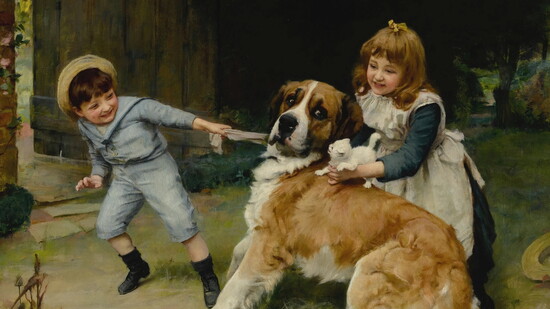
Human beings have had a close relationship with animals since ancient times, and their images are found throughout the history of art. Dogs evolved from wolves and are thought to be the first animals that were domesticated by man. They were trained to hunt or act as guardians for the benefit of their human masters. The ancient Egyptians created beautiful sculptures of cats. The Greeks often portrayed dogs in art while the Romans immortalized them in paintings and mosaics.
Owning pets was both practical and personal as they acted as highly valued hunting and leisure companions, guardians of property against intruders, as well as a source of entertainment. In the 15th, 16th, and 17th centuries, collecting exotic pets like monkeys and caged birds was a symbol of wealth and opulence. They were often found in paintings alongside the elite.
Leonardo Da Vinci’s circa 1490 portrait of the mysterious and beautiful Cecilia Gallerani, known as Lady with an Ermine, comes to mind. Portraits of favorite dogs and horses were often commissioned by European royalty. Ownership of prize-winning breeds was a prestigious aspect of the lives of the landed gentry in 18th-century England, and individual portraits of favorite horses, cattle, and dogs were the subject of many paintings by prominent British artists including Stubbs, Gainsborough, Reynolds, and Landseer. One of the most highly prized creatures was “The Durham Ox,” a massive 189 stone steer that travelled on exhibition throughout Great Britain. Painted by the artist John Boultbee in 1802, over 2,000 engravings of the painting of the famous prize ox were sold that same year.
The heyday of painting family pets interacting with children was in 19th-century Britain. Arthur John Elsley (1860–1952) would be considered the foremost painter of animals and children from this period. Trained at the Royal Academy of Art in London, Elsley started drawing animals at the age of eleven and, like many of his colleagues, he sketched animals at public zoos. Many of his oil paintings, like Friend or Foe? displayed on the previous page, depict happy children playing with very large and lovable dogs as well as often mischievous cats. His artworks were highly popular in the late Victorian and Edwardian periods and were often widely reproduced as color lithographs and prints. They were even used in advertisements by several commercial enterprises such as on Peek Freen cake and biscuit tins, Sunlight Soap advertisements, and A&F Pears’ annual company calendar. Over time, his works became less fashionable and were thought to be overly sweet and sentimental. They were later referred to as “chocolate box” paintings compared to more modern standards.
It is important to understand that as tastes change, the monetary values of works of art often change as well. A case in point is Arthur John Elsley's painting Friend or Foe? – a 35” x 40” oil on stretched canvas – which was offered for sale at public auction at Sotheby’s New York on three separate occasions.
- In April 2009, it was estimated at $300,000 to $500,000 and sold as Lot #90 for a hammer price of $200,000.
- In May 2017, it was offered as Lot #83 with an estimate of $70,000 to $100,000. Unfortunately, it did not make its reserve price.
- In February 2018, it was sold at Sotheby's as Lot #820 for a hammer price of $32,000.
The reality is that collector interest for certain periods and subject matter changes with the passing of time. While human sentiment may remain, works of fine art often move in and out of fashion like many other things we value.
Mark Alexander can be reached through www.artserv2000.com.
<PULL QUOTE>
Collector interest for certain periods and subject matter changes with the passing of time. While human sentiment and relationships with family pets may remain, works of fine art often move in and out of fashion like many other things we value.