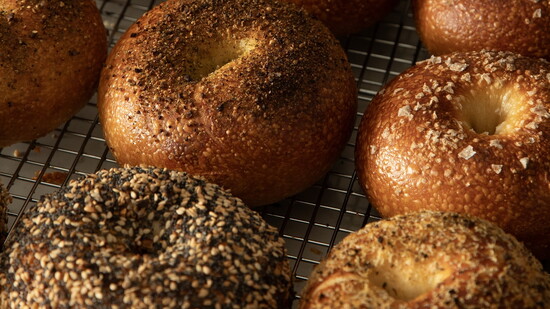
On a quiet stretch off Portland’s peninsula, there’s a moment when the neighborhood starts to stir. A dog barks, a car door shuts, someone heads out for coffee. Inside one house, though, the morning has been underway for hours. Ryan Mash is already baking. The dough he’s working with isn’t new—it’s been resting, developing, quietly doing its thing for nearly two days. By the time it hits the oven, every variable has been considered, every detail tested.
“It’s just six ingredients,” Mash says, listing them off. “High protein flour, salt, yeast, barley malt syrup, diastatic malt powder, and water. It’s really a matter of ratios and process and timing that gets you pretty drastically different results.”
Blue House Bagels, Mash’s small-batch, home-based operation, started the way a lot of good things do: with a little extra time and a curiosity that turned into something more. After the birth of his second child, Mash found himself on paternity leave with a rare stretch of time. Instead of slowing down, he leaned in. “I spent a good amount of time just testing and making a bunch of batches,” he recalls.
Mash firmly believes bagel making is collaborative in nature, and, unlike some bakers who prefer to keep their methods secret, is a proponent for publicly sharing his techniques. “Anytime anyone reaches out, I’m more than happy to give specifics and help troubleshoot. If you’re going to be making bagels like this, you have to be pretty into it,” he laughs.
His initial stretch of experimentation included mixers bought and broken, techniques refined, and tiny adjustments made over and over. It laid the foundation for what has quickly become one of Portland’s most talked-about bagel drops. These days, Mash’s weekly offerings sell out almost as soon as they’re posted, with customers setting reminders and planning their weekends around pickup windows.
The process itself is deliberately unhurried. Mash starts two days before a bagel ever reaches someone’s hands, mixing a low-hydration dough that leans dense by design. After shaping, the bagels rest in the fridge for 36 to 48 hours in a cold fermentation that transforms both texture and flavor. “It’s what gives them the blistered, dark crust,” he explains. “That’s kind of the thing that I strive to do over everything else.”
What he’s chasing is contrast—the kind you notice immediately but can’t quite put into words. A thin, crackling exterior that gives way to something soft, chewy, and satisfying. “For me, great food is all about contrasts,” Mash says. “When you bite into it, you should first meet a crunchy crust. And then it should be soft, chewy, but dense on the inside.”
It’s also fleeting. Bagels, he’ll tell you, are “very ephemeral.” They’re at their best within hours of coming out of the oven, when that contrast is still intact. It’s why Mash times his bakes so carefully, and why customers are often picking up bagels that are barely 90 minutes old.
And, if you ask him, it’s why you shouldn’t be reaching for the toaster. “If you feel like you need to toast your bagel to add that texture,” he says, “then to me that’s not a great bagel.”
What makes Blue House Bagels feel different, isn’t just the product. It’s the setting. There’s no storefront, no commercial kitchen, no polished counter separating baker from customer. Everything happens out of Mash’s home, tucked into a neighborhood where walkable food options are limited and a fresh bagel can feel like a small luxury.
“The whole vision was just being a place people could walk over in the morning,” he says. And they do. There’s a kind of ease to it, a sense that this is as much about connection as it is about food. “It’s been great just getting to meet a lot of people in the neighborhood I didn’t know were here,” Mash adds.
That community has grown even faster than he expected. Each week, Mash makes somewhere between 15 and 20 dozen bagels, a number dictated not by demand but by the limits of his equipment and time. Orders open, fill, and close within a day or two. “I didn’t think it was going to be this popular,” he admits. “Something that I struggle with is turning people away.”
The tension between wanting to say yes and needing to set boundaries is part of the reality of keeping something small on purpose. Mash still works a full-time job in legal and compliance, and he’s also a dad of two young kids. Blue House Bagels exists in the in-between hours: early mornings, late nights, and weekends that revolve, at least in part, around dough. “The biggest sacrifice I’ve had to make is time,” he says.
But because it happens at home, it’s not separate from the rest of his life. Mash’s three-year-old helps hand off orders at the door, proudly passing out containers of cream cheese and handing over bags of bagels. His family is part of the rhythm, even when it’s a little chaotic. “It does become a little bit bagel-centric,” he says, laughing.
That balance between ambition and sustainability is something Mash is protective of. In a city like Portland, where food businesses can quickly scale and expectations rise just as fast, he’s intentionally moving at his own pace. “I’m not trying to set the world on fire,” he says. “I just want to be able to put out the best thing I can.”
It’s easy to see that mindset in the menu, which blends classic staples with more playful, rotating specials. There’s always an everything, a sesame, a poppy. But then there are the curveballs: cacio e pepe, spice-driven blends, and a French onion bagel layered with deeply caramelized onions and Gruyère that quickly became a customer favorite.
“I’m just thinking of different types of food I like to eat,” he says. “And like, can I use any of those spices in a way that would not turn to charcoal in a 475-degree oven?” Still, no matter how creative the toppings get, they’re never the main event. Structure and texture reign supreme. “I’m much more interested in the crust than other flavors,” he says.
Looking ahead, Mash isn’t rushing toward a brick-and-mortar or a bigger footprint. If anything, he’s focused on staying in the sweet spot where the work still feels meaningful and there’s room to grow without losing what made it special in the first place. He’s exploring small equipment upgrades and leaning into partnerships like his pop-ups with Twin Swirls, but beyond that, he’s taking it one batch at a time. “Once it stops feeling like I want to do this, I think some of the joy will get sucked out of it,” he says.
For now, the joy is still very much there—in the early mornings, in the careful shaping of each bagel, in the knock on the door from a neighbor who planned their weekend around this small, thoughtful ritual. In the end, that’s what Blue House Bagels really is. Not just something to eat, but something to look forward to.
"I just want to put out the best product I can.”
“The whole vision was just being a place people could walk over to in the morning. It’s been really great getting to meet people I didn’t even know were in the neighborhood.”
“There are so many small little things—the way you shape it, the temperature, the timing—and they all have this profound impact on the final product.”