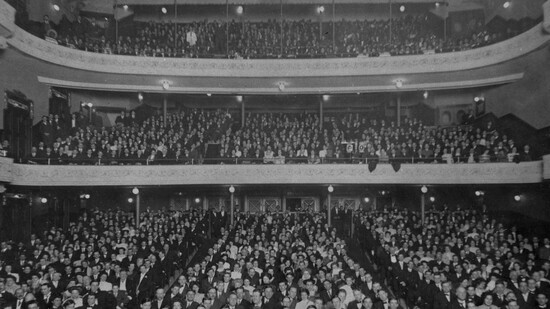
Late last year, the nonprofit Knoxville History Project published a new book for the Bijou Theatre, The Second Balcony: The African American Experience at the Bijou Theatre. Researched and written by Jack Neely with the assistance of the Beck Cultural Exchange Center, this project is part of a coordinated effort by the theatre’s board and staff to honor the past of this historic theater that opened in 1909, but is connected to the Lamar House: the old, Gay Street-facing building that dates back to the early 1800s.
It might not be obvious to concertgoers, but the Bijou has two balconies. However, only the first balcony is open to the public; the second balcony, with its steep perspective, has been closed for more than 50 years. But when the Bijou opened in 1909, this higher balcony, accessible only by a separate staircase, was the only place where African Americans were allowed to sit.
In the book’s foreword, Rev. Reneé Kesler, who serves as the executive director of the Beck Center, and a former Bijou board member, writes that “Black individuals were integral to the history and culture, contributing to every aspect of the building later known as the Lamar House, constructed in 1816, and the new addition, the Bijou, built in 1909, from laying its foundation to reaching the height of its second balcony.”
Irish immigrant and local merchant Thomas Humes, a prominent community member in the early 1800s, served as an elder at First Presbyterian Church and sat on the city’s first Board of Aldermen. In 1815, he began construction of a new building project on the corner of Gay Street and Cumberland Avenue, but didn’t live to see it completed. However, we can reasonably assume that enslaved people helped build it. After Humes died, his widow, Margaret Russell Cowan, rented it to one Archibald Rhea, who opened a hotel there in 1817.
Throughout the ensuing decades, the building operated as a tavern or hotel and became known as one of the city’s finest hostelries, albeit with many names across the years: the Knoxville Hotel, Jackson’s Hotel, the Coleman House, the White House, City Hotel and more. The enduring name of the “Lamar House” honors a onetime investor from Atlanta, whose reputation Knoxvillians clearly respected, Gazaway Bugg Lamar.
During the Civil War, Confederate general Joseph Johnston held his headquarters here, and following occupation by Union troops in 1863, the building became a military hospital, one of several in the city. After being seriously injured on Kingston Pike, Union General William Sanders, died here.
After the conflict ended, several African American staffers are known to have lived and worked here, including porter James Mason, who later became the first Black policeman on the city force, and Shadrack Carter, later the first Black postal carrier in Knoxville.
In 1872, right across the street from the Lamar House, Staub’s Opera House opened, and for decades remained one of Knoxville’s most prestigious entertainment venues. Although Black performers were only occasionally seen on stage during that era, Staub’s balconies could be reserved for African American audiences. A similar story would play out at the Bijou.
Memphis-born baseball player and theater operator Jake Wells, with his Bijou Company, often sponsored shows at Staub’s as well as other Knoxville venues, including Chilhowee Park. After looking at several options, Wells finally decided on the Lamar House as the site for a new theater that would become the fifth in his chain of Bijou theaters across the South. The Knoxville Bijou Theatre opened in March 1909 during the Jim Crow era, when most public places were strictly segregated.
Like at Staub’s, African Americans would be admitted to the new Bijou Theatre, but only on the second balcony. And even then, sometimes only a few rows may have been reserved for them, as proved to be the case on opening night when a traveling Broadway play, Little Johnny Jones, played on March 8, 1909.
This new book documents all the key theatrical stage shows, films, and concerts featuring African American performers throughout the decades at the theater, up to the present day. One standout is Shuffle Along, an all-Black cast Broadway show in 1924. Also included is the Civil Rights era, when demonstrators lined up to ask a white ticket booth attendant for a ticket to see a movie, only to be repeatedly turned away. Interviews with Civil Rights leaders, including Theotis Robinson and the late Robert Booker, plus musician Sparky Rucker, poignantly inform the story. They each share memories of their first visits to the Bijou in their youth, when they came here to watch films during the 1940s and 1950s, when segregation was the norm.
The book also includes a fascinating survey of “Black Shows of the Post-Renovation Era,” after the theater was saved by forward-thinking preservationists (the effort led to the formation of the enduring Knox Heritage) including musicians like Howard Armstrong, Wynton Marsalis, Dizzy Gillespie and Rhiannon Giddens; legendary singers, including Sarah Vaughn and Mavis Staples; as well as contemporary acts such as André 3000, Big Freedia and Seun Kuti.
The Second Balcony can be purchased directly from the Bijou Theatre at KnoxBijou.org or KnoxvilleHistoryProject.org.
About KHP:
The educational nonprofit Knoxville History Project tells the city’s true stories, focusing on those that have not been previously told and those that connect the city to the world. Donations to support the work of KHP are always welcome and appreciated. Learn more at KnoxvilleHistoryProject.org.