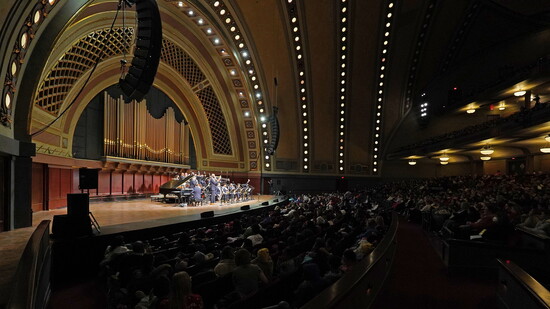
Before the first note is played, before a dancer crosses the stage, before the lights shift or a story begins, something else can happen.
A child walks into Rackham Auditorium and looks up.
The ceiling is hand-painted and ornate. The seats are lush velvet. The room itself feels different from the rooms of ordinary life. And for some students arriving for a UMS School Day Performance, that first moment of wonder begins before an artist ever appears.
“I have seen kids who walk into the space, and they’re looking up at the ceiling, and they’re looking at their surroundings, and they’ve never been into a space like that,” says Cayenne Harris, UMS Vice President of Learning and Engagement. “It’s just the act of walking into a concert space.”
For UMS, that moment matters. So does what follows: the gathering, the attention, the shared experience of live performance in a world increasingly shaped by screens.
“For nearly 150 years, UMS has been built on the simple but powerful belief: that gathering for live performance matters,” says UMS President Matthew VanBesien.
Harris wholeheartedly agrees. “One of the things that I love most about the performing arts is that it is an opportunity for people to gather together, typically without phones, without screens, and have a shared live experience together,” she says. “I think that is more important than ever for young people.”
UMS’s K–12 education programs have been at the heart of the organization’s mission for about 30 years, built on relationships with educators across Ann Arbor, Ypsilanti, Dexter, Saline, Detroit, and beyond. Last year, Harris estimates that roughly 5,000 students attended live School Day Performances, with an additional 3,000 to 4,000 participating online.
Those performances vary widely, from music and dance to theater and culturally specific work. Some are adapted from UMS’s public presentations; others are created specifically with young audiences in mind. Harris is careful to distinguish between making art accessible and making it less ambitious.
“There’s a difference between dumbing something down and creating something that is accessible for kids,” she says. “Creating an invitation for kids to really get into the story, get into what’s happening, doesn’t involve dumbing anything down.”
That invitation might be a chance to clap along, respond to a question, hear directly from an artist, or recognize a culture, language, or story from their own lives. It might also mean encountering something entirely new.
For Harris, children are not passive recipients of culture. They are, in many ways, the most honest audience.
“Kids are the best audiences,” she says. “They’re the most truthful audiences. If they like something, they let you know it. If they’re not into it, they let you know it.”
Sometimes, that truthfulness creates unforgettable moments. At a recent School Day Performance with Wynton Marsalis and the Jazz at Lincoln Center Orchestra, a first grader from Perry Early Learning Center in Ypsilanti asked if the audience could make music with the band. When invited to sing something, she started singing “Baby Shark.” The orchestra played along.
“You never know what’s going to happen,” Harris says.
That responsiveness is part of what makes live performance singular. Unlike film, television, or video games, the live arts often ask children to participate imaginatively. They must fill in gaps, suspend disbelief, make meaning, and connect dots.
“There’s something about the live performing arts that requires you to show up and fill in the blanks,” Harris says. “In real life, we are often in situations where it’s not clear what’s going on, and we need to figure out — we need to use our imagination.”
That imaginative work can foster empathy, especially when students encounter stories and perspectives beyond their own. In the upcoming season, UMS will present “300 Paintings,” a theatrical work about one artist’s experience with bipolar disorder. Lupita Infante, a mariachi ranchera singer and granddaughter of Pedro Infante, will offer students another kind of connection: the chance for some children to see their culture represented on stage, and for others to learn more about their classmates’ heritage.
The same philosophy is now expanding into UMS’s new Family Programming Initiative, beginning with “Marooned! A Space Comedy” by Alex and Olmsted. The production, rooted in puppetry, live action, and theatrical imagination, follows a young astronaut who crash lands on an unknown planet and must find her way home.
For Harris, the pilot fills an important gap. UMS has long served schools and adult audiences, but family-centered programming creates a visible welcome for parents, grandparents, siblings, and young children to experience the arts together.
“Their presence in the theater is not an afterthought,” she says.
That matters in a community where many parents prioritize academics and sports but may not always think of live performance as part of a child’s development. Harris sees early childhood through elementary school as a particularly important window, when children are especially open to curiosity and wonder.
“There is a time in kids’ lives when they are really open to new ideas,” she says. “It’s such a critical window to offer exposure, to give kids a chance to connect to new ideas.”
That sense of connection also informs the broader Arts & Wellness theme shaping UMS’s 2026–27 season. The focus emerged through several converging threads, including conversations with the London Symphony Orchestra about its creative health work in clinical settings, the University of Michigan’s emphasis on human health for the academic year, and theatrical works such as “300 Paintings” and “Watch Me Walk,” which explore mental health, illness, disability, diagnosis, and resilience.
UMS does not position itself as a clinical expert, Harris says. Instead, the organization hopes to shine a light on artists and institutions exploring the relationship between art, healing, and human well-being.
For audiences, the connection is often deeply personal.
“We hear from our audiences how important UMS is to their lives,” Harris says. “We have people who tell us they build their whole social season around coming to performances, or people use terms like, ‘This is my church.’”
For young people, live performance can offer something equally essential: the sense that they are not alone. A story on stage, a song in another language, a dancer’s movement, a puppet’s journey through space—each can help children feel part of a wider human experience.
Awe, Harris says, gives us the sense of being “part of something that’s much bigger than you, and much bigger than your daily life.”
And perhaps that is the case for more awe. Not as an extra. Not as enrichment tacked onto “real” learning. But as one of the ways children begin to understand themselves, one another, and the world they are growing into.
Learn more at ums.org.
“Kids are the best audiences. They’re the most truthful audiences.”
“Awe gives us the sense of being part of something that’s much bigger than you, and much bigger than your daily life.”