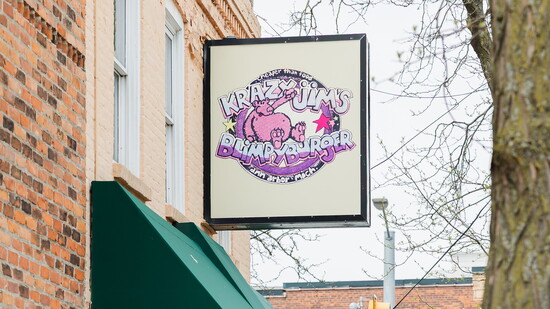
It’s a rare feat when a business becomes a true cultural experience. The kind of place you want a T-shirt from not because it’s fashionable, but because it represents something far better, a kind of counterculture, a badge of having been there.
It’s not something you can set out to create. It must be earned, organically, over time.
In Ann Arbor, a place like that has to strike a very specific balance. It has to be just weird enough, just authentic enough, unwelcoming and completely irresistible all at once. And if you’ve spent any time here, you already know the place.
Krazy Jim’s Blimpy Burger.
For generations, Blimpy hasn’t just been a place to eat. It’s been a rite of passage. And for the first time in decades, it’s entering a new chapter.
Founded in 1953, Blimpy Burger has always existed slightly outside the norm. It never tried to be polished. It didn’t need to be. What made it iconic wasn’t just the food. It was the experience. The personality. The consistency. The sense that, no matter how much the city changed around it, Blimpy’s spirit defiantly stayed the same.
That identity was shaped by longtime owner Rich Magner, who first left his mark as the artist behind Blimpy’s original T-shirt and hand-drawn menu before taking ownership with his wife, Cindy, in 1992 and carrying that legacy forward.
Following Magner’s passing, the future of Blimpy felt uncertain. Because places like this don’t just operate. They carry something.
They carry culture.
Enter Noah Kaplan and Pete Levin. At first glance, they might seem exactly like what you’d expect. Two successful operators, the kind who move from one project to the next. But look closer, and you realize they are exactly who this moment calls for.
Kaplan may be the owner behind Ann Arbor-based ventures like Leon Speakers, Mothfire Brewing, and York Food & Drink, but he identifies first as an artist and musician, someone who spent years in this city playing gigs and immersed in the creative scene. Levin may be the operator who brought New York’s iconic Joe’s Pizza to Ann Arbor, followed by Bo’s Bagels, but he’s also someone who left a successful career in New York, working on Saturday Night Live and running a thriving NYC bar, to build his life in a city he has loved since his college days. Joined by Kaplan's brother and business partner, Ethan Kaplan, and operating partner and fourth-generation Ann Arborite, Doug Botsford, this is a team with deep roots in the community and an even deeper affection for the Blimpy legacy.
This isn’t about expansion. It’s about connection.
For all of them, Blimpy was never just a business. It was part of their Ann Arbor story long before it became part of their portfolio. Levin admits he wasn’t initially looking to take on something new. Time is limited. The demands are real. But when Blimpy entered the conversation, everything shifted.
“It’s such a special place,” he says. “That changes everything.”
So what does it mean to take something like that on?
For Kaplan, the answer is rooted in a simple idea: the best businesses are an extension of the people who created them. They carry a point of view. A character. A consistency that people come to rely on.
That’s what Blimpy has always been. And that’s exactly what they intend to protect. “We’re not coming to change it,” Kaplan says. “We’re coming to carry it.”
Of course, carrying something forward doesn’t mean freezing it in time. The reality is that even institutions must evolve to survive.
“You look at the longest touring bands,” Kaplan says. “They’re always redefining and rewriting, but the core sound has to remain the same.”
Behind the scenes, there will be changes: operational improvements, updated infrastructure, and a shift toward digital ordering to meet how today’s customers, especially college students, engage.
There are also thoughtful additions designed to extend, not redefine, the experience. The team plans to introduce beer in partnership with Mothfire Brewing, extend hours past midnight, and bring Blimpy into the broader community through local events like Top of the Park.
But step inside, and the core will remain.
The ordering ritual. The quality. The edge. The snowbears.
“There’s a balance,” Levin says. “You have to keep the charm and the grit, but make it work operationally.”
The opportunity now is to widen the circle without losing what made it special in the first place. To let more people in on the experience while still preserving the feeling that made it iconic.
Upstairs, Kaplan is already imagining what comes next — a creative space, a listening lounge, something that expands the world of Blimpy without altering its core. Downstairs, the line will still move the way it always has. A little fast. A little loud. A little unforgiving.
Exactly as it should be.
Because the truth is, places like Blimpy don’t survive by accident.
They survive because someone chooses to step in. To take responsibility. To understand that what they’re holding isn’t just a business, it’s a piece of a community’s identity.
Learn more at blimpyburger.com.
“You have to keep the charm and the grit, but make it work operationally,” Pete Levin says.
“We’re not coming to change it,” Noah Kaplan says. “We’re coming to carry it.”