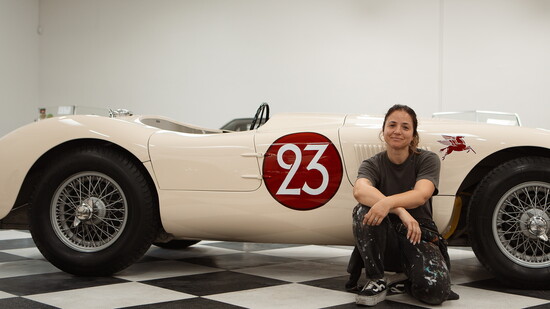
Valentina Trentini paints the way craftspeople of the old world have for a century: unhurried, exact, and utterly unwilling to fake the parts that matter. This is a craft you earn, letter by letter, and in a Boulder scene enamored with the handmade, her sign shop, Brushetta Signs, has become a salute to old-world patience and style. She is one of only a handful of artists in the world still practicing this trade at a professional level, and among an even smaller handful of women who do.
Valentina left Bologna for the States in 2012, trading the city's arcaded streets for a string of American ones, New York first, then Los Angeles, then eventually the foothills of Boulder. She's been painting her whole life, but sign work found her in the States. In LA she enrolled at Trade Tech, the only school in the world still formally teaching sign painting, a lineage dating back to 1924.
Her real education, though, happened at the elbow of masters. In Minnesota, Mike Meyer drilled her on brush technique: the consistency of a stroke, the architecture of a letterform, the difference between a line that's correct and one that's alive. Later, a gold leaf mentor handed her an entirely different vocabulary: gilding, the ancient art of laying gold onto glass and wood so it seems to generate its own light.
Then came Rod Emory, the man Valentina calls the god of Porsches. They met, hit it off immediately, and she found herself restoring the original graphics on vintage racing cars (numbers, stripes, sponsor logos), all painted by hand exactly as they were decades ago, down to the wobble of a period brushstroke. It's meticulous, borderline archaeological work. Her restorations have since been shown at Pebble Beach Concours d'Elegance and Monterey Car Week, where a fraction of an inch of historical inaccuracy can cost a car its class. But that's precisely the point: a decal can be printed in seconds, and it will never carry what a hand-pulled line carries. Valentina's work insists on the human element. The almost imperceptible imperfection that tells you someone was there, breathing, deciding, correcting.
Even the shop's name has its own small story. Brushetta started as a gift, someone's well-meaning misspelling of bruschetta, but it had “brush” hiding right there inside it, and it stuck.
That reverence for restoration, for coaxing something old back into its own light, feels central to who she is. Bringing things back to life isn't sentimentality; it's a mission: to honor the past, elevate the present, and make work built to stand the test of time. It's why a decades-old Porsche graphic and a gold-leafed Boulder storefront sign belong to the same practice in her hands.
BrushettaSigns.com
@brushettasigns