Most national parks ask visitors to leave no trace. A visit to Weir Farm National Historical Park—the only national historical park dedicated to painting—invites the opposite. Its lush, slightly overgrown but meticulously maintained grounds, antique storybook stone walls, and winding woodland paths seem to whisper to visitors: create.
Julian Alden Weir—known professionally as J. Alden Weir—came from a family steeped in art, making it hardly surprising that his life, and later the lives of his children, gravitated toward artistic pursuits.
His father, Robert Walter Weir, was a painter of the Hudson River School and a professor of drawing at the United States Military Academy at West Point. His best-known work, Embarkation of the Pilgrims, adorns the rotunda of the United States Capitol.
His brother, John Ferguson Weir, was a painter, sculptor, writer, and educator who rented studio space in the Tenth Street Studio Building—the first facility of its kind developed to house artists in New York City. Located on West 10th Street between Fifth and Sixth Avenues, the building is credited with helping transform Greenwich Village into an international art hub.
Weir studied at the National Academy of Design for three years before heading to Europe, where he spent four more at the École des Beaux-Arts under the academic painter Jean-Léon Gérôme.
For someone who would later become one of the fathers of American Impressionism, Weir was spectacularly unimpressed when he first encountered the movement at the Paris Salon. After viewing works by Claude Monet, Pierre-Auguste Renoir, Edgar Degas, Édouard Manet, and their contemporaries, he wrote home: “I never in my life saw more horrible things… They do not observe drawing nor form, but give you an impression of what they call nature. It was worse than the Chamber of Horrors.”
Weir returned to the United States in 1877 and established himself in New York City as a portrait and still-life painter, an art teacher, and an avid buyer and collector—a habit that would lead, in the most charming and fortuitous of ways, to one of the more remarkable trades in American art history.
But first came Anna Baker.
The 19-year-old from Windham, Connecticut had accompanied a friend to a painting class where Weir was teaching. The couple became engaged within three weeks and went on to have four children: Caroline, Dorothy, Cora, and Julian, who died in infancy.
One of Weir’s most generous patrons, the collector Erwin Davis, had amassed an impressive collection by the1880s—including works by Jules Bastien-Lepage, Manet, and Degas. But Davis had his eye on something in Weir’s own collection.
Davis owned a 153-acre farm in Branchville, at the intersection of Nod Hill Road and Pelham Lane. In exchange for a painting from Weir’s collection—plus $10—he offered to trade. Although the identity of the painting has been lost to history, one has to wonder: might it even have been an Impressionist work?
“If I go up to Ridgefield tomorrow, I will look at the 153 acres and see if they are habitable,” Weir wrote to Anna in 1882. “If so we might have that as a sort of hunting lodge for part of the season.”
That “hunting lodge” would go on to become a wellspring of creative inspiration for Weir and his friends and contemporaries—among them Childe Hassam, John Singer Sargent, and John Twachtman—for the next three decades. Weir came to refer to it affectionately as the “Great Good Place.”
More than anything else, it was the Branchville landscape that converted him to Impressionism. He painted the countryside en plein air—outdoors, directly from life, captured in natural light—endlessly and joyfully, and invited friends to do the same.
“I feel that I can enjoy studying any phase of nature,” he wrote, “which before I had restricted to preconceived notions of what it ought to be.”
Weir eventually had a studio built on the property. Its ceiling was first painted a vivid blue and adorned with stars, though Weir later discovered that the color altered the quality of the light. This prompted him to have it repainted gray.
He further enhanced the property’s pastoral charm by using $150 in prize money from one of his paintings to construct Weir Pond. The pond became a favorite spot for fishing, swimming, leisure, and, of course, painting.
In 1898, Weir helped found The Ten American Painters—known simply as The Ten—a group that deliberately broke from the conservative mainstream of the American art establishment and brought renewed energy and ambition to their exhibitions.
But modernism was spreading. Post-Impressionism, Fauvism, and Cubism were reshaping the art world, and while the landmark Armory Show was meant to trace the evolution of modern art out for its American audience, it also introduced them to the avant-garde.
Weir’s painting The Factory Village was included, yet he and his contemporaries increasingly found themselves overshadowed by artists such as Henri Matisse, Marcel Duchamp, Pablo Picasso, and Vincent van Gogh.
Weir responded with characteristic generosity. “These young artists are getting at the real thing,” he said. “They are the ones to watch. Our work is a thing done.”
Weir died of heart disease in New York City in 1919. But the farm’s creative forcefield did not end with him. His three daughters became the stewards not only of his artistic legacy, but of the property itself.
The eldest, Caroline Weir Ely—known as Caro—worked across bookbinding, printmaking, etching, and painting. She maintained a studio in Old Lyme, Connecticut throughout her life, even after marriage and motherhood—a rarity for women artists of her time.
Dorothy Weir Young most fully embraced life as a painter, working in oils, watercolor, and woodblock printmaking. She studied under her father and became the “keeper of the flame,” preserving the family farm, his studio, and his letters, which she meticulously transcribed for eventual publication. Dorothy married the sculptor Mahonri Young, who built a studio on the property near Weir’s. Here, he created numerous works for the Mormon Church including This Is the Place Monument in Salt Lake City.
The youngest daughter, Cora Weir Burlingham, became one of the property’s most passionate caretakers. Though not a painter herself, Cora possessed a deep love of landscape design and horticulture, studying at Parsons and later working with the New York Botanical Garden. After Dorothy gifted her the adjoining Webb Farm in 1931—today the Visitor Center—Cora painstakingly restored and reimagined the property, creating an innovative sunken garden and commissioning extensive stone walls her brother-in-law Mahonri affectionately dubbed the “Great Wall of Cora.”
In the late 1950s, Weir Farm was purchased by New England painters Sperry and Doris Andrews, a couple who spent years painting and caring for the property and who had been friends with Young. But as Ridgefield’s population grew, the pastoral countryside known as “the Land of Nod,” which had inspired so many paintings, came under pressure from residential development.
Together, Cora, Sperry, and Doris launched a determined campaign of preservation. Cora organized Citizens to Preserve Weir Farm in the 1960s and later donated 37.5 acres of her own property to The Nature Conservancy—the first parcel in Weir Preserve, a 110-acre landscape adjacent to the park.
Their grit and determination ultimately paid off. On October 31, 1990, George H. W. Bush signed legislation establishing Weir Farm National Historical Park as a National Historic Site. In 2021, it was redesignated as a National Historical Park.
What those early advocates saved—and what the National Park Service and Friends of Weir Farm, its philanthropic partner that fundraises to support projects and programs—has so carefully stewarded ever since—is not simply acreage. It is a feeling, a philosophy, and an invitation to slow down, pay attention, and create art.
Visiting Today
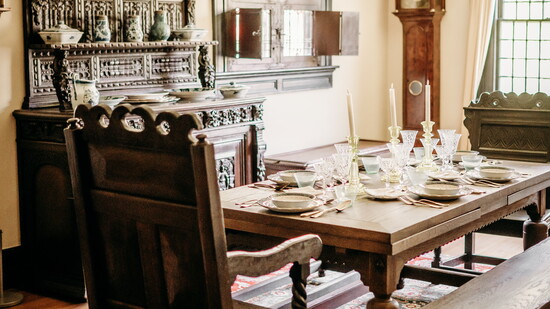
The 68-acre property is open to the public daily from sunrise to sunset. The Visitor Center is open Wednesday through Sunday beginning at 10 a.m., with tours of Weir House and the Studios beginning at 11 a.m.—offering an intimate look at Weir’s world: his paintings, his studios, his palette, and yes, the ceiling he ultimately had painted over, complete with the gorgeous stars he had once added to it.
A newly restored stone causeway along the Wagon Trail loop connects the Visitor Center parking area to Weir Pond through wetlands used for grazing livestock in the farm’s heyday. Stone causeways were a practical feature of southwest Connecticut farms, allowing people and animals to cross marshy ground, and a version of this pathway existed on the property even before Weir acquired the farm. Rebuilt using native stone and traditional masonry techniques, the crossing blends seamlessly into the historic landscape.
When the land was first farmed, stone walls were built to clear the fields and contain livestock. Over time, as the fields lay fallow, the forest returned and reclaimed the terrain—but the walls remain. Today they stand as reminders of the land’s earlier lives—both practical and inspirational—breaking up the woods with steady persistence. Three distinct types are still visible across the property: thrown, laid, and rubble-filled.
The Artists Who Still Come
For artists—active and aspiring alike—the Weir Farm Artist Collective is perhaps the most natural extension of what this place has always been. A community of local painters and creators, the Collective gathers twice monthly to do what Weir and his friends did here more than a century ago.
On the first Thursday of each month from May through October, artists convene in the Burlingham Barn for discussions ranging from exhibiting work and entering juried shows to sparking creativity and building community. On the third Thursday, they gather for an en plein air paint-out, their easels dotting the meadows and pathways.
The Collective also exhibits twice annually at local libraries, including summer and fall shows at the Ridgefield Library and Wilton Library.
For those who want to try their own hand at Impressionism, master instructor Dmitri Wright leads free painting workshops at Weir Farm throughout the season. His workshops are free to the public and fill quickly.
Then there is the Artist-in-Residence program, one of the more magical traditions at Weir Farm. From May through October, one artist per month is selected from dozens of applicants nationwide to live on the property with full access to a working studio and the kind of uninterrupted creative time Weir himself once enjoyed here.
The park is especially welcoming to younger visitors, with free paint kits and sitting mats for children to take into the landscape and try their own hand at painting en plein air. Dogs are welcome on the trails, and the B.A.R.K. Ranger program offers a playful way for them to experience the park alongside their owners.
If you have not yet visited Weir Farm, plan a trip during golden hour. With the evening light illuminating the landscape, it is impossible not to feel Weir’s presence lingering here still.
His brother John once wrote to him: “I advise you to hang on to this place, old boy; a ‘lonesome lodge’—a pleasant place of retreat in times of storm or drought—is no bad thing to have for an artist. Keep it trim and untrammeled and you will find it a haven of refuge.”
More than a century later, Weir Farm remains exactly that: a haven of refuge, kept trim and untrammeled, and generously shared with all of us.
Visit nps.gov/wefa/index.htm to learn more about this extraordinary local gem and find out upcoming events. Follow on Instagram @weirfarmnps.