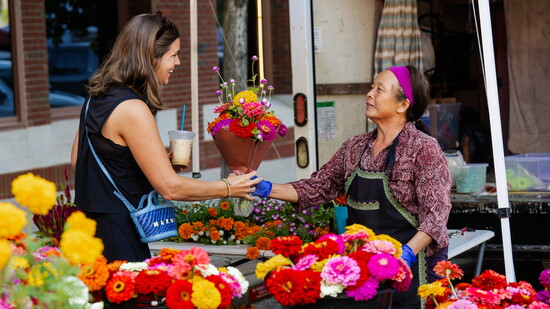
Whether you’re simply strolling through or arriving with a basket to fill, a morning spent at the farmers market has become a Saturday ritual for Fayettevillians.
We grab our veggies, pause as musicians play around the square, and settle on a bench as dogs pass by. We wait all year for summer peaches and crisp greens come fall. We take home bouquets for loved ones or sourdough to slice at breakfast.
We know how to enjoy the farmers market.
What we don’t always know is what happened before we got there.
Most food we buy doesn’t ask us to think very hard about where it came from. An onion appears in a grocery bin. Honey sits on a shelf. Cheese waits behind glass. We’ve become separated from the beginning of the story.
The farmers market closes that distance.
Here, the person handing you tomatoes worried about them through 100-degree heat. The person selling honey was awake until midnight moving bees. The person behind the glass can tell you about the years a cheese wheel spent aging.
The market is a collection of people who have built lives around growing things, sometimes deliberately and sometimes by accident. Their stories differ, but they keep showing up to the market. For more than 50 years, Fayetteville has shown up for them, too.
Mark Cain arrived at the market the morning after a hailstorm. He spent the evening cutting downed trees so they could leave the next morning. He still didn’t know what remained in the garden.
And yet, there he was at the market.
In 42 years of Saturday mornings, Cain has missed only one. That consistency has given the co-owner of Dripping Springs Garden a front-row seat to the market’s evolution. The market has grown, but the essence hasn’t changed.
“It’s a grower’s-only market,” Cain said. “It’s very strict.”
That structure dates to the market’s beginning. Founder Marcella Thompson helped establish the market around that idea. Its nonprofit structure placed governance in the hands of farmers rather than an outside board, preserving something increasingly rare: the food came from the farm represented on the other side of the table.
Cain knows how unpredictable farming can be. When he began in the 1980s, making a living growing organic produce was uncertain. Dripping Springs adapted by growing more of what sold. Increasingly, that meant flowers.
Today, Cain still stands at the market pulling stems into bouquets. Despite the previous evening’s weather, his response is simple: keep moving.
There is one thing he can predict. The people show up. “Rain or shine,” Cain said, “you’re as predictable as daffodils.”
That predictability makes it easy to forget every farmer had a first Saturday.
Morgan Boehm’s first farm was his backyard.
At 23, he rented a house with a quarter-acre backyard and no farming experience. He had never even been on a farm.
A flyer at Ozark Natural Foods led Boehm to Foundation Farm, where he learned techniques to recreate at home. He wasn’t planning to start a business. Then a Friday market opened across the street. Boehm loaded a wagon with vegetables, walked over, and sold them. The proceeds bought pizza and beer at Mojo’s.
“One thing led to another,” and in 2017, Boehm found the property that became Middle Fork Farm. Today, it has nearly 110 growing beds and six greenhouses. Farming at that scale hasn’t made nature more cooperative. Boehm has learned to protect what he can, accept what he can’t, and look beyond a difficult week.
After 20 years in Fayetteville and restaurant jobs before farming full time, Boehm sees familiar faces return week after week. Customers know he’ll be there. That consistency has built trust and a relationship that keeps him farming.
Boehm had to learn how to grow. For Xeng Lor, it was something she had always known: “It’s in the blood.”
Lor grew up in Laos, where farming was part of family life. After coming to the United States and eventually Northwest Arkansas, she decided to farm for herself. About 20 years ago, that path brought her to the Fayetteville Farmers Market.
The farm’s name is rooted in family. Lor grew up with six sisters and later had six daughters. When it came time to name it, one daughter landed on Sister's Sprouts.
Lor grows a little of everything, but flowers are her favorite. Perhaps that’s because flowers leave room for something else Lor values: making things her own. Farmers may grow the same things, she explained, but with flowers, everyone brings a different idea.
For some, farming is inherited. For others, the path appears by accident.
Caleb Hutcherson intended to play baseball. Life intervened. He returned home to his grandparents’ three-acre property in Prairie Grove. There was gardening. Then there were bees.
Hutcherson taught himself to catch swarms and relocate honeybees, some nights working until sunrise. He harvested honey from his first hive and sold out at the farmers market that weekend. One hive became 50. Then came the 2021 freeze, and Hutcherson considered quitting. But when spring arrived, his phone started ringing. Word spread that he was “the bee man.”
So he rebuilt.
Customers of C’s Bees ask about honey, and beginning beekeepers come for advice. “I want people to know where their food comes from, where it’s being produced,” Hutcherson said. Saturday is his day off, but he doesn’t consider the market work. Honey may bring someone to his table. By the time they leave, they know the work behind the jar.
A few tables away, another product carries a story of its own.
Tessa and Scott McCormick went from teaching science and math in California to a life filled with yurts, goats, and wheels of cheese aging in the Ozarks. After a medical disability and house fire, the McCormicks started White River Creamery in what the family calls its “silver lining.” They began something that couldn’t be hurried: building a creamery and becoming USDA certified.
Then came the goats. Fourteen eventually became 200. The herd is smaller now, but the cheesemaking continues. The process begins before the milk reaches the vat. The McCormicks place as much importance on caring for the animals and safely handling the milk as the cheesemaking itself.
The Fayetteville Farmers Market has been one of their greatest sources of support. The McCormicks have watched children arrive with their parents, grow up and eventually return with children of their own.
“The farmer’s market is more than just a place to buy food,” Tessa wrote. “It is a place to belong.”
Perhaps that is what makes this market endure. These are the people who quite literally bring food to our tables. They grow through hailstorms and heat and plant another crop knowing there are no guarantees. Saturday morning comes, and they carry the week's work to the square. We arrive with our baskets and leave with something grocery store shelves rarely give us: the beginning of the story.
The hands that feed Fayetteville are right there on the other side of the table.
"The farmers market is the heart and soul of Fayetteville. It has a pulse." - Mark Cain with Dripping Springs Garden