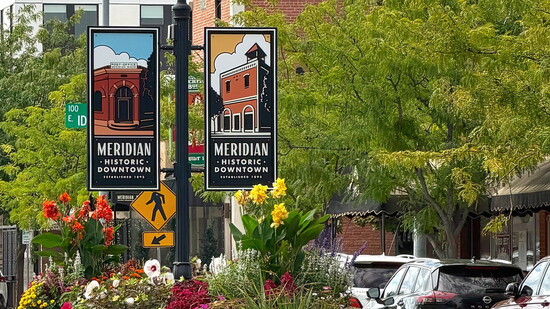
Music spills into the streets. There is a tangible energy. People take their time, discovering restaurants and businesses they may have driven past dozens of times. For a day, downtown Meridian feels like somewhere you simply want to be.
When Meridian’s Oktoberfest debuted in 2022, organizers hoped 3,000 or 4,000 people might attend. An estimated 10,000 showed up. One of the reactions that stayed with Meridian Chamber of Commerce President and CEO Sean Evans wasn’t about the beer, music or crowd size. “Wow, I didn’t know Meridian had such a nice downtown,” he remembers hearing.
For Evans, that response gets to the real purpose behind Oktoberfest. The beer may bring people in, but the larger goal is to help people discover downtown—and give them reasons to stay.
It’s the latest chapter in an effort that has been unfolding for more than two decades.
Creating a Place
Downtowns have always mattered to me. I grew up in Moscow, where we shopped, held parades, visited the candy store, enjoyed the farmers market, listened to music and created memories downtown. It was the heart of the community because it was a place people wanted to be.
During my 16 years as Meridian’s mayor, placemaking became an important part of how we thought about downtown: creating public spaces around how people would actually experience and use them. Sometimes, transformation happened one small project at a time.
Traveling, I found myself photographing the details that made places feel alive—outdoor dining occupying former parking spaces, lights and colorful umbrellas strung between buildings, public art, landscaping, inviting alleyways and streets that could transform into pedestrian gathering spaces. I came home with ideas for what might work in Meridian.
Some took root. Public art and murals brought color downtown. Utility boxes became canvases. Historical markers invited people to walk through Meridian’s past. Generations Plaza created a gathering place. The old post office and police station became a community center. Flowers, banners, concerts, a farmers market and other events added reasons to come downtown.
City Hall stayed downtown intentionally, bringing employees, residents and daily activity into the historic core.
Other ideas were harder.
We piloted outdoor dining that converted a few parking spaces into places for people. Patrons enjoyed it; critics focused on the three parking spaces that disappeared. Walking through a pedestrian-friendly downtown in Holland inspired the idea of a meandering water feature. I raised money for an interim project to demonstrate such a feature on 2nd Street by painting it down the center—a way to help people imagine a roadway that could serve vehicles at some hours and transform into a pedestrian gathering space at others.
That one still hasn’t happened.
But placemaking taught us something important: transforming a downtown rarely happens through one grand project. It happens incrementally, as people begin to see familiar spaces differently.
From Placemaking to Activation
Evans uses another word frequently: activation. The philosophy is familiar. Give people a reason to come. Give them reasons to move around once they’re there. And, most importantly, give them reasons to linger.
The Chamber learned something interesting while planning Oktoberfest. Traditional parades can bring thousands downtown, but spectators often arrive, claim a viewing spot and leave as soon as the parade ends. “We don’t need another parade,” Evans remembers hearing.
Oktoberfest was originally planned for 2021 but delayed until the following year. When it finally happened, the response demonstrated an appetite for something Meridian residents had once looked elsewhere to find.
“This is great that we have these things in Meridian now,” Evans recalls. “We used to have to go to Boise for activities like this.” Today, Evans sees downtown increasingly becoming an epicenter of its own—a place with restaurants, employment, entertainment and destinations that keep people here.
The Chamber’s downtown car show follows the same philosophy. Its first year drew about 135 cars and an estimated 1,000 visitors. This year, more than 200 vehicles were preregistered, requiring an expanded footprint. The point isn’t simply attendance. It’s what people do once they arrive. People stop for coffee, browse a shop, eat lunch, tour a building or discover a business they didn’t know existed.
That movement matters.
Reasons to Stay
For years, Meridian’s rapid growth was most visible around its edges: new subdivisions, commercial centers and destinations like The Village at Meridian. Downtown had a different challenge.
It already had history. What it needed were more reasons for people to stay. That is beginning to change.
Entrepreneurs such as Mike Garcia of Loose Screw Beer Co. and Josh Evarts of The Vault have invested in downtown because they see opportunity in creating experiences people can’t get from a drive-through commercial corridor. And more change is coming.
The stalled property near Meridian City Hall is being reimagined as Heritage Square, a mixed-use development planned to include office space, retail, multifamily housing and public plazas. If successful, it could bring something every downtown needs: people who are there not just for a special event, but throughout the day and evening.
That mix is what makes a downtown feel alive.
Evans imagines a future where residents might spend an entire day downtown without needing to leave—breakfast, shopping, an activity, lunch, maybe a little more wandering, followed by dinner or an evening event.
A staycation, without ever leaving Meridian.
What was once a small agricultural community is now one of Idaho’s largest cities. But growth doesn’t eliminate the need for a center. If anything, it makes one more important.
Downtown gives a community a place to recognize itself—not simply through buildings, but through shared experiences. That may be what events like Oktoberfest reveal best.
The strongest downtowns aren’t necessarily the biggest. They are the ones that create curiosity. They make you wonder what is around the next corner. They give you choices about where to eat, shop, gather or simply sit awhile.
They reward discovery—and create memories.
And somewhere along the way, people stop thinking of downtown as a place they came to visit.
They simply decide to stay.