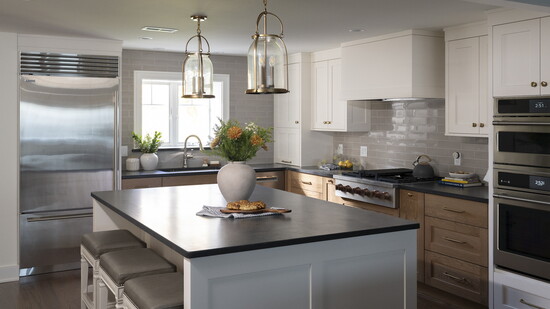
The kitchen has always been more than a place to cook. It's where family gathers, friends linger, and some of life's best conversations happen. For nearly 100 years, Heydlauff's Appliances has helped homeowners create those spaces. As the family-owned business approaches its centennial in 2028, we sat down with fourth-generation owner Jake Heydlauff and co-owner Jason Aguirre to talk about the trends, innovations, and practical advice shaping today's modern kitchen.
What are homeowners prioritizing in today's kitchens that they weren't 10 years ago?
One of the biggest changes we've seen is customization and personalization. Ten years ago, your options were pretty much stainless, black, or white. Today there are matte finishes, dark stainless — even black stainless has made its way into brands like Sub-Zero, which you never saw before. You can also customize the hardware, so it doesn't have to be the standard stainless. People want their kitchen to reflect their style and not look the same as their neighbor's kitchen.
Technology has also become a huge part of the conversation, and it's much more than being able to preheat your oven from the grocery store. Connected appliances now receive software updates, just like your phone. Manufacturers can add new cooking modes or even fix certain issues through an update. When I bought my range, it didn't have air fry. Then an update came through, and suddenly it did. Those kinds of updates help keep your appliances current even after you've brought them home.
Induction cooking is becoming increasingly popular. What should homeowners know before deciding if it's right for them?
Let's face it, the performance is better than gas in a lot of ways. You're boiling faster, cooking faster, the whole process is faster, and it's much easier to clean. It's also better for the environment because you don't have to worry about gas fumes or ventilation in the same way.
The biggest thing people should know is to make sure their cookware is magnetic. It's as simple as that. Old cast iron pans work fantastic. The way induction works is there's an inductor underneath the glass surface, but the glass itself doesn't get hot. Instead, because the pan is magnetic, the pan becomes the heat source. If you're using a pan that's smaller than the burner, only the area under the pan gets hot. That also means your control is immediate. You can bring something to a rolling boil, turn it down, and it responds right away. That's why people always used to prefer gas over traditional electric because they wanted that level of control. Induction gives you that same responsiveness.
It's also incredibly safe if you have young kids. I tell this story a lot on the sales floor. We went up north for a long weekend a couple of years ago, and when we got home, one of the burners on my induction range was still on. At the time, my daughter was three, so I'm sure she bumped it. But nothing happened because there wasn't a pan on it. It had been on for four days, and it simply timed out because there was nothing magnetic for it to connect to.
One thing homeowners should consider, especially in Ann Arbor where many homes are 50, 75, or even 100 years old, is their home's electrical capacity. We've seen situations where someone has one or two electric vehicles in an older home and simply doesn't have enough room in the electrical panel to add induction. It's not a dealbreaker, but it's something worth checking before you make the switch.
For someone who's never used a steam oven, what are they missing?
Everything. They're missing everything.
People hear "steam" and immediately think vegetables. That's the first thing everybody thinks of: "Why would I need a steam oven?" But it'll do seafood. It'll do meat. It'll do bread.
The reheat function is incredible because it uses a combination of convection and steam. I don't think people realize just how good the reheat function is in a steam oven. I mean, pizza, steak, chicken, anything. The steam remoisturizes food instead of drying it out like a microwave. You know what it's like to put a piece of pizza in the microwave. It comes out like cardboard. Sure, it takes a little longer in a steam oven, but you put a day-old piece of pizza in for 10 minutes and it's like having a fresh slice all over again.
Steam ovens are incredibly versatile, and I think it's just something people haven't learned enough about yet. Bread is another great example. It comes out moist on the inside, crusty on the outside. The technology has come a long way. Today's steam ovens ask what you're cooking, how big it is, and then set the programs for you. You're not just putting something into a steam chamber anymore — the convection feature gives you that crisp finish, too.
One of the coolest things about a steam oven is that cross-contamination isn't an issue. We used to cook couscous, asparagus, and salmon in the same oven during training. You'd think everything would taste like salmon, but it doesn't. In a traditional oven, everything picks up those smells because the food dries out. In a steam oven, the food absorbs the moisture instead, so each dish keeps its own flavor.
What's the biggest mistake homeowners make when choosing kitchen appliances?
Ventilation. Without question. It's always an afterthought, and it's a really important part of the kitchen experience. Somebody will buy a 48-inch gas range, get through the whole process, and then it's,"Oh yeah...I need a hood." Especially with those professional-style, higher-output BTU gas ranges, it's really important to have adequate ventilation.
A lot of people don't want to spend the money because they're already spending so much on the rest of the kitchen. And for code reasons, many homeowners want to stay under 400 CFM so they don't have to add what's called makeup air. That can get expensive because you're bringing conditioned air back into the house as you're pulling that much air out.
At the same time, you don't want to be setting off your smoke detectors or having ventilation issues that affect the whole house. That's why we always try to talk about the range and the ventilation together instead of treating the hood as the last thing to check off the list.
If someone loves to entertain, where should they invest first?
A beverage refrigerator. That's a big one. And a second dishwasher. For people who do a lot of entertaining, a second dishwasher is amazing.
The big thing with a beverage refrigerator is that your main refrigerator is already going to be full of food for the party. Having that second refrigerator, whether it's under the counter or one of the larger glass-door models, gives people a place to help themselves to drinks without constantly opening the main refrigerator while you're trying to cook.
A second dishwasher might sound excessive, but if you host often, it's a game changer. One dishwasher fills up surprisingly fast, and having two makes cleanup after a party significantly easier. One tip I always give people: bring a basket of your own plates when you're shopping for a dishwasher. Every dishwasher loads a little differently, and it's important to see how your plates fit.
What's one piece of advice you'd give every home chef before buying new appliances?
Start by thinking about how you actually cook and live, not what's trending.
Every kitchen is different, and every family uses it differently. You might cook large holiday meals and need one big oven. Or you might cook a lot of smaller things and would rather have two smaller ovens. Maybe fresh produce is a big part of your routine and extra refrigerator storage matters more than a specialty ice maker.
The best appliance isn't necessarily the one with the most features — it's the one that fits the way you use your kitchen. That's why we spend so much time asking questions before we ever make a recommendation. We want to understand how you cook, how you entertain, and how you use your space so we can help you choose something that's right for you, not just what's popular.
Interior Design by Amber Lisowicz Design
Learn more at heydlauffs.com.
PULL QUOTE:
"Start by thinking about how you actually cook and live, not what's trending. Every kitchen is different, and every family uses it differently...The best appliance isn't necessarily the one with the most features — it's the one that fits the way you use your kitchen."