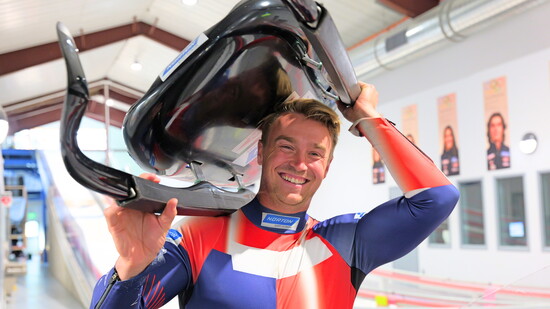
Tucker West’s journey to the 2026 Winter Olympics, like the luge tracks he’s slid on since childhood, has been anything but straightforward.
Now 30, Tucker spent his formative years in Ridgefield before relocating to Lake Placid, New York to follow his dream. There are less than a handful of luge tracks in North America at all, with the best arguably on Mount Van Hoevenberg in the Adirondacks.
Another one, incredibly, is on West Mountain Road.
While watching luge on TV during the 2002 Winter Olympics, 6-year-old Tucker and his father, Brett, caught the bug. They immediately immersed themselves in the thrilling and dangerous niche sport, which sees sliders zip down courses on sleds at speeds around 90 mph. Races are routinely decided by tenths of seconds.
To try and replicate what they saw, Tucker slid down hills at home; when those weren’t fast enough, Brett iced them over for less friction and more speed. Still not enough.
At this point, a diehard might have decided to build a giant Lego structure as an homage to luge. Brett took it way further: he built an entire track in his backyard.
“We got pretty fast on that,” Tucker told me years ago in Lake Placid, “like 45 miles per hour at top speed, just on those little flexible plastic sleds.”
No wonder, considering the homemade course is 485 feet long, with a vertical drop of 38 feet.
“There’s no scientific journal that has articles published about luge and equipment,” says 2018 Olympic silver medalist Chris Mazdzer, Tucker’s longtime teammate. (Maybe Brett should author one.) “And that’s challenging in the sport—especially for Tucker, because he always wants to give 100 percent.”
From West Mountain Road to Western Europe, the unofficial luge capital of the world, Tucker has kept it one hundred. Affable and athletic, he’s represented Team USA at three Olympic Games; when he made the 2014 team at just 18, he was the youngest male competitor in U.S. luge history. He’s won three gold medals on the World Cup circuit; when he conquered the Lake Placid event for the second time, in 2016, he did so by a margin of 0.006 seconds.
Luge races are measured by how you finish, but the start is critical to success. Before gravity helps take you down the serpentine course, it’s up to the racer to forcefully push off the block with both arms, then get settled into the sled. Few do this better than Tucker. He has won USA Luge’s start competition 13 times and has set records around the world for this integral part of the race.
“Going into this year, I really felt he would have broken every start record on every track that he went to,” says Mazdzer.
“I couldn’t be more proud,” says Brett, in a moment of reflection. “It’s just so amazing, the life that he’s had. He exploded on the scene when he was 16, traveling the world in the junior circuit. It’s been a hell of a ride for him, a great experience, and he’s learned a ton of life lessons.”
One of those lessons is disappointment. For all he’s achieved, Tucker has never put it all together at an Olympic Games, where sliders post an aggregate time over four heats. His 22nd-place finish in Sochi (2014) was a highlight simply because it was his Olympic debut. But with higher expectations at PyeongChang (2018) and Beijing (2022), Tucker’s best showing has been 13th. Go to Tucker’s profile page on TeamUSA.com and you can see the disappointment in his face (interesting photo choice).
After rounding the curve of his 20s, Tucker can see the finish line. He’s looking forward to starting a—some might say “real”—career and, as a married man, starting a family. That means this Olympic Games, no matter what happens, will be his last.
“I’m kind of in uncharted territory right now,” says Tucker, who is dealing with a neck injury at an inopportune time. “I’m really trying to take it one race at a time to see what my body will allow me to do. If I am fortunate enough to make it to the Games, that’s awesome. Hopefully we end it well.”
Some veteran Olympians might not be as graceful as Tucker was when adversity strikes. Especially when the sands of his Olympic hourglass are falling like a snowstorm.
“You have to fall in love with a sport that can break your heart,” says Mazdzer, who calls Tucker “the most disciplined, hard-working athlete I ever met in my 30 years at USA Luge.”
Ridgefield will be watching in early February to see if Tucker can end his one-of-a-kind career with a triumph. He has medal aspirations in both singles and the team relay, which includes men’s and women’s singles sliders, plus a doubles team.
The Wests moved from West Mountain Road in 2021, but the fabled track remains standing. On a sign attached to it, the last line reads: “The purpose of the track is to have family fun and to ignite Olympic dreams.”
It cannot be debated that the flame remains lit—not unlike the Olympic torch—for Tucker and all those who will follow in his legendary luge legacy.
“If I am fortunate enough to make it to the Games, that’s awesome. Hopefully we end it well.”—Tucker West