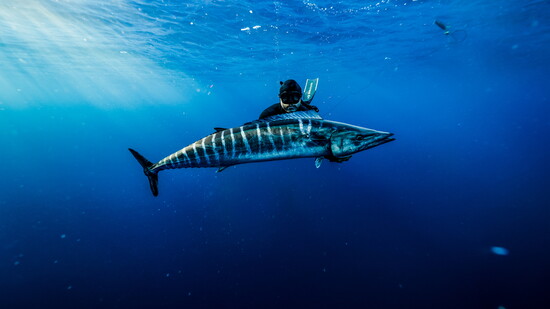
“In the ocean, everything is amplified,” says Justin Lee.
Lee remembers the day he discovered his son’s name while diving with a dear friend, Mike Hong. It was a joyous day spent floating in the blue. “I was trying to shoot this ‘ahi, and I missed a layup of a shot. The first thing that hit my ears was Mike Hong’s laughter.”
Lee eventually landed a large ulua, which felt like a consolation prize. The signs of a morning at sea were evident on his skin, warm and salty, as he drove home to his pregnant wife. His friend’s laughter echoed in his mind until a single word landed in his thoughts: pa‘akai.
Salt.
The word is a combination of pa‘a (solid) and kai (ocean water). The name means the solid form of the ocean.
“The importance of pa‘akai can never be overstated, because that is how the Hawaiians preserve the past to bring it into the future,” Lee explains. “You catch too much i‘a (fish), you simply put pa‘akai on it and you can eat it tomorrow. Pa‘akai is going to be the shoulders our lifestyle is carried into the future. He is going to be the salt we put on the stewarding of the land, the spearfishing, the archery hunting and having pride in your name. And whether he knows it or not, as a 6-year-old, he carries a lot of kuleana (responsibility).”
A National Spearfishing Champion who has represented Team USA in the World Championships, Lee is an outdoorsman, hunter and the subject of several documentaries. He lives a life that commands respect. Yet, when asked to share on what truly matters, Lee speaks most deeply of his family, heritage and responsibility to pass down a lifestyle rooted in mālama ‘āina (care for the land).
Lee grew up in Honoka‘a as the middle of three sons. His father, a teacher, was a patient man and the catalyst for Lee’s love for the land and sea. His mother, a nurse and a strong Filipino woman, was essential to raising three wild boys who frequently returned from adventures with minor injuries.
His childhood was spent entirely outdoors, turning every moment into a friendly competition with his brothers. This environment pushed Lee to develop the skills he relies on today.
A scar runs across his stomach—the remaining mark of a battle with cancer as an infant. Because he could not undergo traditional treatment at the time, doctors removed his right kidney, half of his liver and his right adrenal gland.
“Because of my brothers, I never got treated like the sick kid,” Lee says. His brothers used to joke that the reason he could hold his breath so long was that he simply had fewer organs taking up space.
“Looking at the scar on my stomach reminds me that I’m living on borrowed time to the fullest I can,” he says. “Nothing is unattainable.”
With contact sports sidelined by his medical history, Lee turned to the water, where he broke state records as a high school swimmer. This evolved into a practical pursuit—and the brothers’ fiercest competition: Who could best provide for the family dinner? Later, mastering the bow and arrow created a greater challenge and a deeper connection to the land.
“Because of the speargun and the bow, I’ve gotten to see parts of the world I never would have otherwise,” Lee says. “They are the reason I swim to the bottom of the ocean or climb to the top of a mountain. You notice so much more in that hunter mindset. Some of my favorite spearfishing stories have nothing to do with pulling a trigger.”
He recalls a dance with a whale shark—45 minutes of connection between man and beast in total isolation. As the shark departed, it circled back with two mahimahi on its tail as a parting gift. Lee brought one home for dinner.
“It was the most magical moment,” he says. It took 30 years of being in the water to experience that interaction.
Lee’s accomplishments set him in the international arena. At the World Championships in Greece, he speared a fish at 192 feet on a single breath. He finished ninth in the world—the highest American ranking in three decades. While he went on to compete in Portugal and Spain, he has recently stepped back to focus on his family as his wife navigates her own battle with cancer.
At home, he is teaching his children the "why" behind their lifestyle: why they catch only certain fish, and why they take only enough for dinner. In 2010, his family purchased 3,000 acres of land dedicated to restoring native Hawaiian forests. The project, Hāloa ‘Āina, has seen the planting of 1.5 million native trees, ensuring the island's water cycle remains healthy.
As a father to a "feral boy and a princess wearing camouflage," Justin Lee embraces a masculinity defined by protection, stewardship and care.
“I take my kids to the top of the mountain and teach them the importance of growing trees to collect water,” Lee says. “Everything flows downstream. We’ve got to take care of the island to take care of the ocean. There is a connection all the way through.”
Though he has seen the world, his favorite palace is home: Honoka’a.
“I have so much pride in this town, this coastline and these mountains. I want the next generation to have these same places,” Justin says.