When people think about investment, they often picture financial portfolios or retirement plans. But Theresa Hubbard believes one of the most important investments anyone can make is in their own mental, emotional and nervous system well-being.
As a licensed marriage and family therapist and founder of the Kansas City Neuroplasticity Institute (KCNPI) in Liberty, Theresa has built her work around helping people strengthen their internal systems so they can live with greater clarity, resilience and intention.
For Theresa, that investment starts with understanding the brain’s remarkable ability to change through neuroplasticity.
“Our brain, our entire life, until we take our last breath, has the ability to change,” she explains. “We didn’t use to believe that…[but] our brain has this ability to rewire itself if we help it along.”
That concept of neuroplasticity is the foundation of the Kansas City Neuroplasticity Institute, where Theresa and her team combine traditional talk therapy with advanced tools designed to help clients retrain their brains and nervous systems.
“From a mental health perspective, that is KCNPI — that is traditional talk therapy, neurofeedback, the Shiftwave chair, and different trauma modalities that we offer called EMDR, or brain spotting or hypnotherapy,” she says.
At KCNPI, Theresa and her team use different tools, such as traditional talk therapy, neurofeedback, the Shiftwave chair, EMDR, brain spotting, hypnotherapy and more to help support people on their healing journey. KCNPI offers a multidisciplinary approach that addresses emotional patterns, trauma responses and nervous system regulation.
One of Theresa’s primary goals is to help people pause and respond to life with intention rather than reaction.
“What people will notice as they develop that pause,” says Theresa. “They’re able to reflect before they make a choice, so they’re acting from more intentionality than reactivity.”
Another unique offering at the institute is the Shiftwave chair, a nervous system training device that uses rhythmic stimulation to guide the body into different states such as relaxation, focus or sleep. For Theresa, tools like this represent another way people can invest in strengthening their nervous systems and building resilience and balance.
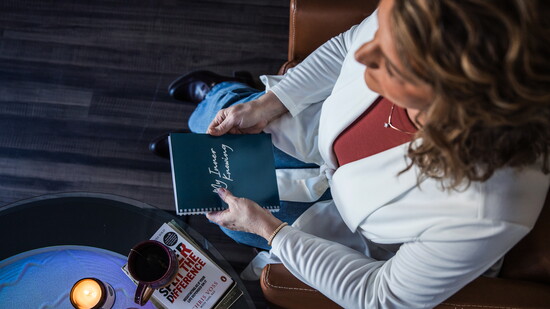
But Theresa’s work extends beyond her therapy office. She also reaches people through her podcast, My Inner Knowing, which releases new episodes every Friday.
The podcast explores themes such as emotional awareness, relationships, grief and self-trust. Its central message focuses on helping people develop deeper curiosity about their inner lives.
“It’s all about learning to trust ourselves, increasing our knowing, paying more attention to ourselves, asking ourselves deep questions so we understand why we’re doing what we’re doing,” Theresa says. “Most of us don’t.”
Rather than simply discussing these ideas conceptually, Theresa structures the podcast to demonstrate them in real time.
“The point is to model how to do those things, not just talk about it,” she says. “Most people are talking about it. For me, the goal is always to show people.”
Some episodes feature conversations with guests, while others involve guided reflections or discussions. Theresa often invites guests to demonstrate their practices directly so listeners can experience them themselves.
“You can come on and talk about it, but you have to show us — we have to do it,” she says.
Theresa also shares guided meditations and live sessions through the Insight Timer app, a global meditation platform with a large library of free content. The app allows her to connect with listeners around the world without advertising or paywalls interfering with the experience.
Once a week on various days, she hosts live meditations that bring together participants from multiple countries.
“I may have people from India or the Netherlands joining me because…they just picked up their phone and thought, ‘I need a little something,’” she says.
Whether through therapy, brain-based tools, meditation or conversation, Theresa’s work centers on helping people become more aware of their internal patterns and choices.
Ultimately, she believes that investing in mental and brain health expands a person’s entire world.
“It’s also presenting resources that you in your small world just may not even know about, whether it’s a book or a modality or a treatment provider,” she says. “It makes your world bigger.”
And that expanded perspective, she believes, is one of the most valuable returns a person can gain from investing in themselves.
You can learn more about Theresa and her work at the Kansas City Neuroplasticity Institute at kcnpi.com. You can also listen to her podcast, My Inner Knowing (available on all major podcast platforms), or download her free meditation app, Insight Timer.
“It’s all about learning to trust ourselves, increasing our knowing, paying more attention to ourselves, asking ourselves deep questions so we again understand why we’re doing what we’re doing."