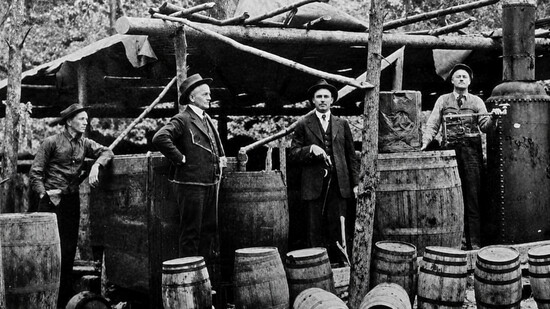
The Utopia that General James Oglethorpe envisioned for the Georgia Colony has been a long time in coming, but we're getting closer. Slavery, initially outlawed, crept in quickly and took almost 100 years to eradicate, over the objections of Georgia Governor and Canton resident Joseph Emerson Brown. Alcohol restrictions would take even longer, with Cherokee County's John Henry Hardin producing corn liquor during Prohibition on a scale large enough to be branded as "The Moonshine King."
It was on June 9th, 1732, that the charter for the Georgia Colony was finalized, the state named in honor of King George II, who granted the charter. It was the last of the 13 colonies, chartered just over 50 years after the twelfth (Pennsylvania). From the beginning, the gap between his vision and that of the King and the various corporate entities involved was vast.
The Crown, the Carolinas Company, and the Virginia Company saw it as a buffer state and garrison province to defend the southern colonies against Spanish Florida. They imagined a province populated by stalwart farmers that would guard the border. Oglethorpe imagined a colony populated by English subjects imprisoned for debt, "the worthy poor" as he called them, who would be given a chance to start anew. At Oglethorpe's insistence, slavery was outlawed, as were alcoholic beverages. When one realizes that the Southern Colonies were founded on rum, slavery, and tobacco, Georgia emerges as entirely different than its neighbors. Oglethorpe also enforced a system of smallholdings rather than plantations, in part to avoid slavery and in part to allow for a greater population of farmers/citizens. When Oglethorpe returned to Britain in 1743, his vision of Utopia went with him. He never returned; in 1751, the slavery ban was lifted, and by 1755, the proprietary colony failed outright, and the province returned to being a Royal Colony. By 1760, King George III now ruled England, and at the conclusion of the French and Indian War in 1763, he extended Georgia's southern boundary to its current border, along the St. Mary's River. The British would control Florida for the next twenty years, so Georgia was no longer needed as a buffer colony, and by now, Oglethorpe's restriction on liquor and his maximum allowance of fifty acres were both gone.
It's fair to say Georgians were drug into the war after violence erupted in Massachusetts. Radical patriots stormed the royal magazine in Savannah and carried off its ammunition. Loyalists were expelled, and in 1776, a provincial congress declared independence and created a constitution. The last Royal Governor, James Wright, had dismissed the Royal Assembly late in 1775 and escaped to a British warship in February of 1776 after briefly being captured by the revolutionaries. Wright regained control of Savannah on December 29, 1778, restoring British rule along the coast, driving the patriots inland. In 1779, the Continental Army attempted to retake Savannah but failed; in 1781, it succeeded in retaking Augusta. By 1782, the War was over, and in July of that year, British forces evacuated Savannah.
By the end of the War of Independence, Georgia had become like every other Southern Colony, with the exception that, while legal, slavery remained unpopular, especially with Scottish settlers. Scots settlers used to colder climates, mountains, and skilled miners preferred the piedmont and North Georgia mountains to the plains, and so it's no surprise that when the vote for succession came into play, most of the northern counties voted against; the greater number of voters of the southern plains counties carried the day. Canton's own Joseph E. Brown, the Governor at the time, was representative of the prevailing attitude. He thought slavery benefited the state's economy as a whole and was against its abolition. At the same time, he had no interest in allowing Richmond to simply replace Washington as having Federal Authority. When he asked Jefferson Davis to allow some of the state's volunteers to defend Georgia's borders, Davis declined. Later when Davis asked for additional troops, Brown would turn him down. Governor Brown believed that the South's only real hope lay in preserving the Confederate industrial production and supply chain in Georgia. It was the engine critical to the Confederate cause. The Union agreed, thus Sherman's march through Chattanooga to take and burn Atlanta, followed by his march to the sea, which did in fact break the back of the Confederacy.
Governor Brown, for his part, would be imprisoned less than a month before receiving a pardon from President Andrew Johnson. He'd renounce slavery and embrace reconstruction. He even championed the education of emancipated blacks after the war, believing that "having been granted freedom, we must now teach them what they have gained," and by extension how to profit from it. Oglethorpe's dream of abolition in Georgia had now been achieved, 120 years after his departure, and only after a conflict that had almost permanently divided the colonies.
And what of his ban on alcohol? Here, a longstanding battle between Scottish Highlanders and British tax collectors left the shores of the United Kingdom and replayed itself in the American Colonies. At the end of the Revolutionary War, President Washington introduced a tax on liquor designed to collect enough to repay the nation's war debt was enacted at the suggestion of Alexander Hamilton. In the absence of taxes on other industries, farmers viewed the tax on their production as unfair, and from 1791-1794 Washington personally led the US militia westward through Pennsylvania to quell the Whiskey Rebellion. Some of the rebel leaders lost their lives, and around 150 rebels were captured. Ultimately, ten of the fourteen ring leaders of the Whiskey Rebellion were pardoned by President Washington, and the usurious tax was repealed.
The tax was reintroduced by the Union during the War between the States, once again to cover the costs of the war effort. The Confederacy never enacted such a tax; when the War ended and Southern farmers found themselves subject to a tax, they unsurprisingly rebelled just as Pennsylvania farmers had 70 years before. North Georgia farmers in particular continued to produce untaxed and therefore illegal liquor; revenue agents sent to collect the tax faced immense danger. Federal troops were sent in to enforce the tax, but moonshining went on, more or less unabated. In 1885, moonshiners from Moccasin, Georgia, actually laid siege to a hotel in Highlands, North Carolina, to free men arrested for producing moonshine. The North Georgia Whiskey War was in full swing.
By 1908, the State of Georgia had entered the effort, enacting a statewide prohibition of liquor long before the Federal Prohibition in 1920. While state and later federal efforts to control liquor production increased, it only served to intensify the "war" as moonshiners and bootleggers continued to clash with authorities. Bootleggers modified cars to outrun "revenuers," from which stock car racing emerged. Federal Prohibition of alcohol ended in 1933; Georgia ended its prohibition in 1935, but many counties and localities continued to prohibit its sale into the 1970s.
Here in Cherokee County, this is where the legendary moonshiner John Henry Hardin, the "King of Georgia Moonshiners," rose to fame. John had worked at the Franklin-Creighton Gold Mine until it collapsed and closed for good in 1908. Thereafter, he bought large tracts of farmland along the Cherokee-Bartow County border, fertile but also subject to flooding because they were adjacent to the Etowah River. In 1916, flooding ruined his crop; a farmhand suggested that the flood-damaged crop could still be used to make corn liquor, and, facing foreclosure, the Sunday School Teacher and choir member at Sixes UMC learned how to do it. For the next quarter of a century, Hardin produced corn liquor at such a scale that he became the second largest employer in the County and ran the largest moonshine operation east of the Mississippi.
John Henry Hardin never imbibed his product. Likewise, he never transported it; if you wanted it, you came and got it. He'd buy his neighbor's production at half price and resell. He made the rounds each morning in his truck, driving neighborhood children to school. He was released on his own recognizance before his federal trial, on the belief that if Hardin said he'd be there, he would. Even the revenue agent who secured his conviction, Duff Floyd, stated, "Outside of his illicit liquor business, John Hardin is the most ethical man I know."
Of course, Georgia's contribution to these United States is so much more: it's Ty Cobb, Bobby Jones, Jackie Robinson, Hank Aaron, Dominique Wilkins and Herschel Walker. It's also Margaret Mitchell, Flannery O'Connor, and Alice Walker. It's MLK and Jimmy Carter; it's Ray Charles and James Brown. It's Georgia Pacific, Home Depot, and Coca-Cola, and it's gold, granite, and marble. And it's Sequoyah, the creator of the Cherokee alphabet. For more stories like this one, check out "Witness of the Times," a history podcast by Dr. Bruce Baker.
A CONTRIBUTION CARVED IN STONE
Many of us know that North Georgia was home to one of America's great gold rushes, with the US installing a mint in Dahlonega to convert the gold mined into coinage. But Georgia's greatest ore contribution to the US, by far, is marble. Marble of many different colors and shades has been mined extensively in Cherokee, Pickens, and Gilmer Counties, and graces many of the buildings and monuments in our nation's capital: The Lincoln Memorial, The US Capitol, the Air and Space Museum, the John Adams Building, and most of the gravestones in Arlington National Cemetery. It was used to build Chicago's iconic water tower, and in New York, the New York Stock Exchange Building, the Museum of Modern Art, and the Swan Building are all made of Georgia marble. Here locally, you can see the linen white Murphy Marble on the old Cherokee County Courthouse in Canton, and the rosy salmon Etowah Marble of the Tate House in Pickens County. The History Center has an exhibit that has a slab of deep green Serpentine marble from an old mine in Holly Springs.