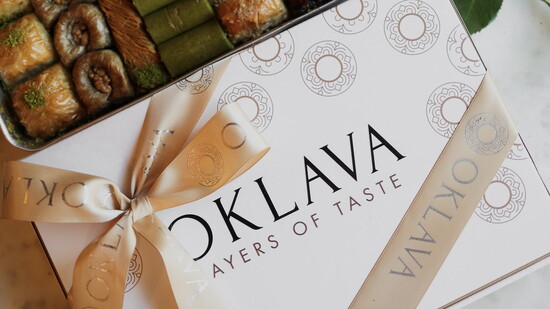
Elif Uzun, co-owner of Oklava, remembers her first Palo Alto evenings ending earlier than she did.
She and her family fell in love with the town fast: the energy, the startups, the mix of people and cultures, the sheer range of places to eat, all of it within reach. The days were never the problem.
"I remember evenings after we first moved here when everything around us seemed to be closing, but I still had so much energy," she says. "I would think, I just want somewhere nice to sit, have a hot tea, and keep talking."
In Turkey the block would still have been open. Sitting late over tea and dessert is an unremarkable Tuesday there. "Nobody is watching the clock," she says.
That gap, between the town she had chosen and the one she missed, is where Oklava came from.
She and her business partner, Aziz Aslan, opened it at 205 University Avenue in June 2023, four months later than they meant to. Storms had flooded the space that January, two weeks before the original date. "Water was pouring from the ceiling," she told Punch Magazine. "Everything was ruined." She did not go looking for another address. The idea behind it had already taken shape — a small bridge back to the things she missed, with a name to match.
An oklava is a rolling pin: long, tapered, no handles, used to work dough out to the width of paper. It is the tool behind every sheet of phyllo in the case, which is exactly why she put it on the sign.
Two things came over intact from Turkey: the long breakfast and the late table. The breakfast is served here all day and every day, arriving as tomatoes and cucumber, olives, pastirma, white cheese, and honey with clotted cream. Order it for two and the table also gets scrambled eggs, an Anatolian börek, and simit. It is nothing like grabbing a pastry on the way out the door.
Tea does most of the work. In a Turkish home there is nearly always a pot going somewhere in the house, and it gets poured for reasons that barely qualify as reasons. Someone comes by, you pour tea. You sit down to talk, you pour tea. Children start on a weakened version the adults call pasha tea — and somewhere along the way, without quite noticing, they fall in love with it. Grown-ups take it dark, brewed to a particular deep red that has a name: tavşan kanı, rabbit's blood. Elif will tell you, with some pride, that a Turk can drink a glass at ten at night and sleep perfectly well.
That is a habit with a business plan inside it. The room opens at eight every morning and stays open until eleven every night, which makes a fifteen-hour day, every day. You can order tea by the glass, or by the thermos, which holds eight cups (enough to keep a table going the whole evening).
The room was built for that hour. Elif's father taught literature, and she grew up reading Turkish writers who gathered in coffeehouses to argue and to work. She wanted a room where that was still possible, a time capsule, she says, that could carry you to Turkey through the artwork, the colors, the details, without tipping into a theme. The space she took, across from Lytton Plaza, is narrow and long, with more wall than most rooms know what to do with. She lined the back one with a mural of Ottoman coffeehouses and gave another to historic portraits tracing the history of baklava.
The case behind the counter runs to seventeen kinds of baklava, listed as Mussel Shape with Pistachio, King Shobiyet, Carrot Slice with Walnut, and fourteen more. Some of it arrives from Şekerci Cafer Erol, a confectioner in Istanbul, finished in the kitchen here; the rest of the case is made fresh, including desserts most people crossing University Avenue have never heard of: supangle, trileçe, profiteroles, a cake called Malaga.
Around it sit the syrupy desserts and the milky ones, künefe that takes twenty minutes because it is not started until you order it, and thirty-odd kinds of Turkish delight sold by the pound, which you pick out by hand. Poğaça comes five ways, from plain to olive. But the menu also keeps an easy way in: you can order an espresso or a latte you already know, and right next to it, on the same list, sits Turkish coffee and Turkish tea. "There's always an easy way in," Elif says, "and then something new to discover." You can walk in knowing exactly what you want and leave having eaten something you cannot pronounce.
Ask Elif who comes in and she describes people: families with young kids, a startup team working through something, students behind laptops, someone at the far end alone with a book. What she notices most, though, is the returning face — the person who was here last week and is here again. "That's when a café starts to feel like part of a neighborhood," she says, "rather than simply a business."
She hopes people leave having found something they didn't expect — a latte-drinker who discovers Turkish coffee, a first taste of trileçe or supangle, a quick breakfast that turned into something longer. The food matters, but so does the rest of it. If someone walks out knowing a little more about Turkish culture than they did walking in, curious enough to try another dish, or even to visit Istanbul someday, she counts that as a win.
Late in the evening she will sometimes look up and find a table that has been there a while. The tea glasses are empty. There is a dessert in the middle nobody has finished. No one is gathering their things.
She lets them sit.
"Everything around us seemed to be closing, but I still had so much energy ... I just want somewhere nice to sit."
"That's when a café starts to feel like part of a neighborhood, rather than simply a business."