The iron gates standing at the edge of Woodmont’s shoreline are not just a property boundary; they mark the threshold to an era when the Connecticut coast was the primary vacation location for entertainment royalty.
The story of Villa Rosa and the surrounding homes began with wax. Sylvester Poli arrived in America not as a businessman but as an artist.
“He came to America as a wax sculptor,” explains a descendant of Poli. “His name was Zepherino, middle name Sylvester–S.Z. Poli. When you came to America, you had to have an American name, so he picked Sylvester because he was born on St. Sylvester’s Day.”
The wax museums were the primary source of visual news for the public, often displaying notorious convicts and other notable figures. In fact, Poli’s wife and daughters would often assist in the craft, with family stories recalling how they would hand-inset individual hair follicles to ensure total authenticity. To draw crowds into these museums, Poli began placing song-and-dance acts on the street to grab attention.
“That eventually turned into vaudeville,” explains Charlie Nolan, a great-grandson of Poli, and a resident who owns one of the cottages next to Villa Rosa with his siblings. “He was one of the originators of vaudeville because of that work.”
Indeed, Poli was one of the true originators of the genre, eventually building a massive circuit of ornate theaters that stretched from Philadelphia, Pennsylvania, to Worcester, Massachusetts. At his peak, he owned nearly 40 theaters, including three in New Haven and two in Bridgeport. For those seeking to understand the “Poli Flair,” as Charlie describes it, one need only look at the Waterbury Palace Theater, a perfect representation of his style.
“Once you see the Waterbury Palace, you’ll see the intricate workings, the carvings, the marble,” he says. The theaters were nationally renowned palaces of marble and intricate details, using Italian artisans to create architecture that brought European influence to the American public.
However, life shifted dramatically for Poli in the 1920s when his son and intended heir, Edward, died of appendicitis.
This tragedy prompted Poli to sell his massive business to Loew’s Theaters. After the sale, he hunted for property along the Connecticut coast from Greenwich to New Haven until he found a specific point in Milford where he could build a family compound for his children and grandchildren. Poli’s vision for this compound was a Mediterranean-style sanctuary where his family could reside together.
To cultivate the space, he created a massive seawall as the foundation for what would become a private family community. Due to his immense wealth, he was one of the few individuals across the country who could afford the highest level of craftsmanship. In fact, he employed the same Italian stonemasons and artisans who were building the Gothic structures at Yale University, bringing Ivy League-level designs to the Milford shoreline.
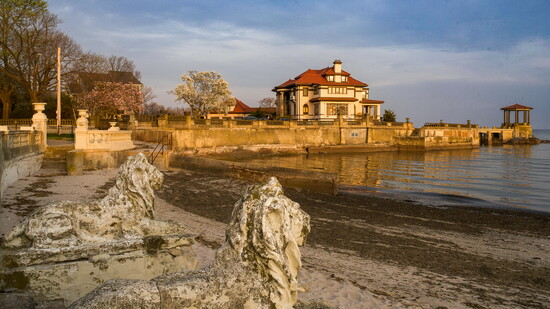
The estate was reminiscent of the mansions described in F. Scott Fitzgerald’s The Great Gatsby, and was a model for the opulence of the 1920s. The main residence featured a boathouse for two boats that led directly into a private screening room. This room was a bridge between the era of Vaudeville and the birth of modern cinema, featuring projectors, lighting systems, and seating.
Long before home theaters, Poli held pre-screenings of movies in the basement. Family stories recall limousines lined up around the circular drive with movie stars waiting for premieres at the house.
“We have pictures of all the limousines lined up,” a descendant recalls. “And they’re really famous people…standing in line for the opening in the basement of that house.”
A massive patio on the side of the structure features columns that extend 40 feet toward the water and is equipped with men’s and women’s changing rooms for guests. Guarding the structure are two massive lion sculptures, crafted by Edward Clark Potter – the same sculptor who designed the Patience and Fortitude lions outside the New York Public Library.
The estate became a social hub for the elite, hosting galas, parties, and events. Charlie explicitly recalled a family story surrounding a famous wedding in the 1930s of his Aunt Lilyto an Italian Marchese. To celebrate the wedding, Aunt Lily was sent off in a seaplane that landed right on the water to take the newlyweds away to Newport, Rhode Island.
Today, the Poli heritage lives on through the fourth and fifth generations. While many original family homes were sold over the decades, the commitment to the land remains an important aspect for the extended family. 10 Villa Rosa Terrace is still owned by Charlie and his siblings – Laureen, Thomas Jr., Cathy, and Susie. They are all great grandchildren of Sylvester Poli.
“I’m fortunate enough to be the primary steward of my family home,” says Charlie. “I’m the guy cutting the hedges, raking the beach, and hosing the porch down…so when everybody comes in, they feel welcome.”
However, there is also a profound commitment to the family name. Many of the male descendants carry “Poli” as a middle name, a tradition intended to ensure that while last names like Nolan may take prominence, the family name remains on their birth certificates.
Even in death, the family remains close. At the St. Lawrence Cemetery in New Haven, the largest mausoleum serves as the final resting place for several generations of the family. It features an altar and eight burial spots, a place for the grandchildren to see their name carved in stone and memorialized for centuries.
Life at Villa Rosa is defined by deep traditions that have survived the changing landscape of Milford. The estate has weathered the storms of the Atlantic, with the family recalling the devastation of Hurricane Irene and, more recently, Hurricane Sandy. These storms completely leveled the historic seawalls, but each time, the family has rebuilt.
The biggest event of the year for the family is the Fourth of July, when the whole place is “lit up,” and cousins from all over fight for parking spots to celebrate with the next generations and share in their family's history. Every year, the family harvests steamer clams from the sandbars during the weekend.
“We all grew up with that tradition,” recalls Charlie.
The proximity of the property to what is currently Anchor Social reminds the family of the original Woodmont trolley station that previously stood in its place. The station was converted by Poli into a restaurant for his grandson and Charlie’s father, Thomas Poli Nolan, and was known for years as Tom’s Villa Rosa.
The future of the estate rests on the shoulders of the younger generations. The family is currently working to archive their history, acknowledging that the story is a “puzzle” with pieces and anecdotes scattered among various relatives. From the original wax molds stored in Charlie’s attic to the grainy photos of seaplanes on the Sound, the effort to archive their family story is about connecting fragments into a cohesive narrative. In fact, Charlie recalls that many of his siblings, cousins, and other descendants have cherished historical memories through photographs as well.
“We’re all engaged to keep it as a family home for generations to come for the historical legacy,” says Charlie.
There is a collective sentiment to ensure the legacy does not go to the wayside. Despite the grand and opulent history of the property, the descendants of Poli stay grounded, seeing themselves as lucky and fortunate to have this legacy to carry on.
As the fifth generation continues to fish off the same seawall their great-great-grandfather built, the rich history embedded in the Poli family remains unbroken by the passage of just over a century. The hope is that the city of Milford always remembers the man behind the gates.
"The estate was reminiscent of the mansions described in F. Scott Fitzgerald’s The Great Gatsby, and was a model for the opulence of the 1920s."
Rosa Poli
Rosa Poli was born in Genoa, Italy, and came to America at age 10. She married Sylvester Poli at 16 and worked alongside him from the very beginning — helping build the wax museum displays that would eventually grow into a 30-theater empire across the Northeast. Beyond her role in the business, Rosa was a devoted philanthropist, raising funds for veterans and the disabled, efforts that earned her the Italian Cross of Honor from Queen Elena of Italy. She died in 1960.