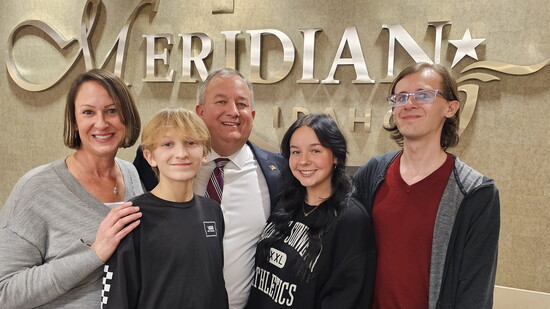
I knew Robert Simison long before he became Mayor.
For thirteen years, he served as Chief of Staff—steady, disciplined, and deeply trusted.
What struck me in sitting down with him now is that the qualities people see in public are not separate from who he is at home. They are expressed more subtly there—in the kitchen before everyone else is awake, in the care he gives his home, in the meals he prepares, and in the way he gathers people around a table.
When he talks about a good day off, there is no performance in it. In winter, it may begin on a ski slope with family. At home, it starts earlier and more simply: cleaning the kitchen before everyone else is awake, putting the house in order, tending the yard, organizing the garage, taking care of the details that make a home feel cared for. He enjoys accomplishing things with his hands. He likes seeing the result.
That thread runs throughout his life.
Raised outside Pocatello on five acres, he grew up doing things because they needed to be done. Mowing the lawn. Pulling an engine out of a Volkswagen. Learning, even through complaint, the satisfaction of finishing a job and seeing where it could have been done better. It is a quality I had seen long before the title—less in what he said than in how he worked, steadily and without needing to be seen doing it. That same mindset still shapes him now, whether he is repainting his house, building a wine cellar, or helping shape a city. “I like seeing the end result,” he told me. “You can still be proud of what you did.”
At home, that steadiness also shows up in hospitality.
Robert loves to cook, though not in the way some people collect recipes or chase novelty. His approach is simpler and more revealing. “I don’t need to be great at cooking 50 different meals,” he said. “I need to be able to create one or two meals and just do them well.” There is discipline in that, but also care. He wants the food to taste good, but he also cares about presentation, about creating what he called a “simple elegance” around quality food.
And he cares deeply about what happens around that meal.
To Robert, having people in his home is about more than entertaining. It is about friendship, connection, and creating the kind of evening where people linger long enough to truly know each other. “A great meal can connect you that much through the food, through the conversation, through the wine,” he said. In his view, a rushed dinner is not quite the same thing. It is the longer evening—the three-hour experience—that creates room for real conversation and unexpected connection.
That sense of intention carries into family life as well.
When I asked him what being a dad taught him that leadership never could, his answer came quickly: sacrifice, patience, and perspective. “Being a father definitely taught me patience,” he said. More than that, fatherhood sharpened what matters most. “What does matter to me is the health of my family,” he said. “That is first and foremost of all decisions.”
He has lived that conviction. Each time he considered running for office, he sat down with his family and talked honestly about the impact his role would have on them. Their happiness and their health mattered. It was not a symbolic conversation. It was part of how he decided whether to serve.
His faith and extended family have also anchored that life in meaningful ways. During Jenny’s health challenges and surgeries, he points first to God, but also to the steadfast support of her parents, who have long been woven into the daily life of their family. Their presence, he said, helped carry them through those years and shaped the lives of their children in lasting ways.
Though Robert’s life has taken him far beyond Idaho—from Whitman College in Walla Walla to time in Washington, D.C.—he and Jenny knew they wanted to return to Idaho to raise their family. Idaho offered more than geography. It offered a way of life. He described it as a kind of rugged independence rooted in being a good neighbor while still wanting the freedom to be left alone. It is a description many lifelong Idahoans will recognize immediately.
Wine, too, fits naturally into that world. His appreciation for it deepened through Whitman and repeated visits back to Walla Walla, then grew through relationships with wineries and winemakers whose wines matched his palate. His philosophy is direct: “I don’t need to know a lot about wine. I just need to know what I like.” He values what is genuine, what is well made, and what deepens over time.
In the end, titles come and go. Roles change. Public service has seasons.
But the clearest picture of Robert Simison is not found only in the office he holds. It is found in the life he has built—through family, faith, friendship, hospitality, and the steady satisfaction of doing the work in front of him well. Long before the title, it looked much the same: work done early, before most would notice, the result left behind for others to step into.