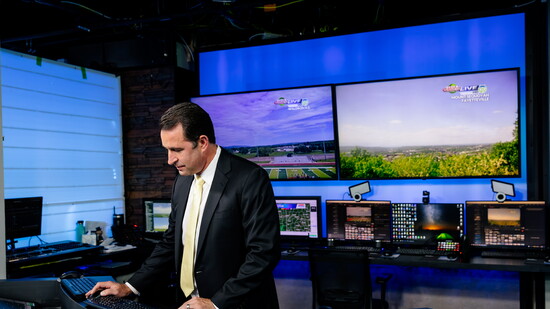
On the night of May 25, 2024, when most were settling in for a typical Memorial Day weekend, a team of people were awake, focused, and watching as the radar predicted the next harrowing hours. One man led the team. He had been preparing, even hours before, at his wife’s birthday dinner. He knew that this would be serious.
By 11:30 p.m. sharp, he was live on air. He and his team provided a constant stream of information to the public until 9:00 a.m.
Two of the largest tornadoes in Arkansas history touched down that night. And through every update, every warning, and every shift in the storm’s path, he and his team remained steady. He was the calm voice thousands of people turned to as the sky changed.
For nearly twenty years, Dan Skoff has been the person Northwest Arkansas relies on when the weather dramatically fluctuates. His job is science, communication, and instinct, shaped by a lifelong fascination with storms and a deep commitment to helping people understand what’s coming.
Dan Skoff always knew he wanted to be a meteorologist. Long before the cameras and awards, and severe late-night weather coverage, Skoff was an eight-year-old kid from Milwaukee, who loved the weather. He constantly asked his father questions, and as the questions began to get more difficult, his father started making up answers. Eventually, he told him, “Why don’t you study this stuff if you love it so much?”
Then came the tornado.
A tornado ripped through his city, so close that it shook his house, and ripped an oak tree bare. He remembered emerging from the basement only to find clear skies and a rainbow shining above. As if nothing happened, but only a quarter a mile away his friend’s house was completely gone.
He had so many questions, but he knew one thing, “I’m studying this stuff for the rest of my life.”
And he did, after receiving his degree from the University of Oklahoma, he began his journey to the meteorologist he is today. First he chased storms in Oklahoma City for a television station.
“There’s nothing like seeing the atmosphere come alive in front of you,” he says. “You study all the equations, all the math, all the models. Then you go out into the field and watch it happen right before your eyes.”
Even now, he still storm chases when he can. He goes when the storms are far enough west that he won’t be needed in the studio.
After Oklahoma City, Dan moved and worked as a weekend meteorologist in Amarillo, Texas, and then worked briefly in Little Rock.
Then in 2006, he was offered a position at KNWA, in the upcoming area of Northwest Arkansas. The place where he and his wife started their family, built a career, and fell in love with.
But, the job of a meteorologist looks different from most, as he arrives at the office around one, and prepares for multiple newscasts: 5, 5:30, 6, 7, 9, 10 p.m.
“It can be a lot,” he admits. “My evenings are shot. Concerts, baseball games, I miss a lot of that.”
But it’s worth it, he explains. The work moves so fast, and every day is different, especially in the wintertime, with the unpredictable zones of sleet, snow, freezing rain, and everything in between. Still, he loves the career. He appreciates the challenge of unpredictability, and training new meteorologists for the team, and being able to help the community as they turn to KNWA for understanding.
Because of his respect for the community, Skoff refuses to sensationalize the weather. In a world of social media, seeking clicks and engagement, he constantly seeks to deliver calm and clear news, telling the people what they need to know, not what will get likes. That is the responsibility that comes along with being the voice people turn to and trust.
But social media has had an impact on forecasting, with the large number of messages in frustration. “People call me wrong before the storm even happens,” he says. But he can understand, especially when people experience storm fatigue - even meteorologists themselves. Dan explains when multiple systems miss the region, day after day, people stop believing the next one will hit. Until it does.
That’s why he works so hard to communicate clearly, calmly, and without panic.
“Not every storm is an impact day. But when it is going to be bad, we want people to know,” he said. “We’re not perfect. No one is, but we do try our best to be as accurate as possible every day.”
Their accuracy has been awarded over these years, the team receiving an Emmy nomination for their work handling May 26, 2024, and Dan Skoff personally winning four Emmys. He is proud of the work that has been poured in to win each award, but he explains his absolute favorite part of the job- the unseen impact of doing the job right.
One moment in his career that still stays with him was from January 2007, when he gave a weather talk to a school in Jane, Missouri. In a crowded gym, Kindergarten through 6th graders sat restless. The projector didn’t work to show his pictures and videos. He wasn’t sure if anyone listened, until days later a teacher reached out. A student’s house was hit by a tornado. A student had remembered exactly what he said and used it to survive.
“That,” he said, “is my favorite part of the job.”
After nearly 20 years in Northwest Arkansas, he still loves the place, the people, and the challenging weather. He loves the purpose.
Because on nights like May 26, when the radar is red and people are scared, looking for any sort of answer, he knows exactly why he does it. Because someone out there is watching, and listening, and he can help save their life.
“Not every storm is an impact day. But when it is going to be bad, we want people to know,” he said. “We’re not perfect. No one is, but we do try our best to be as accurate as possible every day.”